A067Public article topicExpanded article4 min read
Discreteness and Continuousness
Explore how discrete records and continuous mathematical evolution can coexist. Introduce the idea that different descriptions may concern different levels or observables rather than competing pictures of one variable.
The source connects the tension between discrete events and continuous appearance with the SMM account of manifestation. The first step toward precision is to identify the variable under discussion. A theory can have discrete measurement outcomes, continuous parameters, a continuous state space and discrete update labels simultaneously. These properties are not contradictory when they refer to different structures.
02Three independent distinctions
A clock can display integer ticks while its oscillator phase varies continuously. A finite-dimensional vector space contains continuously many vectors. A function defined at discrete times can take real-valued amplitudes. Thus discreteness of labels, discreteness of possible values and finite dimension are separate ideas.
This matters for DTT because calling inner time discrete does not by itself determine whether amplitudes are continuous, whether spatial records form a lattice or whether measured durations have a universal minimum. Those statements require separate definitions and consequences.
Figure 1. Renewal, motion, and retained identity. A film-frame analogy clarifies successive creation and apparent motion. It does not itself provide an update law, a conserved identity, or a continuum limit. View full size ↗
03A simple continuum limit
Consider xₙ₊₁ = xₙ + vΔτ with x₀ fixed. By iteration, xₙ = x₀ + vnΔτ. Defining t=nΔτ gives x(t)=x₀+vt at every sampled time. Linear interpolation already reproduces the same straight trajectory between samples. This elementary example shows how discrete updates can agree exactly with a continuous effective law in a simple case.
For nonlinear dynamics, agreement is more delicate. The approximation error, stability and scaling must be controlled. A visually smooth plot is not a proof that the discrete model has the desired continuum limit.
xₙ₊₁ = xₙ + vΔτ
xₙ = x₀ + vnΔτ
04Continuity of records and continuity of sources
A sequence of records can become effectively continuous when differences lie below the resolution of accessible operations. That is an operational statement. A mathematical continuum limit is a stronger statement about convergence as a parameter changes. The two should not be confused: limited resolution can hide a lattice without proving that its long-distance behavior has the correct symmetry.
Conversely, continuous dynamics can produce discrete detection events. The existence of individual clicks does not by itself establish a universal tick underlying every physical process.
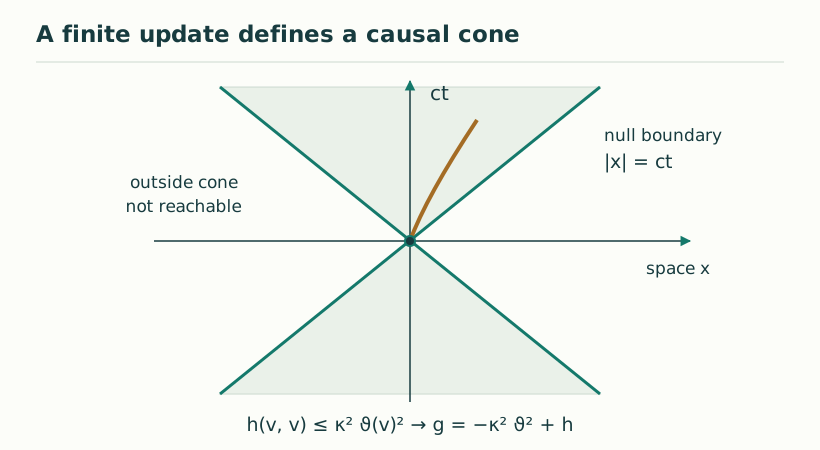
Figure 2. A finite update defines a causal cone. Illustrative finite-update geometry: displacement is bounded by update scale κ times projected inner duration. A Lorentzian metric or a shared light cone still requires the stated readout and field assumptions. View full size ↗
05SMM/DTT as a layered description
SMM proposes a unified origin for distinct manifestations. DTT locates the distinction between generative inner organization and completed outer records. This makes it natural to investigate how discrete completion labels coexist with continuous phase evolution or effective geometry. The explanatory gain comes from an explicit map between these structures.
A model could specify a continuous inner state, a nested preparation process and a discrete completion instrument. Another could use fully discrete updates and derive an effective continuous field. These are different constructions and may make different predictions despite sharing the same broad terminology.
06Continuous evolution can have discrete outcomes
A two-outcome measurement can assign probabilities p and 1−p, where p varies continuously with a preparation parameter. The outcome labels are discrete, while the family of probability distributions is continuous. This simple example dissolves a common false choice between an entirely discrete world and an entirely continuous one. A theory must identify which structure has which property. DTT can use a discrete completion label together with a continuous phase carrier, but it must define the relation between them. If it instead claims that every relevant structure is discrete, it must demonstrate how continuous probability laws arise in the appropriate approximation or limit.
07A precise reconciliation
A reconciliation of discreteness and continuity demonstrates how one description approximates, projects from or coexists with another under specified operations and scales. A continuous state curve, discrete completion events and a finite-resolution observable can all occur in one model. DTT’s constructive question is which features survive completion and which become inaccessible, together with a derivation of the resulting effective dynamics.
KEEP THE CONNECTION
Key ideas
Discrete labels, discrete values and finite dimension differ.
A continuum limit needs convergence and stability.
DTT can connect levels only through an explicit readout and scaling rule.
Scope of the argument. Source-based conceptual interpretation with original worked examples; physical conclusions are stated with their assumptions.
Original public topic. This edition provides an independently written explanation; article-level references identify the passages and additional sources used.