A068Public article topicExpanded article4 min read
The EPR Paradox
Introduce the EPR problem and the role of correlations in quantum theory. Ask what a temporal interpretation must reproduce, and how it preserves the distinction between correlation and usable signaling.
The source uses the EPR problem to motivate a common-origin interpretation of separated quantum systems. The original EPR paper asks whether the wavefunction gives a complete physical description, using predictions about one system inferred from measurements on another. Entanglement does not permit unrestricted faster-than-light messaging, and it does not violate the uncertainty relation. Those distinctions are essential when relating the problem to SMM/DTT.
02A clear two-system example
For a spin singlet, measurements along the same direction are perfectly anticorrelated, although each local outcome is individually random. The joint state cannot be written as a product of two pure one-system states. This is a statement about the structure of the joint quantum description, not a picture of two particles carrying an ordinary signal between them at measurement time.
A common source can explain that records are related, but it must reproduce the full dependence of correlations on measurement settings. Perfect agreement for one setting is too weak a target.
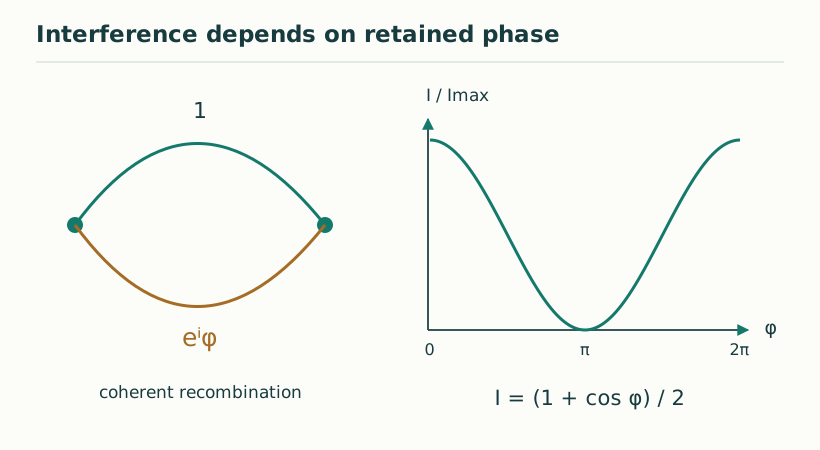
Figure 1. Interference depends on retained phase. The ideal two-path law I(φ) = |1 + eⁱφ|²/4 = (1 + cos φ)/2 is an illustrative quantum baseline. A temporal interpretation must specify which histories retain coherence and how the phase is controlled. View full size ↗
03Why shared instructions are insufficient
Bell's analysis shows that a suitable local predetermined-outcome account cannot reproduce all singlet correlations. The relevant assumptions concern how outcomes depend on local settings and shared variables, together with the statistical setup. Merely saying that both particles came from one source does not escape the constraint.
For SMM this is a useful challenge rather than an obstacle to be hidden. A source model must state which assumption of the local account it changes and how its proposed replacement yields the actual joint probabilities.
04No-signaling from the quantum probability rule
Let Aₐ and B_b be measurement effects for two observers, with ΣₐAₐ=I. The joint probability is p(a,b)=Tr[ρ(Aₐ⊗B_b)]. Summing over the first observer's unreported outcomes gives p(b)=Tr[ρ(I⊗B_b)]. The first observer's choice of a complete local measurement does not appear in this marginal expression.
This calculation assumes ordinary local quantum measurements and no conditioning on a communicated outcome. Conditional correlations can change when an outcome is known, but the remote observer cannot read that conditioning information without an appropriate communication channel.
p(a,b) = Tr[ρ(Aₐ ⊗ B_b)]
Σₐ p(a,b) = Tr[ρ(I ⊗ B_b)]
05The DTT reconstruction target
DTT may interpret the joint quantum state through inner generative coherence and the detections through outer completion. That proposal becomes substantive when it provides the state composition law, the measurement maps and their probability rule. It must recover both the nonclassical correlations and the inability to use local measurement choice for remote signaling.
The six inner stages are not six communication channels between laboratories. Nor can a hidden schedule be assumed to evade relativity without examining its observable consequences. The operational record structure is what determines whether the model is compatible with causal constraints.
06A classical correlation is not yet the quantum target
Imagine a source sending one red card and one blue card to two laboratories at random. Each laboratory sees a random color, and the outcomes are perfectly anticorrelated when compared. This reproduces one simple feature of a singlet measurement but does not supply the full setting-dependent quantum correlation structure. Bell’s result matters precisely because several possible measurement settings must be handled consistently by the same model. A common-source explanation should therefore be tested against the complete family of correlations, not just one dramatic anticorrelation. For SMM/DTT, deriving that family from the source and completion rules is the substantive reconstruction problem.
07What counts as progress
A successful SMM/DTT reconstruction would derive a nonfactorizing joint state and a suitable completion rule, then calculate setting-dependent probabilities. The two laboratories choose settings locally and compare records through ordinary communication. The common-origin idea remains conceptually valuable, while its mathematical obligations are explicit: reproduce the joint correlations, normalized local statistics and the absence of controllable remote signaling.
KEEP THE CONNECTION
Key ideas
A shared origin must reproduce full setting-dependent correlations.
Entanglement does not by itself enable signaling or violate uncertainty.
DTT needs explicit joint states, completion maps and probabilities.
Scope of the argument. Source-based conceptual interpretation with original worked examples; physical conclusions are stated with their assumptions.
Original public topic. This edition provides an independently written explanation; article-level references identify the passages and additional sources used.