
In this article
- What single-particle interference requires
- A two-path calculation
- A path record changes the situation
- Temporal coherence and entanglement are not identical terms
- Delayed choices and the completed record
- The distinctive DTT question
Introduce single-particle interference and the proposal of temporal relations between alternatives. Ask which observable interference features a temporal model must reproduce.
A single detection is localized, while many repeated detections can build an interference distribution. The standard description assigns amplitudes to alternatives and combines them before computing probabilities when the alternatives remain coherent. The effect does not require two independently emitted particles to meet at the detector.
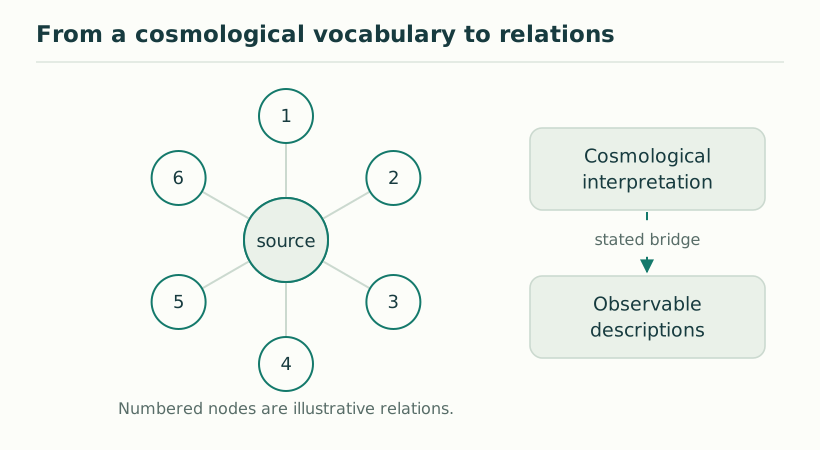
The source article proposes temporal entanglement as an SMM interpretation of this behaviour: successive generative states remain related through the common source. The proposal is conceptually distinct from the established interference rule. Its physical value depends on reproducing that rule and identifying any additional testable restriction.
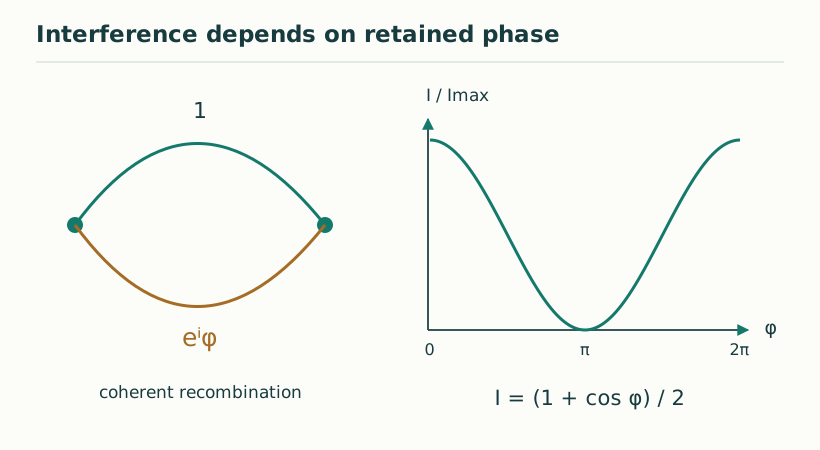
For an ideal balanced two-path device, choose the amplitude at one output to be (1+exp(iφ))/2, where φ is the relative phase. Its detection probability is P₀=(1+cosφ)/2. The complementary output has probability P₁=(1−cosφ)/2, so total probability is conserved.
At φ=0 the first output is certain; at φ=π the second is certain. The changing pattern comes from the cross term between amplitudes. If one instead assigns ordinary probabilities to two exclusive unrecorded paths and adds them, that phase-dependent term is absent. Any proposed generative explanation must supply the mathematical resource that retains the cross term.
Suppose the alternatives become correlated with marker states |r₁⟩ and |r₂⟩. The interference contribution is weighted by their overlap. Identical markers preserve coherence; orthogonal markers make the paths perfectly distinguishable and remove the cross term when the marker is ignored.
This does not require a conscious person to look at the marker. The issue is the physical correlation and which degrees of freedom are retained in the description. DTT’s language of completion is useful if it specifies when such records are created and how they become stable, rather than merely naming observation as the cause.
Entanglement usually refers to a nonseparable state relative to a specified division into subsystems. Alternatives associated with different times require an appropriate history, process or temporal-mode description before an analogous statement can be made. Calling every coherent history temporally entangled without defining the structure obscures the claim.
A constructive SMM/DTT account could identify a retained phase memory connecting inner stages and show how it enters a completed detector probability. This would provide a precise bridge between temporal generation and interference. It would still need to distinguish ordinary coherence, correlations among records and any genuinely new temporal resource.
A later choice of measurement can change which correlations are accessible in a joint data set. It does not follow that a usable message has been sent into the past. Conditional sorting and unconditional detection statistics are different objects. A proposed temporal explanation must reproduce both and state which observer has access to which records.
For example, sorting detections according to a later marker outcome can reveal complementary fringe patterns whose unsorted sum contains no fringe. The calculation concerns correlations between records. Describing it as retroactive creation adds an interpretation that requires further justification and should not replace the statistical analysis.
The most promising question is whether the same generative dynamics that yields spatial alternatives also preserves their phase relations until completion. If phase is added as an unrelated rule, the model reproduces a formalism but has not yet explained its source. If a physical selection principle constrains the phase and record rules together, it may offer a substantive reconstruction.
The worked example provides a compact benchmark: normalized output probabilities, the correct phase dependence, controlled loss of coherence and no signalling from inaccessible choices. Meeting these conditions would establish a coherent model. A new physical claim would additionally require a prediction or restriction beyond the established quantum description.
KEEP THE CONNECTION
Scope of the argument. Standard quantum benchmark and a conditional temporal interpretation; no retrocausal signalling is asserted.
Original public topic. This edition provides an independently written explanation; article-level references identify the passages and additional sources used.
Source register →