Introduce the positive phase–dilation model as an explicit realization within quantum mechanics. Explain how it distinguishes inner work from completed observation without deriving quantum kinematics itself.
01An explicit source is more informative than a controller diagram
The SMM/DTT ambition is to generate records, geometry, clocks, and matter from one process. A diagram with one controller connected to several modules does not establish why their laws agree. The positive phase–dilation model instead supplies a specific constitutive restriction: one powered coordinate drives a phase encoder and work connection through one combined charge.
The construction is an ordinary quantum model with supplied Hilbert space, action scale, unitary dynamics, and measurement rules. It demonstrates a nonempty realization of generation and completion; it does not derive quantum mechanics from source ontology.
02The classical one-mobility law
Let z>0 be a displacement variable and Q=log z. Its conjugate momentum is K, while θ is a phase with conjugate J. A work connection W depends on the configuration and work variables but not on K or J. Define C=K+ηJ+W and choose H=F(C), with a positive quadratic benchmark F(C)=C²/(2I).
Hamilton’s equations give Q̇=F′(C) and θ̇=ηF′(C). Therefore θ−ηQ is constant and phase changes are tied to logarithmic displacement. The restriction excludes an independently powered transverse rotor; it is a physical model choice, not a consequence of simply having one source.
C=K+ηJ+W; H=C²/(2I)
θ̇=ηQ̇; Δθ=ηΔQ
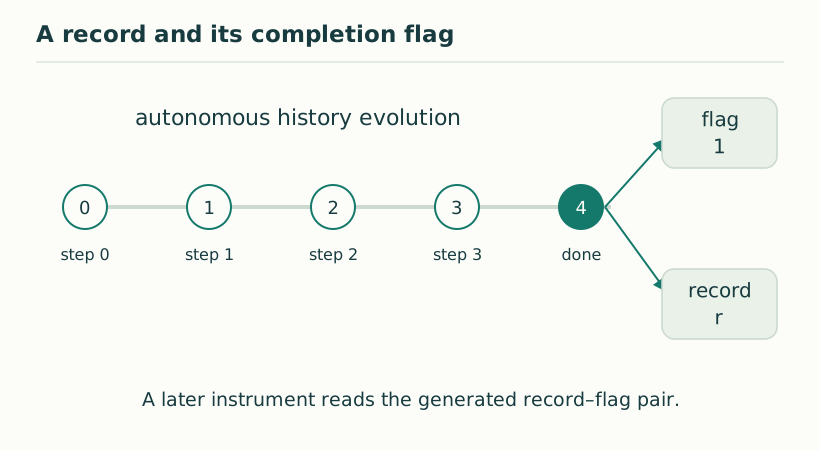
Figure 1. A record and its completion flag. A prescribed autonomous history dynamics can place a retained result and a flag in the same state. A later readout checks the flag and the result; assigning a flag by hand is not a dynamical construction. View full size ↗
03The quantum invariant
On a source space L²(R×S¹) tensored with a finite work register, the charge operator is C=−iℏ(∂Q+η∂θ)+W under the stated domain and boundedness conditions. The positive Hamiltonian is C²/(2I). The phase-difference unitary R=exp(iθ)exp(−iηQ) is conserved.
This conservation is an exact operator property. It does not imply a sharply defined classical trajectory, monotone passage for every quantum state, or attraction of the phase offset to zero. Different prepared offsets remain different conserved offsets. Positive energy also does not by itself choose forward traversal.
Ĉ=−iℏ(∂Q+η∂θ)+W
H=Ĉ²/(2I); R=e^(iθ)e^(−iηQ)
04What the work connection accomplishes
The connection can route reversible gates into structural registers as the source traverses contact regions. A capacity port writes distinguishable child labels, while a separately calibrated scale port checks contraction. These interfaces make the logarithmic phase relation operational rather than a relabelling of an abstract coordinate.
The capacity law and constant-area comparison are supplied mechanical and metrological laws. They use an existing substrate for counts and length comparisons. The construction therefore generates record relations on that substrate; it does not establish the emergence of the substrate from a metaphysical point.
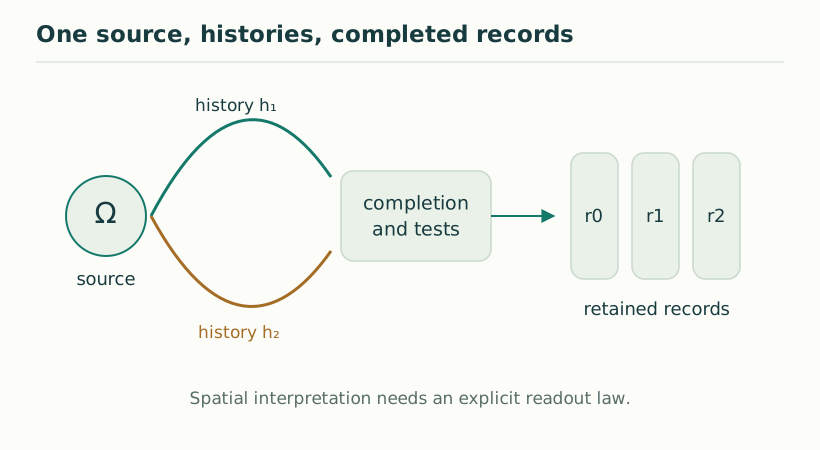
Figure 2. One source, histories, completed records. Conceptual reconstruction: composable source histories are tested and completed before a retained record becomes available. The source is not depicted as a point already located in space. View full size ↗
05Completion is a channel with failure retained
A finite loaded realization defines an acceptance projector for completed traversal and valid comparison. On the accepted region the source-controlled work prefix is constant, equal to the intended completed work V. The accepted instrument factorizes as p times a complete work channel, with p independent of the unknown payload.
The failure outcome remains part of the instrument. Completion is therefore not assumed certain merely because the desired output is displayed after conditioning. Its probability and error budget are calculated from the supplied finite dynamics, while recovery and retries require additional controlled operations.
06How the two temporal roles appear
Inner generation comprises source-ordered transformations and retained coherent information. Outer observation comprises certified access to the finite output and later reading of its stored label. The completion flag certifies a write, the caliper validates a comparison, and the export mechanism protects later access; these are separate physical functions.
The six inner levels can organize nested dependencies such as depth, parent selection, mode, traversal, routing, and elementary action. They are not six independent time coordinates. The model’s evolution parameter, measured activities, material-clock readings, and export durations must remain distinct until an operational relation is proved.
07What would make the source more fundamental
The model narrows an otherwise independent phase-rate freedom by its one-mobility law. A stronger SMM/DTT derivation would explain why that law and its contact interfaces are selected by the underlying physics, why all clocks share the required response, and why matter propagation uses the same conversion.
Those questions can now be addressed against explicit countermodels and observables. The construction’s value is a concrete mathematical target with positive dynamics, retained memory, and a completion instrument. Its limitations identify the next source-selection problem rather than being hidden behind a claim that quantum relativity has already been fully derived.
KEEP THE CONNECTION
Key ideas
One-mobility phase–dilation dynamics supplies an explicit shared source restriction.
The invariant does not guarantee classical monotone passage or universal clocks.
Generation, certification, comparison, and later access are distinct physical functions.
Scope of the argument. Ordinary quantum realization with supplied constitutive interfaces, not a derivation of quantum kinematics or spacetime from ontology.
Sources & further reading
quantum_relativity_temporal_generation_v10.pdfWorking draft, pp. 3–5, 9–11, 23–27
Source editions and catalogue entries
Working manuscript
Quantum relativity and temporal generation — working draft v10
Working manuscript. Article-level references identify the consulted sections and the scope of the interpretation. No public URL was supplied for this exact manuscript version.