Use the ungated-clock countermodel to show that a realizable clock law need not be physically universal. Explain the extra selection principle required for all material clocks to agree.
Constructing one clock that reads only resolution activity is an important consistency result. It shows that the desired law is possible. It does not prove that every material clock must obey it. The same record geometry can be paired with a different allowed clock coupling.
The SMM/DTT goal is stronger than a demonstration device: clocks made from matter should agree with the temporal structure generated by the common source. The draft therefore includes an ungated-clock countermodel to identify exactly what remains to be selected.
02The common geometry interface
Suppose a refinement has B distinguishable children and a contraction factor q⁻¹. Its record dimension is Drec=log B/log q. In the supplied one-mobility interface, independent phase readouts give u=a*log B and τ=a*log q, so u/τ=Drec.
These quantities are measured activities, not automatically the reading of every material clock. The geometry relation can remain true while different clock couplings assign different readings to the same sequence. This independence is the key to the counterexample.
Drec=log B/log q
u/τ=Drec
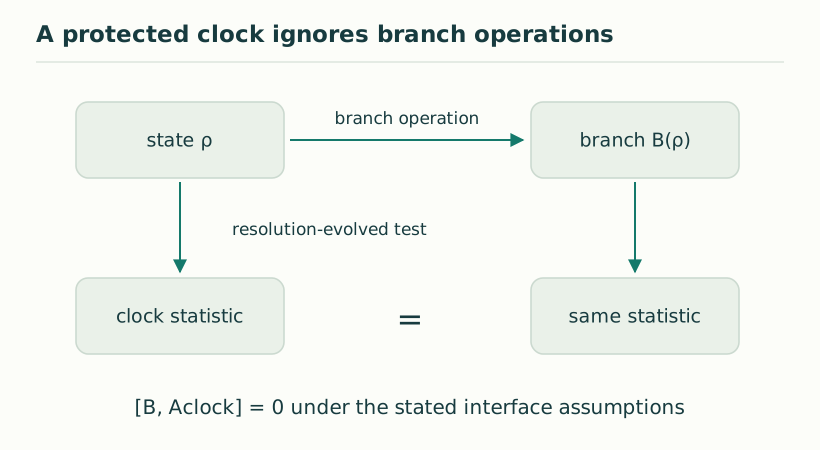
Figure 1. A protected clock ignores branch operations. In the stated stationary finite-dimensional model, branch invisibility is equivalent to the branch generator commuting with the resolution-evolved clock observable algebra. It is a criterion to verify, not an automatic law for every clock. View full size ↗
03Compare protected and ungated clocks
A protected logical clock evolves only during resolution and reads Tℓ=τ. An ungated clock responds equally during branch and resolution operations and reads TA=u+τ. Both are ordinary material-clock models with coherent phase readout and suitable calibration.
Consequently the same branch activity has different conversions: u/Tℓ=Drec, while u/TA=Drec/(Drec+1). If branch-active matter transport has coefficient vg with respect to u, the coefficient measured against these clocks differs accordingly.
u/Tℓ=Drec
u/TA=Drec/(Drec+1)
04A concrete refinement example
Take B=8 and q=2, giving Drec=3. The protected clock yields u/Tℓ=3, whereas the ungated clock yields u/TA=3/4. The record count and contraction measurements are identical in the two cases. The difference comes entirely from clock response.
This is not a disagreement about units: multiplying one clock by a fixed conversion factor cannot generally make the two laws agree over a family of Drec values. Their ratio depends on the refinement setting. An independently varied family therefore distinguishes the couplings operationally.
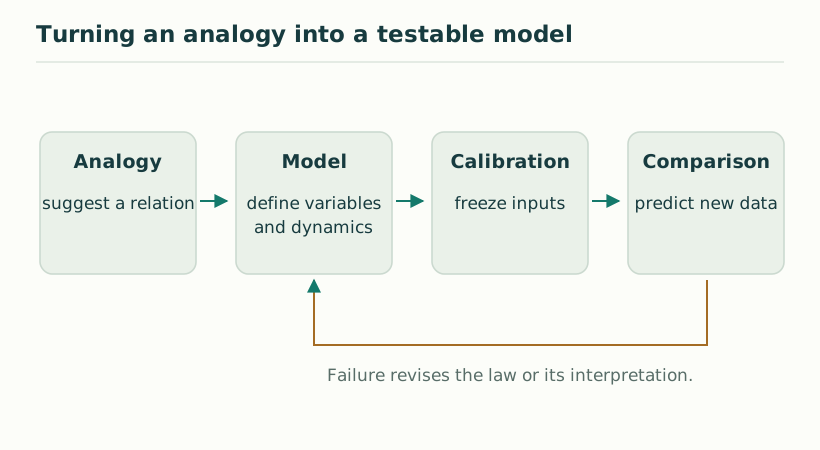
Figure 2. Turning an analogy into a testable model. A numerical or symbolic correspondence motivates a question. A physical claim needs a specified model, independent calibration, and a result that could disagree with observation. View full size ↗
05Why one executor does not remove the freedom
A single autonomous controller can execute two independently chosen couplings. Calling them products of one source does not prove that they share a coefficient or respond to the same operation mode. The one-mobility source law restricts a particular phase encoder, while a separate material oscillator can retain additional response.
To establish universality, the model must derive why admissible matter clocks occupy the protected class, or show that a different common law is selected. It must also account for preparation, export, recovery, and readout durations if those operations contribute to actual elapsed time.
06What could count as a selection principle?
A useful principle would constrain the physical interaction algebra of all clock-bearing matter, not merely define a preferred clock after observing its response. It might take the form of a shared symmetry, a universal coupling, or a dynamical reduction whose stability is proved for the relevant sectors.
Such a proposal should be tested against the countermodel: identify the exact assumption that excludes the ungated oscillator and show why that assumption follows from the source physics. If the countermodel still satisfies every stated premise, the claimed universal law has not been derived.
07The conceptual value for SMM/DTT
The counterexample protects the distinction between a realizable dual-time architecture and a fundamental theory of time. It does not make the protected construction useless; it clarifies what its success establishes and what a future improvement must add.
The six nested inner functions can be implemented in either clock setting. Their existence does not force a unique scalar clock law. A genuine common-source breakthrough would remove that remaining freedom through a justified physical mechanism and then predict a relation among independently measured geometry, clocks, and matter propagation.
KEEP THE CONNECTION
Key ideas
One protected clock demonstrates possibility, not physical universality.
The same geometry admits τ and u+τ clock readings with different conversions.
A universal law must exclude the countermodel through an independently justified source principle.
Scope of the argument. Countermodel to an inference from existence to universality; it does not rule out future physical selection mechanisms.
Sources & further reading
operational_clock_selection_focused.pdfWorking draft, pp. 2–5, 9–11
Source editions and catalogue entries
Working manuscript
Operational Selection and Finite Calibration of Quantum Clocks
Working manuscript. Article-level references identify the consulted sections and the scope of the interpretation. No public URL was supplied for this exact manuscript version.