Investigate whether branch invisibility survives arbitrary interleaving of operations. Explain why checking one isolated operation is weaker than checking the complete admitted sequence language.
01One successful test is weaker than a complete operation language
A clock may ignore a branch operation when tested immediately yet respond after further processing. Nested generation makes this issue unavoidable: branches, refinements, routing steps, and readouts can be interleaved in many orders. The relevant protection claim must cover the admitted sequences, not just one isolated pulse.
The draft proves that the resolution-orbit commutant criterion is strong enough to control every finite interleaving. This is particularly useful for SMM/DTT, whose six inner levels are nested functional dependencies rather than six independent durations.
02Write the nested sequence explicitly
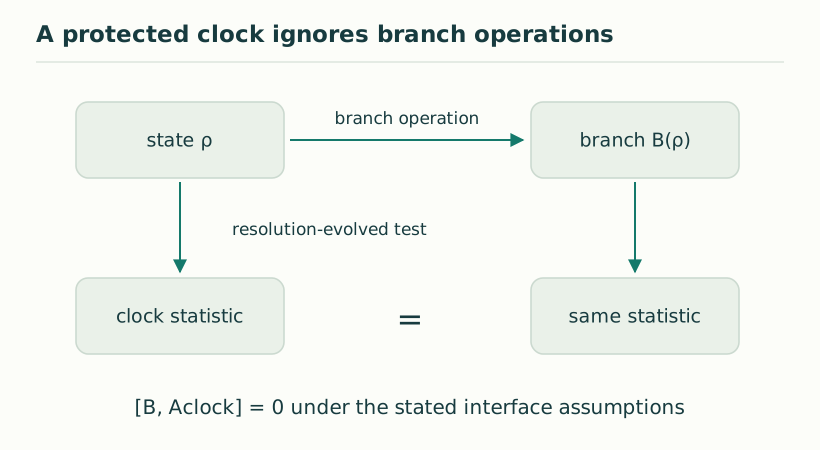
Consider a word W=Ur(τm)Ub(um)⋯Ur(τ₁)Ub(u₁). A resolution-only clock should give the same admitted statistics as resolution evolution for the total activity Στj, regardless of the positions and sizes of the branch intervals.
This is not a statement that the full state is unchanged by branches. Hidden factors may evolve. The requirement concerns all initial states on the tested sector and all effects in the declared accessible algebra. It is therefore an operational equivalence relative to a specified test language.
W=Ur(τm)Ub(um)⋯Ur(τ₁)Ub(u₁)
Admitted clock statistics should equal Ur(Σjτj)
Figure 1. A protected clock ignores branch operations. In the stated stationary finite-dimensional model, branch invisibility is equivalent to the branch generator commuting with the resolution-evolved clock observable algebra. It is a criterion to verify, not an automatic law for every clock. View full size ↗
03The Heisenberg-picture proof
Move the final effect backward through the word. Resolution conjugation keeps the effect inside the resolution-orbit algebra Ar. If Kb lies in Ar′, branch conjugation acts as the identity on every effect in that algebra. Each branch factor can therefore be removed as the effect is propagated backward.
After removing all branch factors, only the resolution evolutions remain. Because they share the same stationary generator, their activities add. No commutation between Kb and Kr is required. The protection concerns their action on the admitted observable algebra, not necessarily on every hidden degree of freedom.
04Why a finite algebra calculation can suffice
In finite dimension, the resolution orbit is analytic. Its linear span is generated by repeated commutators with Kr, and the Cayley–Hamilton theorem closes the relevant superoperator after finitely many powers. Thus the exact test need not sample infinitely many delays.
One can construct the orbit algebra from the supplied matrices and calculate its commutant. This is a finite model-verification task. It does not automatically establish experimental access to every algebraically generated effect; the admitted measurements and preparation class must remain part of the physical specification.
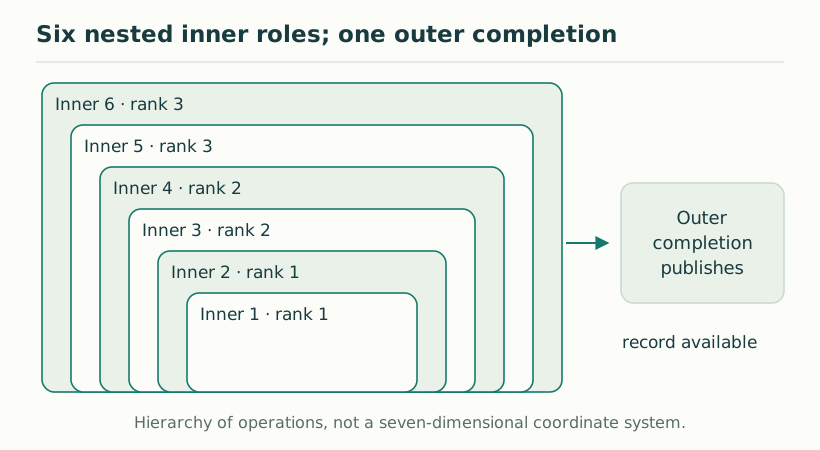
Figure 2. Six nested inner roles; one outer completion. The six inner roles are nested functional stages with readout ranks 1, 1, 2, 2, 3, 3. The outer completion publishes the resulting record. These are not seven independent time axes. View full size ↗
05A failure example with only two operations
For a Z-readout qubit, a Z branch phase is immediately invisible. Insert an X resolution rotation before the same detector, and the phase becomes observable. This already shows why testing branching alone is insufficient. Longer nested words can expose similarly hidden distinctions.
The correct response is not to calibrate a new scalar correction for each word. Instead, identify the orbit algebra generated by all allowed resolution operations and test the branch generator against that algebra. A sequence-independent protection claim then follows from one structural condition.
06Approximate protection and cumulative error
If the actual branch generator differs by at most δ from a protected generator, Duhamel’s formula bounds the error of one branch interval by δ|u|/ℏ. Replacing branch factors one at a time and using the triangle inequality gives a total bound proportional to Σ|u_j|.
The number of nesting levels is therefore less important than the total branch activity and the uniform validity of the generator bound. A long program may require tighter protection even if it repeats the same six functional levels. Time-dependent drifts or changes in the admitted operations require a new analysis.
Probability error≤min{1,(δ/ℏ)Σj|u_j|}
07Connecting nesting to SMM/DTT without overcounting time
A nested source can organize depth, parent selection, operation mode, traversal, routing, and elementary reversible work. A seventh interface exports the completed record. These functions can share one dynamical parameter while supporting distinct measured activities.
The clock theorem says how a chosen readout can remain insensitive to all branch portions of that architecture. It does not derive the number of levels, prove their physical necessity, or identify the resulting reading with relativistic proper time. Its contribution is a robust operational language in which those stronger claims can be formulated and tested.
KEEP THE CONNECTION
Key ideas
Clock independence must cover delayed and nested tests.
The orbit-algebra commutant criterion removes every branch factor from admitted statistics.
Approximate error grows with total branch activity under a uniform generator bound.
Scope of the argument. Finite stationary quantum-clock theorem; nesting depth alone does not select physical time or spatial dimension.
Sources & further reading
operational_clock_selection_focused.pdfWorking draft, pp. 4–9
Source editions and catalogue entries
Working manuscript
Operational Selection and Finite Calibration of Quantum Clocks
Working manuscript. Article-level references identify the consulted sections and the scope of the interpretation. No public URL was supplied for this exact manuscript version.