Introduce the finite-calibration converse under an independently bounded generator bandwidth. Explain what a finite sequence of delayed measurements can certify and which prior bound it needs.
The exact clock-selection criterion refers to all states and a continuum of activities. A laboratory calibration has finitely many settings and finite precision. The draft derives a finite converse under two independent controls: an observable test frame and an upper bound on the branch generator’s spectral width.
These controls address different risks. The test frame prevents unmeasured operator directions from being mistaken for protection. The bandwidth bound prevents a fast nontrivial evolution from completing an exact revival at the sampled activity and appearing motionless. Both are needed to turn small finite contrasts into a robust conclusion.
02Choose delayed effects that span the relevant constraints
For admitted effects E_j and resolution delays τ_j, define F_j=Ur(τ_j)†E_jUr(τ_j). Their common Hermitian commutant should equal the intended invisible class N=Ar′∩Herm(Hc). A finite such family exists in finite dimension, but arbitrary choices need not be informative.
Define a linear commutator map L(X)=(i[X,F_j])_j. Its smallest nonzero singular value σ* on the orthogonal complement of N measures how strongly the frame detects departures from protection. A small σ* means that substantial generator changes can produce small test signals.
L(X)=(i[X,F_j])_j
σ*=min_{X⊥N,‖X‖₂=1}(Σj‖[X,F_j]‖₂²)¹/²
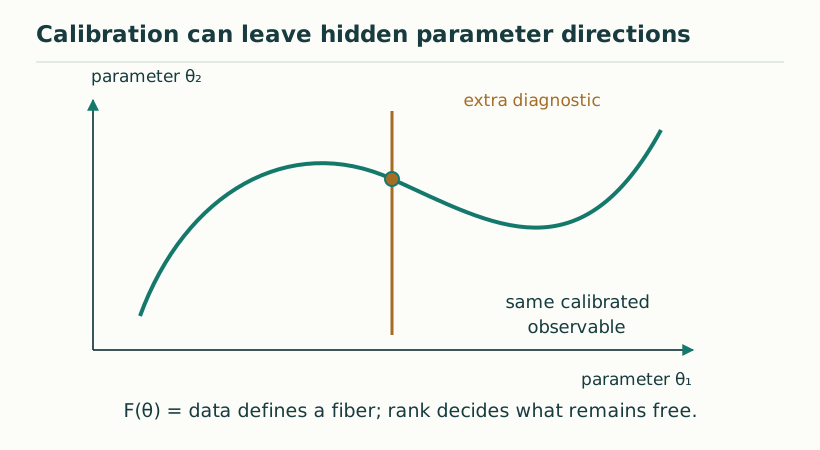
Figure 1. Calibration can leave hidden parameter directions. A fixed measurement may select a curve of models rather than one point. A genuine prediction must be constant on that calibration fiber, or require additional independently measured diagnostics. View full size ↗
03Why an independent bandwidth bound is essential
Let W bound the spectral width of Kb, and choose a branch excursion h with β=Wh/(2ℏ)<π. In the eigenbasis of Kb, a matrix element of the delayed-effect change is multiplied by a sine of its energy difference times h. The bandwidth restriction keeps that sine in a controlled interval.
Without such a restriction, a two-level splitting 2πnℏ/h produces an exact revival at h for any positive integer n. All sampled contrasts can vanish while the generator is far from scalar. A single null pulse therefore cannot prove branch independence on its own.
D_j=Ub(h)†F_jUb(h)−F_j
β=Wh/(2ℏ)<π
04The finite error certificate
Suppose each e_j is an upper bound on the absolute response for every input state, equivalently on ‖D_j‖. The draft bounds the distance δ of Kb from the invisible class by a factor proportional to W/(σ* sin β) times the combined test contrasts.
Once that distance is bounded, any finite nested sequence has output-probability error at most δ times the total absolute branch activity divided by ℏ, capped at one. The proof replaces each branch operation by its protected counterpart and telescopes the resulting unitary differences.
dist(Kb,N)≤√d W(Σj e_j²)¹/²/[2σ* sin β]
Sequence error≤min{1,(δ/ℏ)Σk|u_k|}
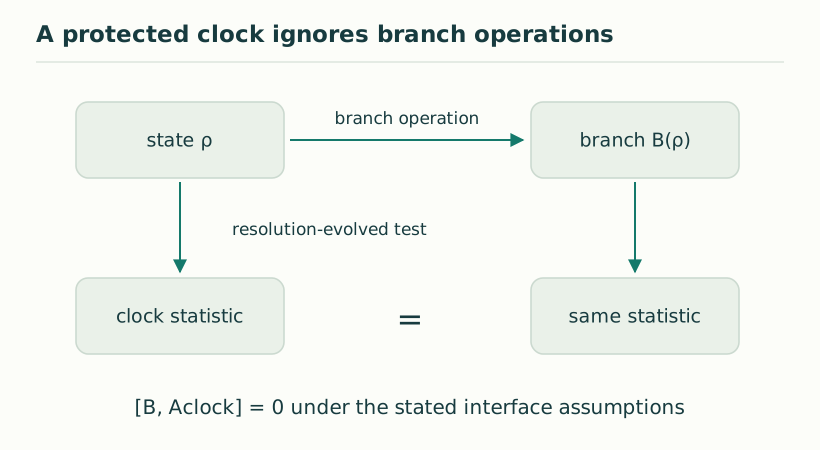
Figure 2. A protected clock ignores branch operations. In the stated stationary finite-dimensional model, branch invisibility is equivalent to the branch generator commuting with the resolution-evolved clock observable algebra. It is a criterion to verify, not an automatic law for every clock. View full size ↗
05How all-input bounds can be obtained finitely
For a d-dimensional clock, calibrated preparations consisting of basis states and real and imaginary pair superpositions determine every entry of a Hermitian response matrix. This is finite tomography. Repeated probability measurements give statistical intervals, while preparation and detector errors contribute systematic intervals.
The upper bounds used in the theorem must include both. A few small Ramsey contrasts are only witnesses for those preparations; they do not certify a supremum over all states. The true test frame also needs a valid lower bound for σ*, and the bandwidth estimate must remain valid over the tested operating family.
06A simple design example
For a qubit with Z readout and X resolution, two delays corresponding to angles zero and π/2 give independent Z and Y effects. Their observability constant is σ*=1. Sampling only two very close delays makes the constant much smaller and amplifies the same probability uncertainty.
A sensible protocol therefore first chooses well-separated effects within the permitted resolution range, then chooses h using the independent W bound, and finally allocates trials to achieve the desired δ. This sequence separates apparatus design from the later data used to test protection.
07Why this matters to SMM/DTT
A claimed outer clock should survive concrete finite calibration rather than only an ideal symbolic commutator test. The theorem supplies a route from measured contrasts to bounded errors for nested generative operations. It also makes the resource assumptions visible.
The result remains ordinary quantum control. Its SMM/DTT contribution is the operational role it can play in a joint geometry–clock construction. To establish universal outer time, a deeper physical selection principle must still explain why all relevant material clocks fall into the calibrated protected class.
KEEP THE CONNECTION
Key ideas
Finite certification needs both a complete delayed test frame and a bandwidth bound.
The singular value σ* quantifies how measurement error affects the conclusion.
A calibrated generator bound controls arbitrary finite nested sequences.
Scope of the argument. Finite-dimensional stationary-model certificate; all-input preparation access and independent calibration bounds are assumptions.
Sources & further reading
operational_clock_selection_focused.pdfWorking draft, pp. 6–9
Source editions and catalogue entries
Working manuscript
Operational Selection and Finite Calibration of Quantum Clocks
Working manuscript. Article-level references identify the consulted sections and the scope of the interpretation. No public URL was supplied for this exact manuscript version.