Examine the additional assumption that electromagnetic dynamics inherit the constructed null geometry. A limiting cone in one sector does not automatically establish universal propagation across all fields.
In the SMM picture, an inner generative process produces the configurations through which spatial motion is observed. DTT distinguishes that generative role from the outer records used by clocks. The limiting-speed model represents the relation with an inner phase, a positive horizontal metric h, and a temporal connection one-form ϑ. A vector separates into a horizontal part and a component along the phase fiber. This is an effective geometric realization of the temporal distinction. It already assumes an emergent spatial base and a projection apparatus; it is not, by itself, a construction of all spatial structure from a structureless point.
02A cone in one sector does not constrain every field
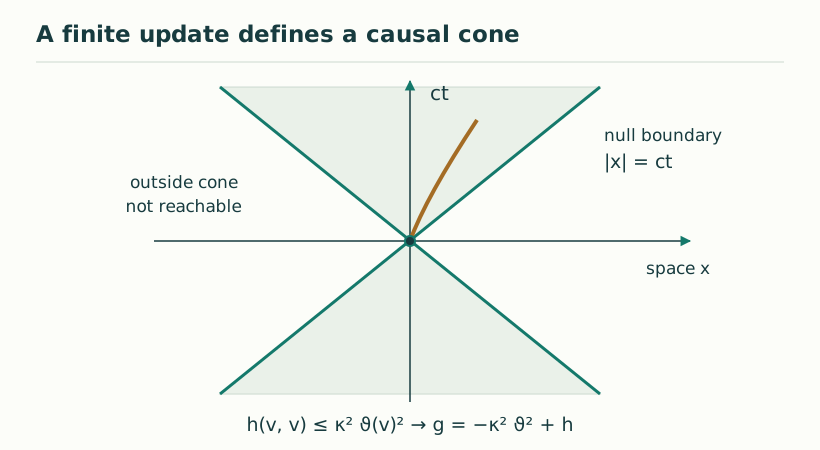
A geometric construction supplies candidate causal directions. To identify the boundary with light propagation, electromagnetic dynamics must use that same metric. Otherwise one could write a second field equation with a different principal part and hence a different characteristic cone. SMM’s common-source ontology motivates seeking one propagation structure, but motivation does not prove universal coupling. The matching step is exactly where a physical reconstruction must connect temporal projection with the equations governing actual excitations.
Figure 1. A finite update defines a causal cone. Illustrative finite-update geometry: displacement is bounded by update scale κ times projected inner duration. A Lorentzian metric or a shared light cone still requires the stated readout and field assumptions. View full size ↗
03The conditional Maxwell argument
Assume source-free Maxwell theory takes the metric form dF=0 and d⋆_gF=0, where F is the electromagnetic two-form and ⋆_g is the Hodge operator built from g. In a geometric-optics expansion, retain the highest derivatives of a rapidly varying phase. The wave covector k then satisfies g⁻¹(k,k)=0 for a nontrivial physical polarization. Thus Maxwell wavefronts follow the null cone already encoded in the constitutive law. This derives the propagation result from the stated field equation; it does not independently derive that field equation from completion.
dF=0, d⋆_gF=0
g^{μν}k_μk_ν=0
04A countermodel that clarifies universality
Take a flat record metric with cone speed c and introduce a scalar equation ∂²_tφ−v²∇²φ=0 with v different from c. Its wavefronts travel on its own cone. Nothing in the mere existence of the record metric forbids this equation. A successful source model must rule out such independent coefficients or explain why their differences flow to a common value in a controlled limit. Showing one electromagnetic matching is therefore a beginning; clocks, matter and other propagating sectors must be checked separately.
05What comparison could discriminate the mechanism
A useful theoretical comparison evaluates the principal symbols of all effective field equations produced by one update. If each is proportional to the same g^{μν}k_μk_ν after independently fixed normalizations, there is a genuine common-cone result. Lower-derivative masses can change group velocities without changing the highest-frequency causal characteristic. Material dispersion is also distinct from vacuum universality. For DTT, this framework makes the claim concrete: the shared generative origin should leave a common structure in completed propagation, rather than being invoked after sector-specific equations have already been chosen.
06Characteristic equality is the useful comparison
When comparing fields, use the highest-derivative part of their equations with a common convention for physical coordinates. Two equations may have different masses, potentials and interaction terms while sharing a characteristic cone. Conversely, equality of one low-frequency phase velocity does not establish equality of their causal characteristics over a range. A useful reconstruction would show the shared principal symbol and quantify residual higher-derivative or anisotropic corrections. This would turn the common-source intuition into an explicit cross-sector restriction, and would distinguish a robust universal mechanism from a coincidence obtained by separately fitting each field’s kinetic coefficient.
07Three levels of the claim
The first level is a mathematical cone obtained from a supplied finite-update inequality. The second is an operational interpretation: lengths and clock intervals must measure the quantities entering that inequality. The third is universality: photons, matter, clocks and other fields must inherit compatible propagation and transformation laws. Each level requires evidence beyond the preceding algebra. Six nested inner stages may motivate the generative architecture, but their existence alone does not determine a clock conversion, a null cone or a field equation. This separation makes the proposed mechanism testable: a mismatch between sectors or a measurable preferred splitting would constrain the model even if its cone construction is mathematically consistent.
The compact phase fiber introduces a global question beyond the local signature proof. If its vertical direction is interpreted literally as physical timelike motion on a circle, a full fiber orbit is a closed timelike curve for the constructed metric. A viable chronology therefore needs a restricted admissible history, a lifted phase or another explicit physical interpretation that prevents identifying recurrent phase with unrestricted closed observable time. Local Lorentzian algebra alone settles neither global causality nor the existence of a single clock function. The completion archive is the natural place to state this missing global information.
KEEP THE CONNECTION
Key ideas
Maxwell light inherits g only when its constitutive law uses g.
A shared source must constrain field principal symbols.
Massive group velocity and characteristic cone are different quantities.
Scope of the argument. Conditional geometric-optics matching; universal field coupling is an additional physical requirement.
Sources & further reading
dtt_limiting_speed_paper_v2(1).pdf — working draftpp. 17–19, §§10–12
Source editions and catalogue entries
Working manuscript
DTT limiting-speed construction — working draft v2
Draft file: dtt_limiting_speed_paper_v2(1).pdf
Working manuscript. Article-level references identify the consulted sections and the scope of the interpretation. No public URL was supplied for this exact manuscript version.