Distinguish the existence of a shared limiting speed from the calibration of its numerical value. Use this distinction to clarify what a reconstruction has explained.
In the SMM picture, an inner generative process produces the configurations through which spatial motion is observed. DTT distinguishes that generative role from the outer records used by clocks. The limiting-speed model represents the relation with an inner phase, a positive horizontal metric h, and a temporal connection one-form ϑ. A vector separates into a horizontal part and a component along the phase fiber. This is an effective geometric realization of the temporal distinction. It already assumes an emergent spatial base and a projection apparatus; it is not, by itself, a construction of all spatial structure from a structureless point.
02Two different questions about a constant
Asking whether all inertial observers share a finite limiting speed is a structural question. Asking which decimal number represents that speed is partly a question about measurement units. A theory can explain a Lorentzian cone without determining a preferred metre or second. Conversely, reproducing a numerical speed by fitting an astronomical length and duration does not prove observer invariance. Keeping these questions separate prevents a calibration identity from carrying more explanatory weight than it has earned.
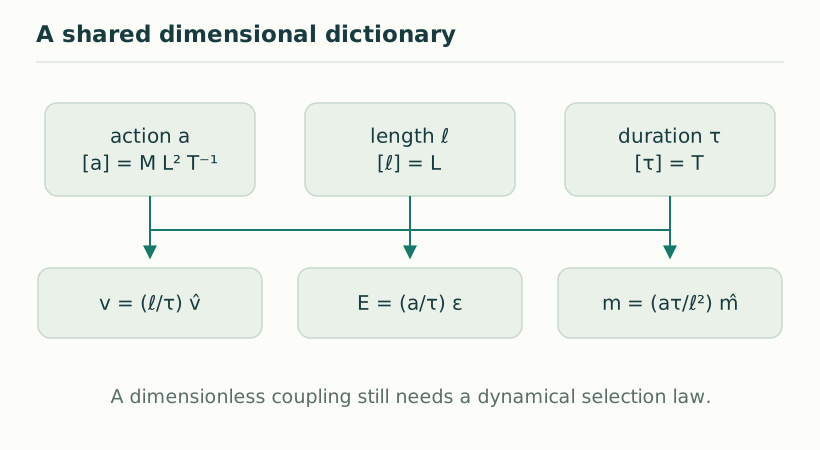
Figure 1. A shared dimensional dictionary. Dimensionless model outputs acquire physical units only after an action scale a, length scale ℓ, and time scale τ are supplied. These conversions are dimensional identities, not derivations of numerical constants. View full size ↗
03How a unit change alters the number
Let length coordinates be rescaled by a positive factor a and clock coordinates by b. A speed represented by c becomes c′=(a/b)c in the new coordinate conventions. Dimensionless ratios, such as a physical velocity divided by the common cone speed, remain the relevant invariant comparisons. In the DTT factorization c=κρ, changes of phase normalization can also redistribute numerical factors between κ and ρ without altering their product. A derivation must state which scales are conventional and which are physically constrained.
x′=ax, t′=bt ⇒ c′=(a/b)c
v′/c′=v/c
04A simple calibration exercise
Imagine an update advances at most three lattice lengths in two clock ticks. In native units the bound is 3/2. If one lattice length is calibrated as two laboratory length units and one clock tick as four laboratory time units, the same physical bound is 6/8=3/4 laboratory units. No physical cone changed. This example also shows what a testable prediction looks like: compare two independently constructed clocks or two propagation sectors in the same standards, rather than treating a rescaled decimal value as new dynamics.
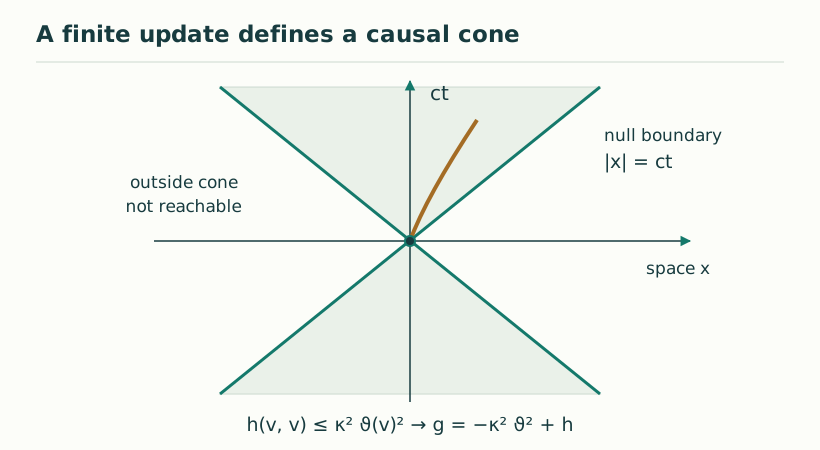
Figure 2. A finite update defines a causal cone. Illustrative finite-update geometry: displacement is bounded by update scale κ times projected inner duration. A Lorentzian metric or a shared light cone still requires the stated readout and field assumptions. View full size ↗
05The SMM/DTT target that survives unit freedom
A substantive reconstruction would show why the same completion law fixes the conversion experienced by different matter systems, why transformations preserve that conversion, and whether any dimensionless departures occur. It might derive a ratio between a microscopic recurrence and a spectral scale after both are operationally defined. Such a result would remain meaningful in every unit system. An exact SI numeral alone cannot resolve the source ontology. The present distinction directs effort toward universal relations and independently measurable ratios, where the proposed temporal mechanism can be assessed.
06Observer transformations require an apparatus law
A mathematical boost preserves the cone equation, but a laboratory observer is represented by preparation, clock, ruler and detector operations. If their calibration does not transform consistently, the same formula can coexist with observable preferred-frame effects. The strong version of the DTT reconstruction therefore needs more than coordinate invariance: it needs invariant outcome probabilities under jointly transformed apparatus and states. This is a useful way to organize a future derivation. First identify operational readings, then derive their transformation, and only afterwards interpret the invariant ratio as the speed shared by physical observers.
07Three levels of the claim
The first level is a mathematical cone obtained from a supplied finite-update inequality. The second is an operational interpretation: lengths and clock intervals must measure the quantities entering that inequality. The third is universality: photons, matter, clocks and other fields must inherit compatible propagation and transformation laws. Each level requires evidence beyond the preceding algebra. Six nested inner stages may motivate the generative architecture, but their existence alone does not determine a clock conversion, a null cone or a field equation. This separation makes the proposed mechanism testable: a mismatch between sectors or a measurable preferred splitting would constrain the model even if its cone construction is mathematically consistent.
The compact phase fiber introduces a global question beyond the local signature proof. If its vertical direction is interpreted literally as physical timelike motion on a circle, a full fiber orbit is a closed timelike curve for the constructed metric. A viable chronology therefore needs a restricted admissible history, a lifted phase or another explicit physical interpretation that prevents identifying recurrent phase with unrestricted closed observable time. Local Lorentzian algebra alone settles neither global causality nor the existence of a single clock function. The completion archive is the natural place to state this missing global information.
KEEP THE CONNECTION
Key ideas
Invariance and numerical calibration are separate achievements.
Unit rescalings change dimensional numerals without changing physics.
Dimensionless cross-sector comparisons are the robust targets.
Scope of the argument. Conceptual and dimensional clarification based on the limiting-speed model; no new metrological claim.
Sources & further reading
dtt_limiting_speed_paper_v2(1).pdf — working draftpp. 5–7, 11, and 16–19
Source editions and catalogue entries
Working manuscript
DTT limiting-speed construction — working draft v2
Draft file: dtt_limiting_speed_paper_v2(1).pdf
Working manuscript. Article-level references identify the consulted sections and the scope of the interpretation. No public URL was supplied for this exact manuscript version.