A proposed audit of earlier lunar-based estimates discussed in the draft. Explain which astronomical inputs, conventions, and fitted factors enter before assessing independent predictive content.
In the SMM picture, an inner generative process produces the configurations through which spatial motion is observed. DTT distinguishes that generative role from the outer records used by clocks. The limiting-speed model represents the relation with an inner phase, a positive horizontal metric h, and a temporal connection one-form ϑ. A vector separates into a horizontal part and a component along the phase fiber. This is an effective geometric realization of the temporal distinction. It already assumes an emergent spatial base and a projection apparatus; it is not, by itself, a construction of all spatial structure from a structureless point.
02The proposed astronomical relation
Earlier material compares a projected lunar orbital length L′ multiplied by 12000 with one sidereal day t′. The draft rewrites this as a calibration proposal, c_astro=12000L′/t′, rather than deriving a causal speed from the Moon. It defines L′=VT′cosφ and φ=2πT′/Y′, with V a chosen mean lunar speed, T′ a sidereal month and Y′ a sidereal year. These are model inputs and conventions whose provenance must be examined before the numerical agreement is interpreted.
c_astro = 12000 V T′ cos(2πT′/Y′)/t′
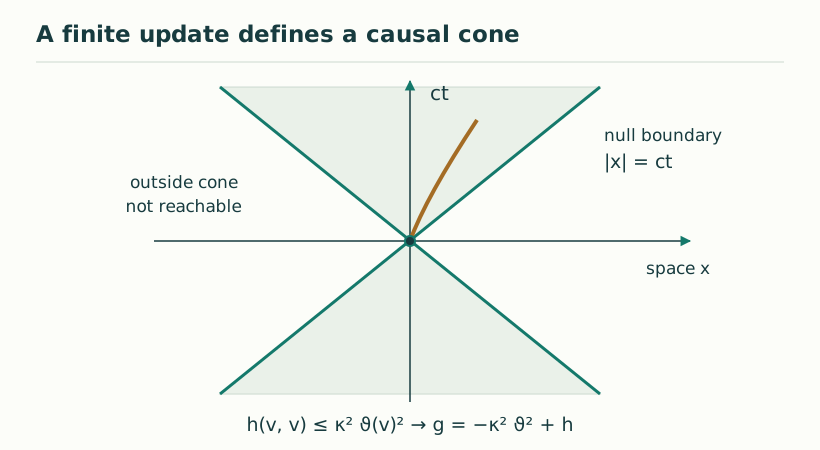
Figure 1. A finite update defines a causal cone. Illustrative finite-update geometry: displacement is bounded by update scale κ times projected inner duration. A Lorentzian metric or a shared light cone still requires the stated readout and field assumptions. View full size ↗
03A non-circular audit
First establish independent sources and uncertainties for V, T′, Y′ and t′, together with their epoch and reference frame. Second justify why a cosine projection is the relevant invariant operation for a noncircular, perturbed three-body system. Third justify the factor 12000 without adjusting it to the target. Finally compute the result with uncertainty propagation and compare it against a held-out target. The draft itself identifies the cosine prescription as model defined; it is not automatically the standard celestial-mechanical removal of solar effects.
04The inverse calculation exposes a possible fit
For any chosen periods and projection factor with nonzero cosine, solve the displayed equation for V. This gives a value of V that reproduces any desired target speed exactly. Therefore many decimal digits of agreement cannot establish prediction unless the lunar speed was independently specified beforehand. Sensitivity is linear in V: a fractional change of one part in a thousand in V produces the same fractional change in c_astro when the other inputs are fixed.
V_fit = c_target t′/[12000 T′ cos(2πT′/Y′)]
∂log c_astro/∂log V = 1
05How the relation can remain useful
The astronomical construction can serve as a historical case study in dimensional calibration and in the difference between motif, model and prediction. A thousand-year interpretive motif explains the chosen cycle count, but it does not establish a physical law. A stronger proposal would derive a relation from independently formulated celestial dynamics and explain its stability across orbital evolution. Until then, the causal-cone model and the lunar numerical coincidence should be evaluated separately. DTT gains clarity by stating what the temporal geometry actually predicts and what is only an optional external normalization.
06How uncertainty should enter the comparison
At fixed cycle count, small variations obey d log c_astro=d log V+d log T′−d log t′−tanφ dφ, with dφ determined by both T′ and Y′. Correlations between astronomical inputs matter because some may be inferred from a shared ephemeris or measurement convention. Reporting many digits without those uncertainties and covariances can create a false impression of precision. The same inputs must also be tied to a specified epoch: orbital parameters evolve, while a proposed universal constant should not track arbitrary astronomical drift unless the theory predicts a compensating relation. This is a concrete criterion for improving the proposal.
07Three levels of the claim
The first level is a mathematical cone obtained from a supplied finite-update inequality. The second is an operational interpretation: lengths and clock intervals must measure the quantities entering that inequality. The third is universality: photons, matter, clocks and other fields must inherit compatible propagation and transformation laws. Each level requires evidence beyond the preceding algebra. Six nested inner stages may motivate the generative architecture, but their existence alone does not determine a clock conversion, a null cone or a field equation. This separation makes the proposed mechanism testable: a mismatch between sectors or a measurable preferred splitting would constrain the model even if its cone construction is mathematically consistent.
The compact phase fiber introduces a global question beyond the local signature proof. If its vertical direction is interpreted literally as physical timelike motion on a circle, a full fiber orbit is a closed timelike curve for the constructed metric. A viable chronology therefore needs a restricted admissible history, a lifted phase or another explicit physical interpretation that prevents identifying recurrent phase with unrestricted closed observable time. Local Lorentzian algebra alone settles neither global causality nor the existence of a single clock function. The completion archive is the natural place to state this missing global information.
KEEP THE CONNECTION
Key ideas
The lunar relation is a calibration proposal, not a causal-cone derivation.
Exact numerical agreement can be enforced by solving for an input.
Independent input provenance and a dynamical justification are essential.
Scope of the argument. Audit of the draft’s proposed relation; no endorsement of an independently predictive lunar derivation.
Sources & further reading
dtt_limiting_speed_paper_v2(1).pdf — working draftpp. 19–23, §§13–14
Source editions and catalogue entries
Working manuscript
DTT limiting-speed construction — working draft v2
Draft file: dtt_limiting_speed_paper_v2(1).pdf
Working manuscript. Article-level references identify the consulted sections and the scope of the interpretation. No public URL was supplied for this exact manuscript version.