Limiting speed as update scale times projection rate
Introduce the draft’s relation between a spatial update scale, a projection rate, and the observed limiting speed. Explain why this relation alone does not fix a numerical value in laboratory units.
In the SMM picture, an inner generative process produces the configurations through which spatial motion is observed. DTT distinguishes that generative role from the outer records used by clocks. The limiting-speed model represents the relation with an inner phase, a positive horizontal metric h, and a temporal connection one-form ϑ. A vector separates into a horizontal part and a component along the phase fiber. This is an effective geometric realization of the temporal distinction. It already assumes an emergent spatial base and a projection apparatus; it is not, by itself, a construction of all spatial structure from a structureless point.
02Two quantities with different operational jobs
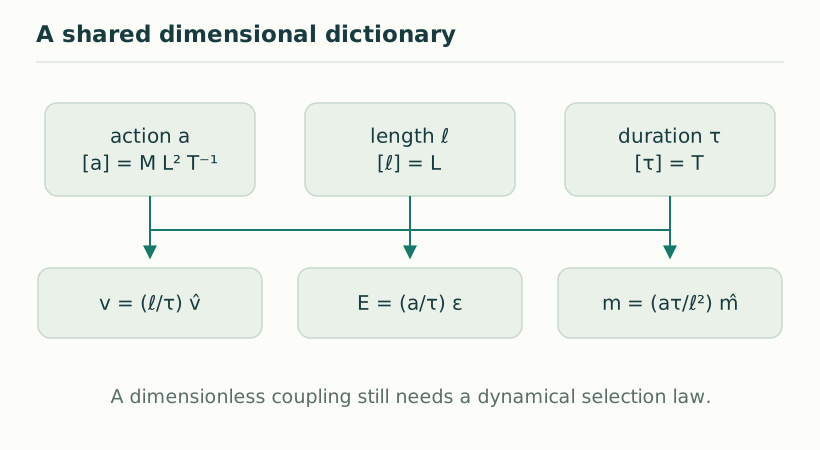
Let κ be the maximal spatial length associated with one normalized inner-phase increment. Let ρ be the number of such phase units accumulated per unit of outer clock time. Their dimensions differ: κ converts phase to length, while ρ converts outer duration to phase. The expression c=κρ is therefore dimensionally meaningful. A bare ratio of two durations is dimensionless and cannot, without an additional length conversion, equal a speed measured in metres per second.
Figure 1. A shared dimensional dictionary. Dimensionless model outputs acquire physical units only after an action scale a, length scale ℓ, and time scale τ are supplied. These conversions are dimensional identities, not derivations of numerical constants. View full size ↗
03The cancellation that produces the speed
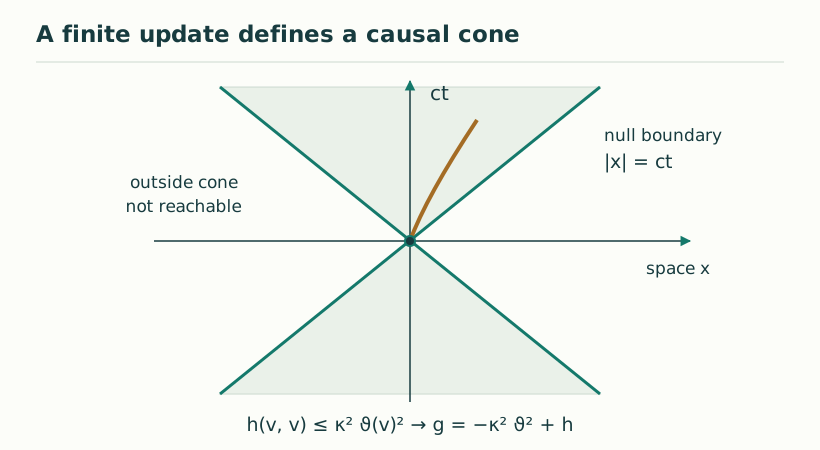
Take any positive phase increment Δτ. Its maximal spatial projection is κΔτ and its outer duration is Δτ/ρ. Dividing cancels the arbitrary amount of phase traversed. The result is independent of the duration of the chosen update only if κ and ρ have the assumed common values over that interval. If they vary along a path, the integrated speed bound involves their local relation rather than a universal constant inferred from one cancellation.
Δℓ_max=κΔτ, Δt_out=Δτ/ρ
c=Δℓ_max/Δt_out=κρ
04An identifiability example
Suppose experiments constrain a product κρ=c₀. Replacing κ by aκ and ρ by ρ/a, for any positive a, leaves every prediction depending only on the product unchanged. Measuring c₀ cannot determine both factors. Independently observable phase counts, an independently fixed microscopic length, or an additional relation selected by the source dynamics would be needed. This is not a defect in dimensional analysis; it is a warning against interpreting a successful product fit as two separate microscopic discoveries.
κ→aκ, ρ→ρ/a ⇒ κρ unchanged
Figure 2. A finite update defines a causal cone. Illustrative finite-update geometry: displacement is bounded by update scale κ times projected inner duration. A Lorentzian metric or a shared light cone still requires the stated readout and field assumptions. View full size ↗
05What an improved SMM/DTT derivation would establish
The strongest next step would derive spatial increments and physical clock increments from the same autonomous source update, define their measurements independently, and prove their ratio without using the target speed as calibration input. Six nested stages could constrain recurrence and readout, but the proof must show how their completion resources fix κ and ρ. A source law that merely executes a chosen length rule beside an unrelated clock rule has not explained their agreement. The present relation is a transparent interface equation on which a stronger joint geometry–clock model can build.
06A shared factor is not a dimension theorem
It is tempting to identify the projection rate with a spatial dimension or a count of nested levels. Such an equality needs independently defined measurements on both sides. A dimension can be inferred from volume growth, eigenvalue growth or diffusion, while a clock ratio is measured from recorded durations; those procedures need not agree in a generic model. Multiplying an independently chosen spatial update by a clock factor only restates their product. A stronger source construction would make the dimension–clock relation unavoidable under a nonempty family of refinements, and show precisely which perturbations preserve or violate it.
07Three levels of the claim
The first level is a mathematical cone obtained from a supplied finite-update inequality. The second is an operational interpretation: lengths and clock intervals must measure the quantities entering that inequality. The third is universality: photons, matter, clocks and other fields must inherit compatible propagation and transformation laws. Each level requires evidence beyond the preceding algebra. Six nested inner stages may motivate the generative architecture, but their existence alone does not determine a clock conversion, a null cone or a field equation. This separation makes the proposed mechanism testable: a mismatch between sectors or a measurable preferred splitting would constrain the model even if its cone construction is mathematically consistent.
The compact phase fiber introduces a global question beyond the local signature proof. If its vertical direction is interpreted literally as physical timelike motion on a circle, a full fiber orbit is a closed timelike curve for the constructed metric. A viable chronology therefore needs a restricted admissible history, a lifted phase or another explicit physical interpretation that prevents identifying recurrent phase with unrestricted closed observable time. Local Lorentzian algebra alone settles neither global causality nor the existence of a single clock function. The completion archive is the natural place to state this missing global information.
KEEP THE CONNECTION
Key ideas
A length conversion is essential in a temporal explanation of speed.
The product κρ does not identify its factors.
A common source law must constrain geometry and clock readings jointly.
Scope of the argument. Dimensionally correct factorization; no independent numerical derivation of κ, ρ or their SI value.
Sources & further reading
dtt_limiting_speed_paper_v2(1).pdf — working draftpp. 6–7 and 11–14, §§1.4–1.6 and 5–7
Source editions and catalogue entries
Working manuscript
DTT limiting-speed construction — working draft v2
Draft file: dtt_limiting_speed_paper_v2(1).pdf
Working manuscript. Article-level references identify the consulted sections and the scope of the interpretation. No public URL was supplied for this exact manuscript version.