Explain the construction of a Lorentzian metric from a positive spatial metric and a temporal one-form. Identify the signature and nondegeneracy conditions required by the model.
In the SMM picture, an inner generative process produces the configurations through which spatial motion is observed. DTT distinguishes that generative role from the outer records used by clocks. The limiting-speed model represents the relation with an inner phase, a positive horizontal metric h, and a temporal connection one-form ϑ. A vector separates into a horizontal part and a component along the phase fiber. This is an effective geometric realization of the temporal distinction. It already assumes an emergent spatial base and a projection apparatus; it is not, by itself, a construction of all spatial structure from a structureless point.
02Constructing the quadratic form
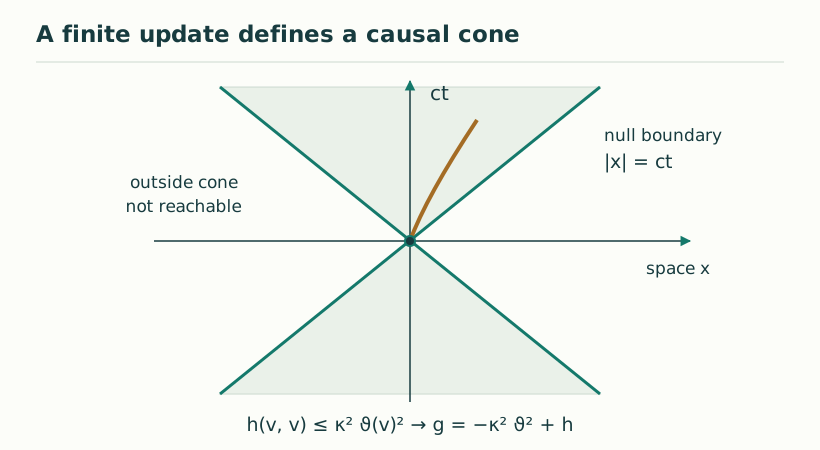
A connection decomposes every tangent vector as u=u_H+ϑ(u)ξ, where ξ is the vertical generator normalized by ϑ(ξ)=1. Extend h to vanish on ξ and define g=h−κ²ϑ⊗ϑ. The original finite-update inequality is then exactly g(u,u)≤0 on the chosen future orientation. The minus sign is part of this construction, motivated by encoding a speed bound as a quadratic cone. It is not obtained by simply naming two quantities inner and outer time.
u=u_H+ϑ(u)ξ
g(u,v)=h(u_H,v_H)−κ²ϑ(u)ϑ(v)
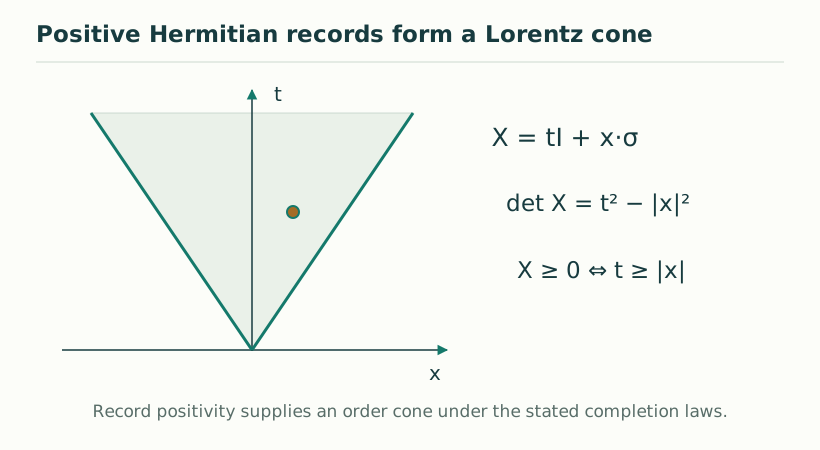
Figure 1. Positive Hermitian records form a Lorentz cone. Writing a Hermitian 2×2 record as X = tI + x·σ gives det X = t² − |x|². Positivity is equivalent to t ≥ |x|. The diagram is a two-dimensional section of the four-dimensional cone. View full size ↗
03The signature proof
Choose three horizontal vectors orthonormal for h and append ξ. In that adapted basis the matrix of g is diagonal with entries −κ²,1,1,1. Positivity of κ and h gives exactly one negative direction and three positive directions, so the form is nondegenerate and Lorentzian. If h is degenerate, κ vanishes, or the horizontal dimension differs, the conclusion changes. The proof therefore makes its assumptions visible rather than presenting the signature as a consequence of temporal vocabulary.
matrix(g)=diag(−κ²,1,1,1)
g(u,u)=0 identifies the null boundary
04A local flat example
In a patch where ϑ=dτ and h=dx²+dy²+dz², introduce an outer clock through dt=dτ/ρ. The metric becomes −(κρ)²dt²+dx²+dy²+dz². A displacement with dx=(κρ)dt and dy=dz=0 is null; smaller spatial displacement is timelike. This coordinate form is useful locally. If dϑ is nonzero, ϑ cannot generally equal a single exact time differential throughout the region, and accumulated clock phase can be path dependent. A global clock function therefore requires additional integrability conditions.
Figure 2. A finite update defines a causal cone. Illustrative finite-update geometry: displacement is bounded by update scale κ times projected inner duration. A Lorentzian metric or a shared light cone still requires the stated readout and field assumptions. View full size ↗
05Lorentzian geometry is not yet relativity dynamics
The transformations preserving g form a Lorentz group in each tangent space. Physical observer equivalence additionally requires clocks, rods, fields and detector laws to transform consistently. If the decomposition into h and ϑ is separately measurable, it may reveal a preferred structure even though g has Lorentzian signature. Likewise a Lorentzian metric alone does not supply Einstein’s field equations, a matter stress tensor or gravitational coupling. The useful SMM/DTT achievement at this stage is a precise conditional bridge from a projection bound to causal geometry; further dynamical bridges remain separate.
06Connection curvature is not automatically gravitational curvature
The two-form dϑ measures twisting of the phase connection. The Riemann curvature of g measures a different geometric object built from the full metric and its derivatives. They can be related in a specified bundle metric, but they are not interchangeable by definition. In particular, a nonzero dϑ does not directly provide an Einstein tensor or determine a stress-energy law. A gravitational extension should calculate the metric curvature explicitly, state any reduction or averaging, and derive the field equations from a justified action or dynamical principle. This identifies the additional work beyond obtaining one negative metric direction.
07Three levels of the claim
The first level is a mathematical cone obtained from a supplied finite-update inequality. The second is an operational interpretation: lengths and clock intervals must measure the quantities entering that inequality. The third is universality: photons, matter, clocks and other fields must inherit compatible propagation and transformation laws. Each level requires evidence beyond the preceding algebra. Six nested inner stages may motivate the generative architecture, but their existence alone does not determine a clock conversion, a null cone or a field equation. This separation makes the proposed mechanism testable: a mismatch between sectors or a measurable preferred splitting would constrain the model even if its cone construction is mathematically consistent.
The compact phase fiber introduces a global question beyond the local signature proof. If its vertical direction is interpreted literally as physical timelike motion on a circle, a full fiber orbit is a closed timelike curve for the constructed metric. A viable chronology therefore needs a restricted admissible history, a lifted phase or another explicit physical interpretation that prevents identifying recurrent phase with unrestricted closed observable time. Local Lorentzian algebra alone settles neither global causality nor the existence of a single clock function. The completion archive is the natural place to state this missing global information.
KEEP THE CONNECTION
Key ideas
A positive horizontal metric and nonzero temporal coefficient give Lorentzian signature.
Curvature can obstruct a global exact clock coordinate.
Cone symmetry does not by itself prove observer equivalence or Einstein dynamics.
Scope of the argument. Lorentzian signature follows from the stated metric construction; physical relativity and gravity require additional laws.
Sources & further reading
dtt_limiting_speed_paper_v2(1).pdf — working draftpp. 12–17, §§6–9
Source editions and catalogue entries
Working manuscript
DTT limiting-speed construction — working draft v2
Draft file: dtt_limiting_speed_paper_v2(1).pdf
Working manuscript. Article-level references identify the consulted sections and the scope of the interpretation. No public URL was supplied for this exact manuscript version.