Explain the entropy barrier to lattice-like relational memories in the stated permutation ensemble. The result concerns a specified preparation problem, not every possible mechanism for emergent space.
SMM proposes that observable multiplicity can arise through one generative source. A mathematical realization must therefore distinguish the active source from retained memory: one cursor can visit many labels while the permutation tables and previous records remain available. Calling the cursor a monad does not eliminate that memory or derive its capacity. In this construction the labels initially carry no positions. A signed operation moves the cursor according to a permutation; a sequence of operations becomes a history, and tests decide which histories have the same completed record. Spatial adjacency is subsequently read from those completed transitions. This gives a precise route from operations to a candidate geometry, provided the chosen operation tables have suitable structure.
02The ensemble before geometry
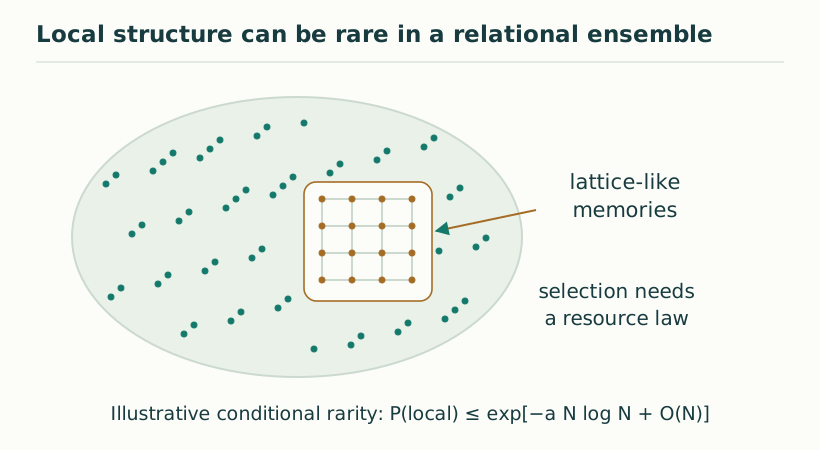
Take N distinguishable record labels and d independently selectable permutations. There are (N!)ᵈ possible operation tables. Most do not resemble translations on a lattice: applying operation a and then b usually differs from applying b and then a. The proposed geometric event is a Hamming neighbourhood of commuting tuples, so its definition is stronger and more specific than an informal visual resemblance to space. Hamming distance counts how many table entries must change. An entropy argument is meaningful only after these alternatives and this event have been fixed; choosing a different ensemble can change the answer.
Figure 1. Local structure can be rare in a relational ensemble. A schematic ensemble contrasts arbitrary relational memories with a small lattice-like subset. In the stated permutation model, rarity is exponentially strong in N log N; constructing an example does not establish spontaneous selection. View full size ↗
03Why bounded selection loses to abundance
The manuscript bounds the reference probability of a δ-neighbourhood of commuting tables by an exponential whose dominant negative term is proportional to N log N. A fixed-depth cost changes by at most order N, so a fixed selection strength β can improve probabilities only by an exponential of order N. The N log N combinatorial disadvantage eventually dominates. This is a large-system statement at fixed d, test depth and β. Cooling a particular finite system sufficiently can still concentrate it near the minimum; those are different orders of limits.
log p_N ≤ −(d − 1 − dδ) N log N + O(N), δ < (d − 1)/d
β osc(E_R) = O(N) at fixed d, R and β
04An illustrative comparison
For d=3 and δ=0.1 the coefficient of N log N is 1.7. The leading expression therefore penalizes geometric occupation as exp[−1.7N log N], before the unspecified order-N correction. This example displays scaling, not a trustworthy finite-N probability: the hidden constants must be controlled before assigning a numerical likelihood. Doubling N increases both the memory size and the logarithmic combinatorial factor. It is this mismatch, rather than a claim that local patterns are logically impossible, that makes an unstructured start difficult.
05What the obstruction teaches about emergence
Waiting longer under arbitrary predetermined updates that preserve the same reference does not create a missing preparation resource. Noncommuting generators also do not help merely by being noncommuting. A mechanism can evade the hypotheses through an informative initial state, a changing reference, feedback with accounted memory, or a more structured state space. Those are substantive changes to the model. For SMM/DTT the useful research question becomes which source principle supplies the requisite structure, and at what cost. The theorem narrows that search without ruling out emergent locality in every conceivable theory.
06Which geometric property is actually rare
The counted event retains signed operation labels. An undirected graph could look locally lattice-like while admitting many different assignments of those operations. Forgetting labels can therefore change both the number of admissible configurations and the meaning of closeness. The entropy theorem should not be transferred to a broader undirected event without a new counting argument. Similarly, the Hamming radius δ measures differences between tables, not an observed curvature or a physical distance between universes. These distinctions suggest a concrete extension: define a label-independent geometric event, compare its combinatorial size with the signed event, and then repeat the resource analysis for the actual observable completion tests.
07What would complete the physical explanation
The six inner stages in this research programme are nested roles of a single generation–completion process. The seventh level publishes a completed configuration; it is not another independent time coordinate. The locality paper supplies concrete finite implementations of this architecture, but their schedules, memory and permitted transport remain specified inputs. A stronger SMM/DTT account would select those ingredients with one physical update law and explain why they persist under perturbation. It would also calibrate graph steps and completion counts against actual rulers and clocks. A proof about a finite labelled memory is valuable even before that programme is complete, provided its conclusion is kept at the level established by its hypotheses.
There is also a metric distinction inside the lattice example. Counting elementary signed operations produces a word metric, which on the standard lattice is the Manhattan metric. A Euclidean-looking embedding or cubic volume growth does not automatically replace that metric by an isotropic Euclidean norm. A continuum limit must specify the probe, its allowed directions and any averaging or refinement that makes its comparison law isotropic. This is why adjacency, volume growth, diffusion, calibrated distance and signal propagation should be checked separately even after an exact lattice neighbourhood theorem has been proved.
KEEP THE CONNECTION
Key ideas
The rarity result concerns a specified permutation ensemble.
Fixed-strength order-N selection cannot generally offset an order-N-log-N entropy deficit.
A source law must account for the resource that prepares geometric memory.
Scope of the argument. Conditional entropy obstruction for labelled permutation memories; not a universal impossibility theorem for emergent space.
Sources & further reading
temporal_locality_v8(1).pdf — working draftpp. 5–12, §§2–6
Source editions and catalogue entries
Working manuscript
Temporal locality — working draft v8
Draft file: temporal_locality_v8(1).pdf
Working manuscript. Article-level references identify the consulted sections and the scope of the interpretation. No public URL was supplied for this exact manuscript version.