A056Public article topicExpanded article4 min read
The Single Monad
Clarify what the Single Monad denotes within this framework. Explain why a unique generative source needs a precise relationship to observable multiplicity and cannot simply substitute for one.
The source explains several uses of jawhar and monad, ranging from substance and an indivisible unit to the Universal Intellect or Pen in its cosmological reading. It also distinguishes individual manifested monads from the Single Monad understood as their common origin. The article's central task is therefore terminological: the same word can function at different levels, and the level must be identified before a physical interpretation is attempted.
02A unique object need not be a featureless object
Being one does not necessarily mean having only one possible state. A single mathematical system can support many states and transformations. Conversely, a truly one-element state set with a fixed output contains no distinguishable alternatives. If it is to generate a varied observable history, additional structure must enter through relations, operations, memory or changing conditions.
This observation is important for any point-origin proposal. A point used as a symbol of unity is not the same as a complete dynamical specification. The latter must explain where distinguishable possibilities and their lawful transitions come from.
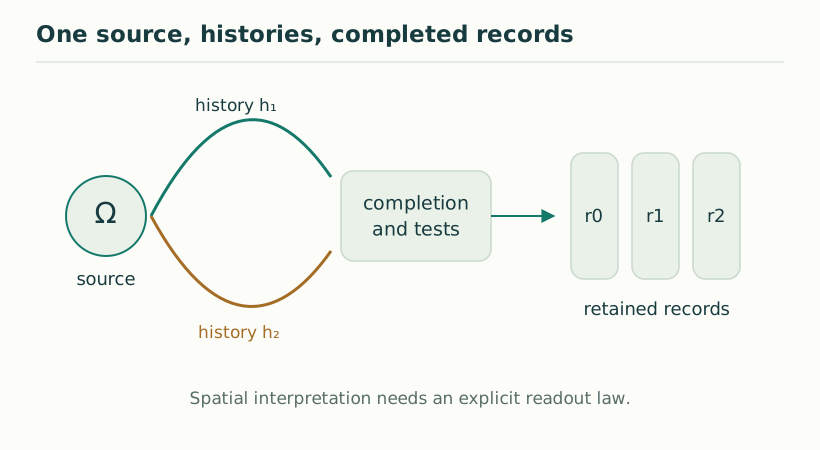
Figure 1. One source, histories, completed records. Conceptual reconstruction: composable source histories are tested and completed before a retained record becomes available. The source is not depicted as a point already located in space. View full size ↗
03The danger of hiding structure in a label
Suppose a model says that a monad emits every possible physical record according to the correct laws. That sentence assigns the desired result to the monad, but it has not explained those laws. A constructive account must show how a limited set of explicit rules generates the records and their correlations.
One useful audit asks which ingredients would have to be changed to alter a predicted phenomenon. If each phenomenon can be changed independently while the monad label remains untouched, the proposed common origin has not yet imposed a strong unifying constraint.
04SMM as an economy of generative explanation
The positive SMM ambition is to replace unrelated foundations with a common generating account. This does not require that every observable object be literally a tiny copy of a geometric point. It requires a justified relation between source organization and the many stable patterns encountered by observers.
A formal model can express this through one state space S, an update F and a family of operational readouts Rₐ. Its explanatory strength depends on how tightly F and the readouts are connected. A derived relation among them is more informative than their shared membership in S.
05DTT gives the source an ordering problem
Once manifestation is described through inner generation and outer completion, the source must explain not only which records exist but when they become available. The six inner stages are nested organizational roles, not six independently adjustable clock axes. Completion must also preserve enough information for successive records to form a coherent history.
This produces a clear physical question: can one autonomous dynamics generate spatial distinguishability, reliable clocks and lawful matter propagation together? Answering it requires more than assigning source unity; it requires an explicit construction and analysis of its limits.
06Source unity is compatible with a rich carrier
A single algebraic object can support many representations, and a single dynamical law can act on a large state space. Such examples show that mathematical unity need not mean absence of internal distinctions. The central issue is whether those distinctions arise from one justified structure or are inserted as unrelated modules. In SMM, the Monad should constrain the available forms and their relations. In DTT, the constraint should also organize the passage from generative histories to completed records. This gives a positive standard for a formal source model: its richness should be productive and economical, with several consequences following from the same assumptions.
07A source prior to spatial location
The Monad functions here as a source role, not a miniature material bead inside already existing space. Its proposed priority concerns generation. The state space, update law, retained relations and accessible records make the role mathematically inspectable. The Single Monad then becomes a research question about a common origin of physical relations rather than a substitute word for everything a model must explain.
KEEP THE CONNECTION
Key ideas
The term monad has several contextual meanings.
A featureless label cannot explain structured outcomes.
The strongest SMM aim is a common dynamics with constrained observable records.
Scope of the argument. Historical interpretation and original conceptual analysis; illustrative mathematical constructions are not identifications of theological realities with physical objects.
Original public topic. This edition provides an independently written explanation; article-level references identify the passages and additional sources used.