A010Public article topicExpanded article4 min read
Introducing Ibn al-Arabi's View of Time
Introduce Ibn al-Arabi’s treatment of time as a relation associated with change and manifestation. Provide a bridge from the historical terminology to the later Single Monad interpretation.
01Time as a relation rather than an independent object
In the interpretation presented by the source article, Ibn al-Arabi treats time as dependent on relations among events and states, rather than as a separately existing container. Calling it imagined does not mean that the experience of succession can simply be ignored. It means that the ordering form should not be confused with a self-sufficient thing standing behind the world.
The article also distinguishes natural and spiritual temporal descriptions and assigns special roles to days and the cosmic week. These themes belong to an integrated account of manifestation. Their modern physical use requires a separate argument, rather than a direct conversion of symbolic terms into units of seconds.
02Why a relation can still matter
The distance between two markers is a relation, yet it is not arbitrary once a measurement procedure is fixed. Likewise, the ordering of two events can be physically consequential even if time is not regarded as an independent substance. Relational dependence should therefore not be equated with the absence of objective constraints.
This point is essential for SMM. If observable distinctions depend on one source, their dependence does not make every distinction freely chosen by an observer. A useful model must specify which relational structures are preserved across allowed observations and how observers can agree about them.
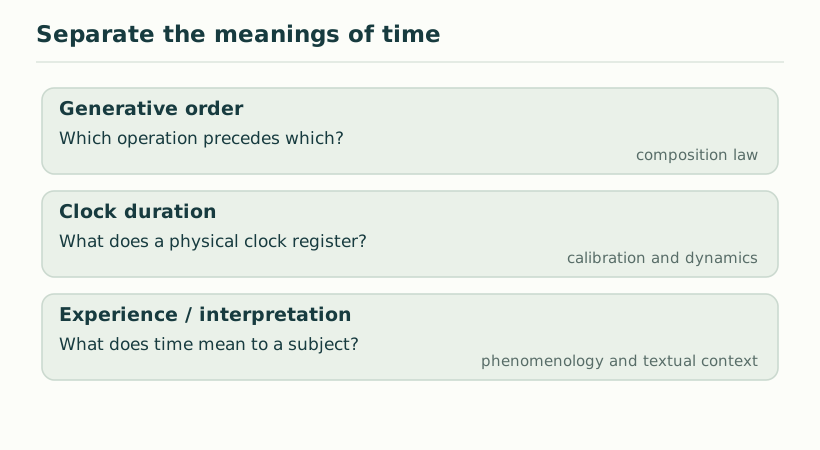
Figure 1. Separate the meanings of time. An interpretive map separates generative order, measured duration, and experienced or theological meanings. A relation between them is a question to formulate, not an automatic identification. View full size ↗
03Renewal and recognizable continuity
Ibn al-Arabi’s theme of ever-new manifestation emphasizes that apparent repetition need not mean numerical identity of successive states. A new appearance can resemble a previous one closely enough to be recognized as the persistence of the same thing. The conceptual question is what grounds that recognition.
In a modern model, continuity can be expressed through conserved or retained relations. A pattern of records may remain identifiable while its microscopic realization changes. This supplies a concrete analogy for renewal, while leaving open whether the analogy describes actual fundamental dynamics. The distinction between resemblance and a specified equivalence relation is important.
04Nested construction in DTT
DTT develops the generation–appearance distinction through inner roles and outer completion. In the current nested formulation, six inner stages are organized as a hierarchy contributing to three-dimensional readout; completion makes the result available to observers. They are not six parallel physical clocks whose readings could simply be added.
A useful analogy is building a coordinate description through successive relational tests and then publishing the completed description. Earlier tests can be prerequisites for later ones without being separate spatial axes. To establish three-dimensionality, however, one must prove the rank and transformation properties of the readout rather than infer them from the number of named stages.
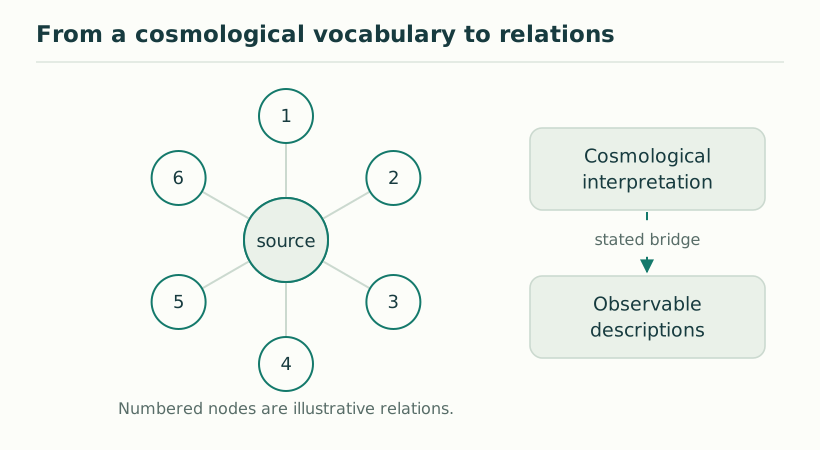
Figure 2. From a cosmological vocabulary to relations. The diagram is a reading aid for the SMM vocabulary: source, relations, manifested plurality, and observation. The arrangement does not assign physical locations to metaphysical terms. View full size ↗
05A careful route from interpretation to explanation
The historical material offers conceptual resources: dependence, renewal, reception and the distinction between a source and its manifestation. A mathematical model supplies different resources: state spaces, maps, invariants and observable predictions. The transition is productive when the relation between the two is explicit.
For example, one can interpret renewed manifestation as motivation for a completion map while still asking whether that map preserves enough information for future prediction. One can interpret a cosmic cycle as motivation for recurrent phase while asking how a nonrepeating record history arises. These questions preserve the depth of the philosophical account and make the physical reconstruction more demanding, rather than treating analogy as a completed derivation.
06A worked distinction between a state and its appearance
Imagine two internal histories that end with the same visible arrangement of three markers. If a later test distinguishes them, their common appearance was not a complete physical state. If every admissible later test agrees, the two histories can be identified operationally. This contrast gives a precise role to the distinction between manifestation and hidden organization. It also supplies a demanding question for SMM/DTT: does an outer completion retain everything needed for future observable prediction, or must additional memory accompany the visible spatial arrangement? The answer determines the correct state space of the model.
KEEP THE CONNECTION
Key ideas
Relational time can retain objective structure without being an independent substance.
Renewal raises the precise question of what preserves recognizable identity.
The bridge from Ibn al-Arabi to DTT requires explicit modern constructions.
Scope of the argument. Historical interpretation connected to a modern research framework; the bridge is explanatory and conditional.
Original public topic. This edition provides an independently written explanation; article-level references identify the passages and additional sources used.