
In this article
- Why the question resists a single answer
- Objects and relations
- A minimal temporal construction
- Generation and observation in DTT
- A worked example of incomplete information
- A useful answer to the title question
Ask what a definition of time must explain: succession, duration, change, and observation. Use the question to distinguish temporal experience from the mathematical variables used to describe it.
Time can name an ordering relation, a measured duration, a coordinate, or the experienced transition from anticipation to memory. A definition that handles one use may leave the others untouched. Saying that time is what clocks measure is operationally useful, but then one must explain what makes a clock reliable and why different clocks can agree. Saying that time is change leaves open how different changes are compared.
The source article presents Ibn al-Arabi’s view that time is not an independently existing entity. It arises in the comparison of events and motion. The interesting consequence is not that events lose their order, but that their order does not require a separate temporal substance.
A relation can be real in its consequences without being another object alongside the things related. The order of words in a sentence changes its meaning even though order is not an additional printed word. Similarly, before and after may organize events without functioning as an invisible fluid through which they travel.
This analogy is especially helpful for SMM. The source can be ontologically single while its manifestations possess many relations. The task is to explain why those relations have a particular structure and remain available to observation. Calling them relational is the beginning of the explanation, not its end.
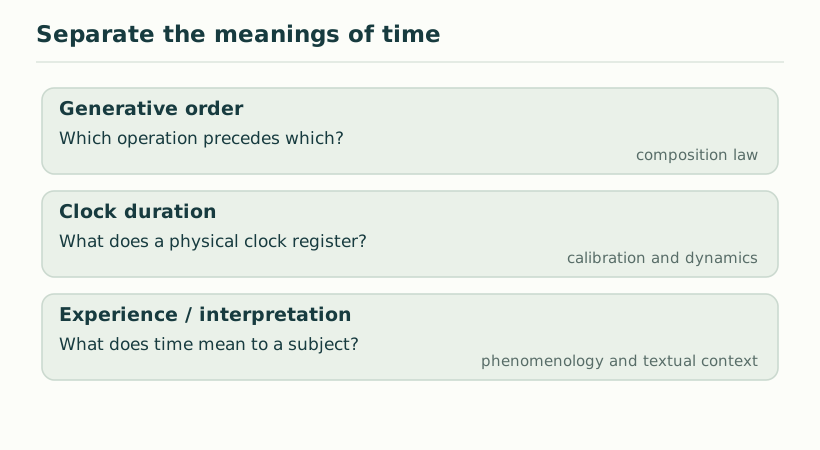
Begin with events and a relation E≺F meaning that E can precede F in the relevant physical process. If the relation is transitive and does not permit a nontrivial event to precede itself, it supplies a consistent order. Some event pairs may remain incomparable, so the structure need not be a universal sequence.
A scalar clock τ adds further information by assigning readings compatible with the order. Compatibility does not determine all intervals uniquely. For example, readings 0, 1, 2 and readings 0, 1, 10 agree about the order of three events but disagree about duration ratios. A physical theory must explain which assignment its clock realizes.
DTT distinguishes the organization of inner histories from the availability of completed outer records. This makes room for internal steps that do not each appear as a separate public event. Several generative histories can yield one observationally equivalent result, while repeated completed results can support a stable temporal order.
The distinction does not entail that inner time is ordinary time running faster somewhere else. A laboratory duration requires a clock observable. Inner order may instead be a compositional structure from which such observables emerge. The interpretation depends on the specific mathematical model, and using the same word time for both roles should not conceal their difference.
Consider a receiver that records only whether a process ends in state A or B. A process with two internal steps and another with twenty might both produce A. The final letter does not determine the internal step count. If a later interference or relaxation test distinguishes the two, however, the letter was not a complete predictive state.
This example identifies two separate notions of completion: a recognizable output and a state sufficient for future prediction. SMM/DTT needs to specify which it uses. Otherwise a hidden variable can be discarded in the name of observation and then silently reintroduced when explaining later behaviour.
For the purposes of this programme, time is approached through the relations that order generative activity and the records that make completed change measurable. This is a research strategy rather than a final metaphysical definition. It directs attention to what the model must construct: order, duration, persistence and the possibility of shared observation.
The approach also clarifies what would count as progress. Deriving an event order is one result; selecting a clock is another; recovering relativistic comparisons is another. Keeping them distinct allows a partial theorem to be valuable without making it carry claims that its assumptions and conclusions do not support.
KEEP THE CONNECTION
Scope of the argument. Conceptual reconstruction with a toy operational example; no unique ontology of time is claimed.
Original public topic. This edition provides an independently written explanation; article-level references identify the passages and additional sources used.
Source register →