Fermions and spinor structure: SMM/DTT and Spectral geometry and Kaluza–Klein models
How far can temporal winding explain spin one-half, and what is still required to obtain fermionic particles? This article compares the source-based construction with Spectral geometry and Kaluza–Klein models, identifies their strongest point of contact, and works through a concrete example that separates a valid mathematical result from the further physical relation needed to explain observations.
Spin one-half is a statement about how a state transforms under rotations: a 2π rotation changes the sign of a spinor, while a 4π rotation returns it to the original vector. The sign can matter in interference even though an isolated overall phase is unobservable. Fermionic statistics is a further statement about exchanging identical excitations in a many-particle theory.
These structures are related by the spin–statistics theorem under its relativistic quantum-field-theory assumptions, but one does not follow from a drawing of a double loop. A complete particle model needs a spinor representation, a kinetic operator, positive-energy states, locality or an adequate replacement, and a consistent rule for combining particles. Mass and electric charge add further data. [1][2][3]
02The SMM/DTT contribution
DTT's inner completion cycles suggest a way to represent a double-valued response to spatial rotation. The six nested inner levels can be interpreted as producing the relational distinctions from which a spinorial carrier is read out. Their nesting does not independently establish the exchange law of identical particles.
The useful constructive claim is therefore narrow and positive: a completion rule might select an SU(2) carrier or a projective rotational action. The next task is to show how that carrier becomes a propagating matter excitation and why its multiparticle sector is antisymmetric. An analogy between temporal twisting and a fermion sign becomes a physical derivation only when those transformations are defined on the same state space.
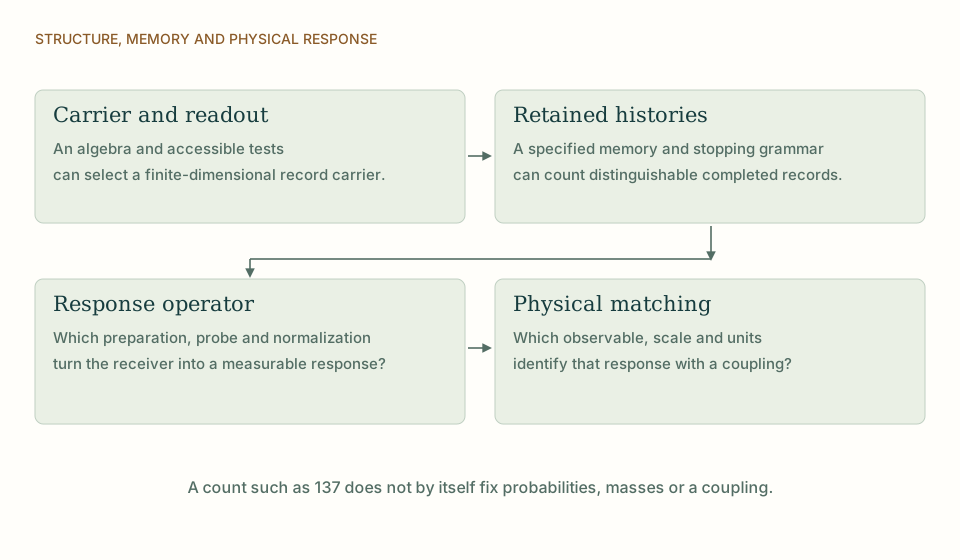
From carrier structure to a measurable response. Representation dimension, a chosen retention grammar, a response operator and physical calibration are separate stages of the constants programme. View full size ↗
03How Spectral geometry and Kaluza–Klein models frames the problem
Kaluza–Klein models relate lower-dimensional fields to a higher-dimensional geometry, often with compact internal directions. Fourier or spectral modes on the compact factor generate towers of effective excitations. Spectral geometry similarly relates operators and their spectra to geometric information, though it need not use a literal extra coordinate.
For DTT the useful comparison is the interpretation of an inner compact cycle. A compact time parameter is not automatically a harmless spatial extra dimension: its signature, operator domain and physical evolution must be stated. Six nested functional levels are not six compact coordinates. The shared mathematics of modes becomes a physical correspondence only when energy, charge and geometry are mapped consistently. [4][5]
04Where the mechanisms agree and differ
A compact internal space produces spectral modes, while spinorial matter requires a spin structure and a Dirac-type operator. Kaluza–Klein models therefore show why a periodic mode count alone is insufficient for fermions. DTT's inner winding may organize a spectrum, but its boundary conditions and carrier representation determine whether the effective mode is scalar, spinorial or something else.
The six nested inner levels are not themselves a spin structure. A useful temporal model would define how the source transports a spinor through a completed cycle and whether periodic or antiperiodic boundary conditions are physically selected. The 4π calculation below gives a clean rotational benchmark; an internal antiperiodic phase is not automatically the same operation as a spatial 2π rotation. Confusing them can manufacture a spin interpretation without a representation of the rotation group. The positive bridge is an explicit spectral construction where one source law fixes the carrier, boundary domain and effective kinetic operator. Such a result could explain both a mode pattern and its spin transformation. It would still need a separate multiparticle composition law before deriving fermionic exclusion or the full matter spectrum. [4][5]
05Worked example: assumptions, calculation and result
For a spin-one-half state, rotation through angle θ about the z-axis is U(θ)=exp(−iθσz/2), with σz=diag(1,−1). At θ=2π both diagonal entries are −1, so U(2π)=−I. At θ=4π both are +1. This explicitly verifies the double-cover behavior without introducing an extra physical time coordinate.
For two identical fermions in the same normalized one-particle state ψ, antisymmetrization gives [ψ⊗ψ−ψ⊗ψ]/√2=0. That proves exclusion once the antisymmetric composition law is adopted. It does not derive that law from the 4π rotation calculation. A temporal model gains strength by proving the connection between its single-carrier rotation and its composition rule, rather than treating them as the same statement. [1][2][3]
θ is dimensionless; σz is a Pauli matrix and i²=−1. These are standard complex spinor operations.
06An independent operational check
An isolated overall sign cannot distinguish two rays in ordinary quantum mechanics, yet a relative sign between two coherently recombined paths can alter interference. A temporal winding model must therefore identify the reference against which its 2π sign is observed. Without that reference, a sign change can be mathematically present but operationally invisible. The same issue appears in completion: projecting onto a phase-insensitive record can erase a sign that mattered in the inner carrier. A strong source model calculates exactly when the sign survives and connects that result to a controlled interference observable before drawing conclusions about particle statistics or mass.
07What follows from the comparison
The comparison points toward a realistic theorem sequence: identify the carrier, derive its transport, establish multiparticle composition, and only then study masses and interactions. Partial success at the first stage remains valuable. It explains an otherwise imposed representation while leaving the physically harder statistics and dynamics questions visible.
THE SAME QUESTION, DIFFERENT STARTING POINTS
The comparison at a glance
Question
SMM/DTT
Spectral geometry and Kaluza–Klein models
Starting physical structure
One nonspatial source; six nested inner functional levels produce records accessible through outer completion.
A specified internal geometry or operator whose modes appear as effective fields.
The central mechanism in this topic
The source must identify rotation, cycle transport and boundary conditions as distinct operations.
Spin structures and Dirac spectra determine the fermionic content of compactification.
How the claim is made operational
A source-to-record map must define geometry, material response and physical clocks with shared inputs.
Dimensional reduction, spectral decomposition, normalization and mode matching.
Meaning of agreement
Agreement is a compatibility result; a source-selected relation or fixed residual would add explanatory content.
The stated framework provides a benchmark within its own assumptions and established domain.
KEEP THE CONNECTION
Key ideas
A temporal spectral mode becomes a fermion only through a defined spinorial action and dynamics.
The worked example establishes only the result stated under its explicit assumptions.
Six nested inner levels describe one generative organization; outer time orders accessible completion.
Develops the source construction or operational distinction used in this comparison.
Sources and further reading
References support the comparator and the specific mathematical or interpretive claims indicated. SMM/DTT connections are developed in the analysis above.