
In this article
- The question behind the comparison
- The single-source and nested-time proposal
- The comparator’s explanatory structure
- The precise agreement and difference
- Worked example: what follows and what does not
- What this comparison contributes


Thermal time makes temporal flow dependent on the physical state, whereas SMM/DTT seeks a source process that also produces the states and spatial relations themselves. The comparison develops this distinction through a worked example and explains its implications for SMM/DTT’s nested generation, completed records and account of the observable world.
To describe time as generative is to treat the arrival of a determinate event as part of what the theory explains. An ordinary dynamical equation begins with a state space, variables and a law. A stronger SMM/DTT construction would explain why certain variables form spatial objects and why their changes share a measurable temporal order. Its appeal lies in reducing the independence of geometry, matter and clock readings. The single-source claim becomes physically significant when the same mechanism constrains all three rather than merely running three separately chosen rules.
A generative process is not necessarily an event before the universe in an earlier external time. If space and outer time are outputs, their source cannot be located at a pre-existing spatial address or timed by an unexplained outside stopwatch. Mathematical descriptions can still use an index to express dependency. The index is then part of the representation until an operational meaning is provided. This is familiar in constructive mathematics: the order in which a proof or object is built need not be a physical sequence measured in seconds. DTT must explain when its generative order becomes more than this.
Six nested inner levels offer a proposed organization of dependencies. Their scientific role would be clearest if dropping one level destroys a necessary capability, while adding a level contributes no independent capability. Such minimality is stronger than naming six stages after a familiar result. A successful construction would also prevent arbitrary reassignment of stage labels from changing its physical conclusions. The point is not the number alone but the restrictions imposed by the nested organization on possible records and their lawful transformations.
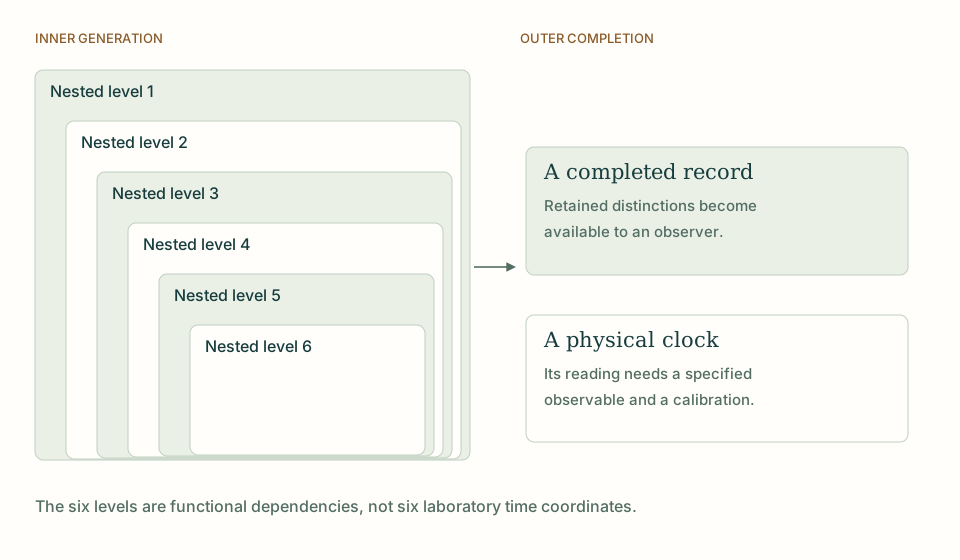
SMM begins with one nonspatial generative source. DTT distinguishes its inner production from the outer order in which completed results become accessible. The six inner levels are nested functional dependencies within that production; the seventh denotes outer completion. They are not six independent clocks, six spatial directions, or six simultaneously occupied temporal axes. This distinction makes the framework more specific than a general claim that everything changes: it asks how a world of persistent relations can be generated before its spatial representation is taken for granted. [2]
Connes and Rovelli propose that an algebra of observables together with a state can determine a temporal flow. In a finite faithful-state illustration, write K = −ln ρ and let observables transform as A(s) = exp(isK)Aexp(−isK). The parameter s is dimensionless. If ρ is a Gibbs state proportional to exp(−βH), then K differs from βH only by a scalar, so s can be related to ordinary Hamiltonian time by t = ℏβs in this convention.
This example explains both the power and the limitation of the comparison. Time need not be an independently supplied universal background, but the observable algebra and state are already doing essential work. A maximally mixed finite state gives a scalar K and hence trivial flow on that full matrix algebra. Different physical states can therefore select different flows. The thermal-time programme is not a claim that every microscopic event dissipates heat, nor does modular evolution alone constitute a thermodynamic arrow. DTT asks the further question of how the relevant state, algebra and accessible records are generated. [1]
Thermal time makes temporal flow dependent on the physical state, whereas SMM/DTT seeks a source process that also produces the states and spatial relations themselves. The theories meet at the question of whether time can be derived from physical organization. They differ in what organization is taken as given. Thermal time needs an algebra and a state; DTT’s strongest form seeks an explanation of their origin.
A constructive bridge could begin with a source update and a readout algebra, derive an accessible stationary state, and compare the induced flow with its modular automorphisms. This would impose a real compatibility condition. Simply defining the outer flow to be the modular flow after choosing a convenient state would leave the crucial freedom untouched. The nested inner levels could matter if they select the algebra or exclude alternative states. The comparison therefore identifies a concrete route for DTT: make the state-time relation a consequence of generated access, while recognizing that the established thermal-time proposal already contains a sophisticated notion of relational temporal emergence. [1]
Consider a rewrite system starting from one mark. A rule replaces each mark with two related marks and preserves their ancestry. After n steps there are 2ⁿ leaves and a rooted tree of relations. The construction has genuinely produced multiplicity and a distance based on shared ancestry. It has not produced ordinary three-dimensional Euclidean space: a tree has a different neighborhood structure. Giving the leaves three coordinates afterwards changes their representation, not the original relation. The example identifies a positive milestone for SMM/DTT: derive relational structure first, then prove which metric and dimension its observations support. Unity can generate many objects without uniquely selecting their geometry.
The comparison therefore concerns explanatory priority. Does a theory start from events and organize them, or provide a process that constitutes events? Both can describe change, but they answer different questions. The most useful bridge is an explicit map from generative states to the observables of a familiar theory, together with an explanation of why the map respects that theory’s symmetries. A completed reconstruction could then illuminate the origin of an established law even before it supplies a new empirical prediction.
THE SAME QUESTION, DIFFERENT STARTING POINTS
| Question | SMM/DTT | The thermal-time hypothesis |
|---|---|---|
| Explanatory starting point | SMM treats spatial multiplicity as a result of nested source relations rather than a collection of locations supplied before generation. | A state and observable algebra determine a modular flow; clock calibration remains a physical question. |
| Key distinction | Generating a relational network establishes multiplicity; its metric, neighborhood structure and physical dimension require further results. | Thermal time makes temporal flow dependent on the physical state, whereas SMM/DTT seeks a source process that also produces the states and spatial relations themselves. |
KEEP THE CONNECTION
Connects this comparison with the author’s discussion of generative.
Connects this comparison with the author’s discussion of generative.
Connects this comparison with the author’s discussion of generative.
Connects this comparison with the author’s discussion of generative.
Connects this comparison with the author’s discussion of generative.
References support the comparator and the specific mathematical or interpretive claims indicated. SMM/DTT connections are developed in the analysis above.
How these comparisons distinguish premises, results and physical claims