


The classical kinetic energy (in the normal time):
In normal classical mechanics, the kinetic energy is the work done in accelerating a particle during the infinitesimal time interval  , and it is given by the dot product of force
  and displacement
  :
:
 (7)
(7)
thus:
 (8)
(8)
Now if we assume mass to be constant, so that:  (and we will discuss relativistic mass further in section 6.2.4 below), we will get:
 (9)
(9)
So in the classical view of apparently continuous existence, when we consider both space and time to be real, i.e. when we consider an infinitesimally continuous and smooth change in speed from zero to  , the result of this integration will give the standard equation that describes the kinetic energy of massive particles or objects moving in the normal level of time:
 (10)
(10)
The reason why we are getting the factor of “half” in this equation is because the velocity increases gradually with time, which makes the integration equals the area of the triangle as demonstrated by the first arrow in Figure 6.2.1.
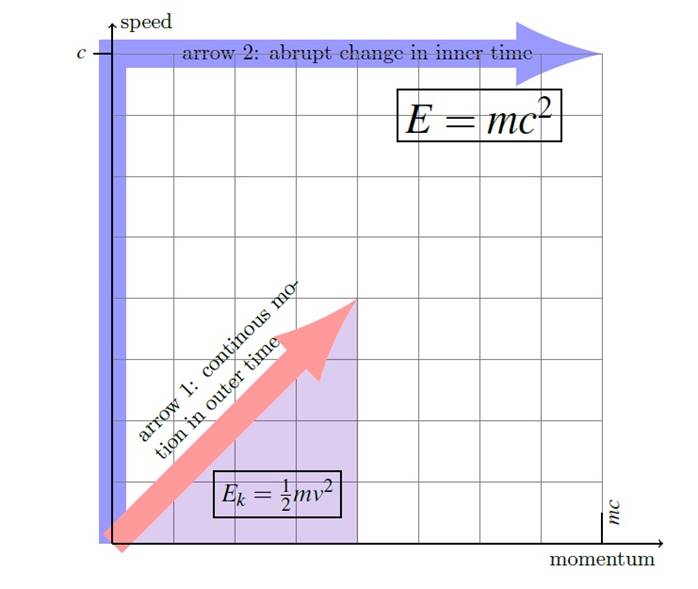
Figure 3: Arrow 1: gradual change of speed in the outer level of time, leading to the classical equation of kinetic energy  . Arrow 2: abrupt change from zero to
  in the inward levels of time, leading to the mass-energy equivalence relation
  , which can not happen on the normal level of time because physical objects may not move at the absolute speed of light.