mₑ
Electron mass
A matched charged-sector gap supplies a mass dictionary. A generic harmonic is not an electron.
Particle assignment openDimension: kg
Understand the ideas, follow the mathematics, and inspect the open steps.
A matched charged-sector gap supplies a mass dictionary. A generic harmonic is not an electron.
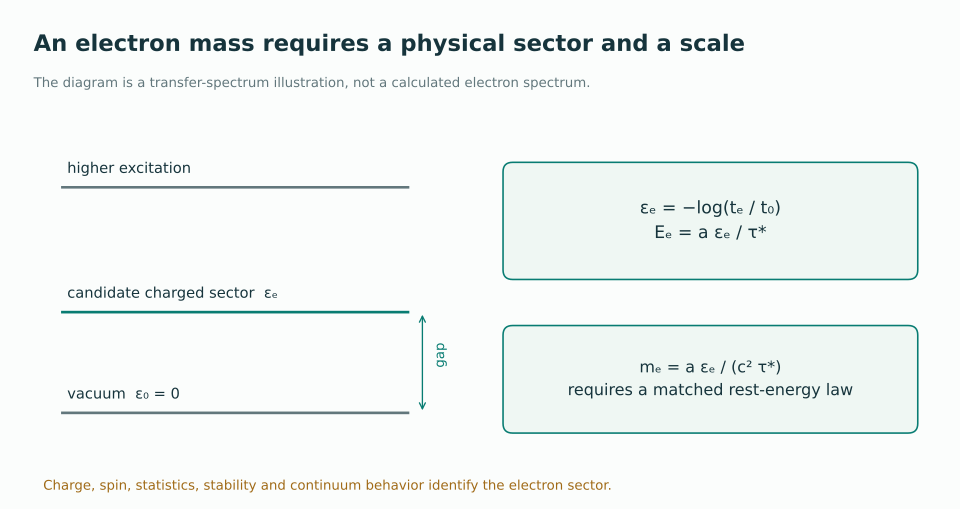
A positive transfer operator gives dimensionless excitation gaps. The action scale and completion time convert a gap into energy. A candidate gap becomes an electron mass only after the physical sector and rest-energy relation have been established.
Read the common SMM/DTT foundations and notation →
Jump to the live workbench ↓
In the proposed temporal account, a particle is a persistent excitation of the common generative process. Its inertia should reflect the cost of sustaining that excitation across completed records. A transfer description makes this idea calculable: compare the propagation of an excited sector with the vacuum over one completion step.
Let T be a self-adjoint, strictly positive transfer operator with eigenvalues t₀ ≥ ts > 0. Use a common vacuum reference t₀ and define the dimensionless generator:
The ratios remove a common normalization. A gap εs ≥ 0 measures relative excitation cost in this model. The transfer operator and its physical sectors must be supplied before naming a particular gap.
For a physical completion interval τ* and action scale a, matching T/t₀ = exp(−τ*H/a) gives:
This is a transfer-to-energy dictionary. It does not identify τ* with an experimentally known clock without a further physical argument.
If a charged spinor sector has the required low-momentum dispersion E(p)² = m²c⁴ + c²p² + …, its rest threshold is mc². Thus:
Charge, spin, statistics, stability and interactions are indispensable. In a theory with massless photons, a charged threshold need not be an isolated one-particle eigenvalue; a controlled finite-volume or infrared prescription is required.
For the particular difference operator U − I on N anti-periodic ticks, Uᴺ = −I, the smallest singular frequency is:
This follows from the distance of the nearest allowed phase eigenvalue to 1. It is an exact property of that selected operator. A singular frequency is not automatically the transfer gap of a physical electron; an additional dynamical identification is needed. The workbench exposes that choice as an alternative input rule.
For a temporal circle with radius Rt measured in seconds, ωn = n/Rt gives mn = an/(Rtc²) after energy matching. For a spatial circle with Rx in metres, kn = n/Rx; only after supplying ω = ck does mn = an/(Rxc). The radius units cannot be interchanged.
Derive T from the source update, identify the electron sector independently of its measured mass, compute its gap and establish a common scale through independent physics. Fitting τₑ = aεₑ/(mₑ,refc²) reproduces the target by construction and introduces a separate electron clock.
Vary the supplied gap and watch the mass change linearly. Switch to the anti-periodic mode to compare the operator-specific value. Turn on the mass fit to see the circular dependency and the warning that a separate fitted clock breaks a common-scale interpretation.
Source basis: C · §§5, 11, 14; pp. 7–8, 18–19, 22–23. These explanations summarize the stated models; they do not add a new physical selection theorem.
Open a premise to inspect its role and jump to every constant that uses it.
Derive the charged spinor threshold and its suppression relative to a common scale, with charge, spin, statistics and stability fixed before comparison.