


Assumptions, results and research status
Exact bundle geometry under spectral regularity assumptions
Assumptions
- A self-adjoint family has a smooth isolated spectral projection of constant rank.
- Local frames are orthonormal and all retained tensors are explicitly specified.
- Adiabatic interpretation requires scale and internal-dynamics control beyond existence of the projector.
Results
- The intrinsic connection is ∇s=Pds, with local A=u†du and curvature P(dP∧dP)P.
- A fixed spectral gap can coexist with arbitrary prescribed local matrix curvature.
- Bare quaternionic source-frame variation can remain completely flat.
Open questions
- Which projector families are selected by a microscopic completion rule?
- Does the physical dynamics implement the determinant-compatible correction?
- Which spectral carriers are retained observables and which must decouple as auxiliaries?
A protected cluster is a family of subspaces
Let H(x) be a self-adjoint operator depending smoothly on a record or parameter x. Suppose a group of eigenvalues stays isolated from the rest, with constant total multiplicity m. The associated orthogonal spectral projector P(x) selects an m-dimensional space Ex. Together these spaces form a Hermitian bundle E over the parameter domain.
For finite matrices, the projection can be defined by a contour enclosing exactly that cluster: P=(2πi)−1∮(z−H)−1dz. The contour construction makes the relevant protection criterion precise. A perturbation preserves the rank while the resolvent stays well-defined on the contour. In an unbounded family one must also control operator domains and the regularity needed to differentiate the projection.
Protection is a separation statement. It does not mean that all eigenvalues within the cluster are equal. A rank-three band may contain three distinct frequencies while its total projection varies smoothly. This distinction becomes important when geometric transport is compared with actual time evolution.
The connection acts on sections
A section s(x) in the retained band satisfies s=Ps. Its ambient derivative ds generally leaves the band. Projecting that derivative back defines the intrinsic connection:
Here u is an orthonormal frame, so s=uψ and u†u=I. Differentiating u†u=I shows A†=−A. The frame derivative accounts for how the band is embedded in the larger Hilbert space. This is the Kato or projected connection underlying geometric phase.
The tempting expression PdP restricted to Ran P is zero: differentiating P²=P gives PdPP=0. It cannot serve as the connection one-form. This does not make ∇ zero, because a connection differentiates a varying section. The later sevenfold manuscript makes this correction explicitly; an earlier forces manuscript prints the vanishing expression.
With components transforming as ψ′=gψ, the frame changes as u′=ug−1. Hence A′=gAg−1−(dg)g−1, matching forward links Uyx′=gyUyxgx−1.
Rank gives a frame group; tensors can reduce it
An m-dimensional complex Hermitian carrier admits U(m) changes of orthonormal frame. Additional retained structures restrict the allowed frames and transport. A complex volume form reduces U(m) to SU(m). On a complex rank-two carrier, a preserved antiunitary quaternionic structure JH with JH²=−I reduces the group to Sp(1), isomorphic to SU(2).
| Carrier | Extra retained structure | Allowed frame group |
|---|---|---|
| Complex line | Hermitian metric | U(1) |
| Complex doublet | Parallel quaternionic structure | Sp(1) ≅ SU(2) |
| Complex triplet | Parallel complex volume | SU(3) |
These are reductions of possible structure groups. The actual holonomy can be a proper subgroup, even the identity. A constant projector supplies a flat example at every rank. Therefore the rank pattern (1,2,3) plus these tensors is a consistent target geometry, but does not prove that the full Standard Model holonomy, matter or dynamics is realized.
Source: Forces Unification, Assumptions 3.3, 4.3, 4.5 and §4, pp. 7–9.
The determinant-linked two-block route
The sevenfold construction uses a different arrangement: a rank-three carrier E3 and a rank-two carrier E2, retaining their product volume rather than two separate volume forms and an independent line. The parallel tensor lies in det E3⊗det E2. Its stabilizer is S(U(3)×U(2)), with one relative central phase.
A raw projected connection need not preserve this tensor. In a local frame where its value is one, put a=Tr A3+Tr A2. The corrections A3→A3−aI3/5 and A2→A2−aI2/5 make the total trace vanish. They define one compatible connection and patch under the reduced group.
The correction is a mathematical construction, not a proof that the microscopic adiabatic process performs it. The raw Kato connection, a connection preserving the retained product tensor, and an independently variable physical gauge field must be distinguished. A global parallel tensor also controls flat determinant periods that a local curvature-trace condition misses.
Worked construction: curvature without gap closure
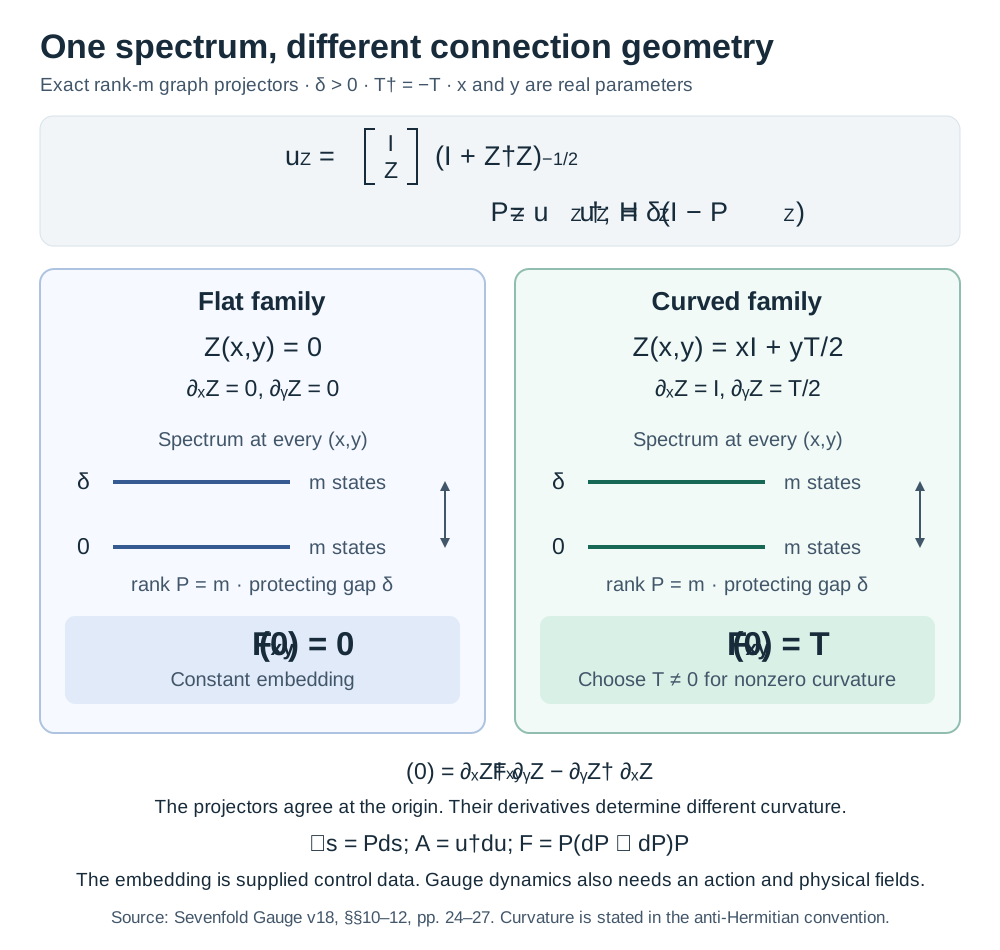
Choose any smooth complex m×m matrix Z and form an orthonormal graph frame in C2m:
The retained band has energy zero and its complement has energy δ at every point. All eigenvalues and the protecting gap remain fixed while Z changes. At an origin where Z=0, differentiation of the frame gives F(0)=dZ†∧dZ. Taking Z(x,y)=xI+yB with B†=−B therefore gives Fxy(0)=2B.
For any prescribed anti-Hermitian curvature matrix T, set B=T/2. This realizes T exactly at the origin. For rank-three and rank-two blocks with Tr T3+Tr T2=0, the determinant correction preserves the prescribed origin curvature. All twelve Lie-algebra directions of the reduced group can be reached in this explicitly permitted embedding class.
The construction proves an existence and accessibility statement. It does not show that the bare finite clock supplies these extra embedding directions or that arbitrary global connection fields arise from them.
Source: Sevenfold Gauge, Proposition 11.1 and Theorem 12.2, pp. 25–27.
The bare source can still be flat
The clock's quaternionic source has a natural real three-dimensional frame. Varying that frame by SO(3), while identifying the fixed line and the cosine/sine copies across the chart, does not vary the full positive-frequency projector: its polar phase commutes with the simultaneous frame rotations. The triplet bundle is then flat.
The doubled cut has two real normalized defect vectors in separate orthogonal summands. Their diagonal derivative inner products vanish, and the cross terms vanish because the summands are orthogonal. Extending their scalars through the selected complex phase leaves a flat doublet connection.
Curved graph embeddings thus add real control data. The source-preserving construction allows independent complex-linear embeddings into larger completion spaces and permits their derivatives to span the needed matrix directions. These assumptions are transparent and testable, but stronger than choosing another oriented quaternionic frame. A gauge algebra's dimension is not by itself a controllability proof.
Source: Sevenfold Gauge, Proposition 12.1 and assumptions A1–A4, pp. 26–27.
Geometric transport, physical evolution and filters
The connection exists whenever the projection is smooth. Adiabatic evolution additionally requires that parameter changes are slow relative to appropriate gap and derivative scales. Within a nondegenerate cluster, evolution also accumulates internal dynamical phases. Measuring the geometry of the whole cluster may require a degenerate band, an explicit echo or a separate comparison protocol.
For a fixed P and varying frame, A may be nonzero but is pure gauge; F vanishes. Conversely a varying projector can have nonzero curvature even though every spectral eigenvalue is unchanged. The eigenvalue list and band geometry encode different information.
A smooth spectral filter χ(H) is also different from an orthogonal projector. Even when it commutes with P, the expression χ(H)Pχ(H) equals χ(H)²P and generally fails to square to itself. A protected bundle requires a genuine constant-rank projection, such as a Riesz projection. Smooth filters are useful for weighting modes, but their weighted ranges should not silently be treated as new spectral subbundles.
Source: Sevenfold Gauge, §11.2, p. 26; compare noncommutative geometry §10.6.
Which band is physical?
A retained matter carrier can make its parallel transport observable through interference or covariant couplings. A completion sector introduced only as a removable regulator has a different obligation: its connection must leave no unintended finite-energy gauge response. Rank one does not solve that problem, because a line bundle can have Abelian curvature or nontrivial flat holonomy.
A valid elimination argument must show that the residual band geometry is unobservable, belongs to already declared physical data, or decouples with controlled responses. It must also preserve the intended local observables and physical constraints. These questions connect bundle geometry to the protected-band and Feshbach analyses elsewhere in this guide.
Finally, even an observable Berry connection is not automatically an autonomous field. To describe gauge radiation or interacting Yang–Mills dynamics, the connection needs physical degrees of freedom, a kinetic term, a state space and a quantum or classical evolution law. A finite inner protecting gap supplies none of the uniform continuum estimates required for a four-dimensional mass gap.
Source: Sevenfold Gauge, §19.1–19.2, p. 45.
Continue reading
- Geometric phase and projection loss
- Protected bands and auxiliary geometry
- Gauge group reconstruction
- Projection and geometric phase explorer
- An exact projector with variable curvature and a fixed spectrum
- Kato transport, projection sequences and physical evolution
- Projector curvature with an unchanged spectrum
Sources for this guide
- Sevenfold reconstruction, v18
- Emergent spectral gauge structure, v7
- Complex-time spectral geometry, v5
- Orientation programme, Paper VIII
Source manuscripts, version notes, and standard references are listed in the reference library.