From record refinement to a joint clock–band relation
Introduce the conditional relation connecting geometry, clock response, and matter transport. Explain why the interfaces and coefficients must be independently calibrated.
01A joint law needs independently defined measurements
A relation between dimension, clock rate, and matter transport is explanatory only if each quantity is measured independently. Defining a clock reading to equal a dimension would make their equality automatic. The draft instead supplies an interface in which child counts, scale comparisons, phase activities, and material bands have separate operational definitions.
The result is conditional on that interface. It is a realization of a desired relation within ordinary quantum mechanics, not a proof that source unity alone forces the relation.
02Record refinement gives a dimension
Let each parent record have B distinguishable children and let its measured scale shrink by q⁻¹. At depth n, the count is N_n=B^n and the scale is ℓ_n=Lq^(−n). The associated infinite address space has record dimension Drec=log B/log q under its stated ultrametric.
The covering argument is direct: level-n cylinders have diameter proportional to ℓ_n and equal measure B^(−n)=(ℓ_n/L)^Drec. This gives matching scaling bounds. The result is a dimension of the declared record geometry, not automatically the dimension of a propagation manifold or of a finite set.
N_n=B^n; ℓ_n=Lq^(−n)
Drec=log B/log q
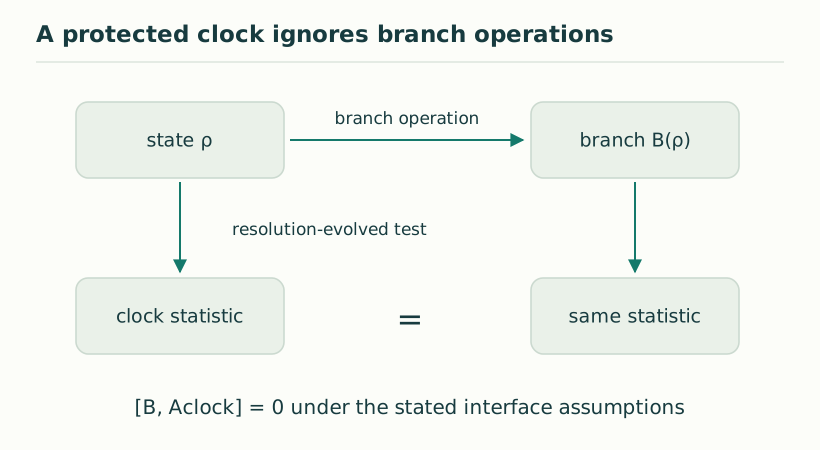
Figure 1. A protected clock ignores branch operations. In the stated stationary finite-dimensional model, branch invisibility is equivalent to the branch generator commuting with the resolution-evolved clock observable algebra. It is a criterion to verify, not an automatic law for every clock. View full size ↗
The source has Q=log z and a phase encoder satisfying Δθ=ηΔQ. An independently validated capacity contact ends at displacement ratio B, while a separate scale comparison ends at ratio q. With one common phase-to-time calibration a*, their readouts are u=a*log B and τ=a*log q.
Their ratio equals Drec because the same encoder and conversion apply to two independently checked endpoints. The capacity and constant-area laws are supplied constitutive interfaces. Conservation of phase difference alone does not prove those endpoint laws or deterministic quantum passage.
u=a*log B; τ=a*log q
u/τ=Drec
04Add a protected material clock and a matter band
Suppose a protected logical clock reads Tℓ=τ and a separate matter factor evolves during branch activity as exp(−iuHm/ℏ). At fixed refinement setting, rewriting the completed matter evolution against the clock gives exp(−iTℓDrecHm/ℏ).
A band coefficient vg defined with respect to u is therefore converted to Drec vg with respect to the protected reading. This is a statement about the specified band and clock. A sharp causal cone, a group velocity, and a general finite-range bound are not automatically the same coefficient.
Umatter=e^(−iuHm/ℏ)=e^(−iTℓDrecHm/ℏ)
vclock=Drec vg
05A family of refinement settings
For q=2 and B=4,6,8, the dimensions are 2, log₂6, and 3. If the same source calibration, protected-clock coupling, and matter Hamiltonian are maintained, the converted band coefficient follows those three factors. Each setting changes a measured record count while preserving the apparatus dictionary.
The comparison becomes meaningful only if vg and the clock response are calibrated independently rather than refitted for each B. Finite contact widths, phase uncertainty, acceptance conditioning, and band truncation contribute errors that should be propagated into the joint relation.
06The ungated-clock alternative exposes the premise
An allowed ungated material clock reads TA=u+τ. Against that clock the same matter evolution has conversion u/TA=Drec/(Drec+1). The record geometry and phase–dilation relation have not changed.
Thus the joint coefficient Drec vg needs the protected-clock premise. The construction demonstrates compatibility of geometry, activity, clock selection, and matter transport, but does not prove universal selection of that clock class. The countermodel identifies the exact physical freedom a stronger theory must remove.
07The SMM/DTT significance
The six nested inner dependencies can organize the refinement and work schedule, while the seventh interface exposes completed records. A joint observable relation would connect that architecture to the clocks and matter made from its outputs. This is a sharper target than simply drawing six levels and three axes.
The next advance would derive the capacity law, scale law, clock coupling, and matter response from a selected source interaction with fewer independent interfaces. Until then, the conditional relation is useful because its premises are independently measurable and its alternatives are explicit. It supplies a concrete experimental and mathematical compatibility test for the common-source ambition.
KEEP THE CONNECTION
Key ideas
Record dimension and phase activities have independent definitions before their ratio is compared.
The Drec band factor additionally requires a protected resolution-only clock.
An ungated clock gives a different conversion on the same record geometry.
Scope of the argument. Conditional joint relation with supplied mechanical, clock, and matter interfaces; not a universal Lorentz-cone derivation.
Sources & further reading
quantum_relativity_temporal_generation_v10.pdfWorking draft, pp. 3–5, 9–11, 20–23
operational_clock_selection_focused.pdfWorking draft, pp. 3–10
Source editions and catalogue entries
Working manuscript
Quantum relativity and temporal generation — working draft v10
Working manuscript. Article-level references identify the consulted sections and the scope of the interpretation. No public URL was supplied for this exact manuscript version.