Emergent spatial dimensions: SMM/DTT and Causal dynamical triangulations
What selects three independently measurable spatial directions, and what additional structure makes those directions into a world containing neighborhoods, distances and matter? This article compares the source-based construction with Causal dynamical triangulations, identifies their strongest point of contact, and works through a concrete example that separates a valid mathematical result from the further physical relation needed to explain observations.
A dimension can count independent coordinates, the growth of accessible states, or the response of a diffusion probe. Those counts agree for ordinary smooth Euclidean space, but they need not agree for a discrete network or a scale-dependent geometry. A three-component observable therefore establishes less than a three-dimensional physical space: the latter also requires points or records, overlap relations, a metric, and a controlled regime in which nearby records behave continuously.
This distinction makes dimensional emergence a precise question. If the source produces records with labels in a three-dimensional vector space, their actual arrangement might still be a line, a disconnected set, or a dense cloud with nonlocal transport. The physical dimension concerns how those records can be compared and traversed. A convincing construction ties the algebraic number of directions to volume growth and propagation using the same dynamics. [1][2]
02The SMM/DTT contribution
SMM starts from one nonspatial generative source. In the DTT reading, six nested inner functional levels prepare the distinctions that become available in the seventh, outer completion role. These are levels of one generative organization; counting them as six additional time coordinates would change the proposal. Its constructive ambition is to explain why an observed spatial relation is a completed relation among generated records.
A quaternionic carrier offers a concrete partial result: the purely imaginary quaternions form a real three-dimensional space. With a suitable positive quadratic readout they support rotationally organized directions. That is a useful algebraic selection mechanism. It does not by itself select a continuum of positions, prove Euclidean distance, or establish Lorentzian spacetime. Those further questions are where comparison with a quantum-gravity model becomes productive.
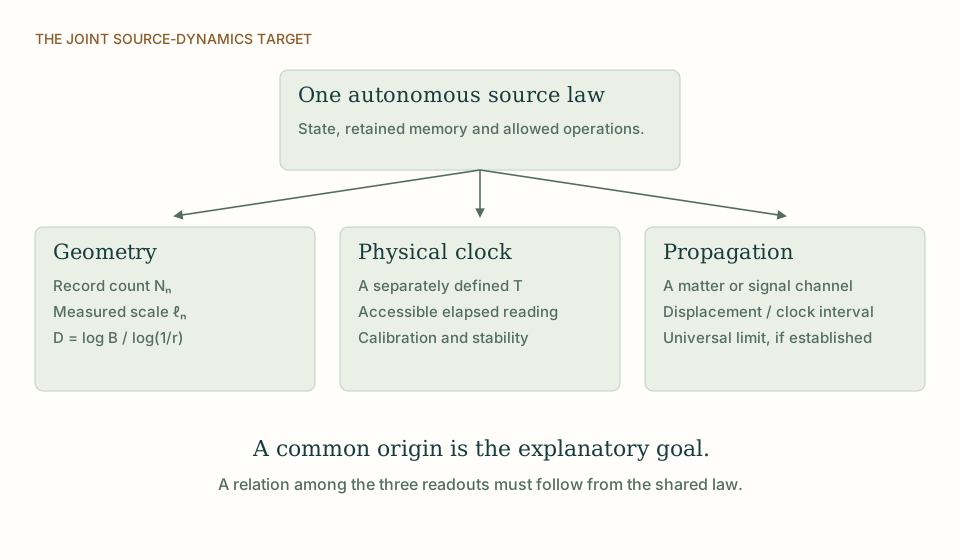
Geometry, clocks and propagation as independent readouts. A single source model should explain the relation between separately defined measurements. Sharing a diagram does not impose that relation. View full size ↗
03How Causal dynamical triangulations frames the problem
Causal dynamical triangulations defines a sum over discretized geometries with a specified causal organization and action. Macroscopic behavior is studied through ensembles and scaling, rather than by treating one fixed triangulation as the final spacetime. Diffusion-based dimension is one useful probe of the generated ensemble. Its numerical behavior is a result inside the model.
The comparison with DTT concerns how a regulated construction produces an extended geometry with stable large-scale observables. A nested inner process is not a triangulation time coordinate, and a computational update used to sample an ensemble is not an observer's clock. Distinguishing these roles is essential when interpreting emergent temporal and spatial behavior. [1]
04Where the mechanisms agree and differ
CDT evaluates geometry through an ensemble rather than a single hand-picked lattice. Its spectral dimension is extracted from diffusion on the sampled configurations, so dimensional behavior can vary with scale even when the construction uses a fixed simplex dimension. This is directly relevant to DTT's distinction between a generative mechanism and the dimension measured by an observer. It shows why microscopic labels and observed dimension need not coincide.
A DTT model could supply a family of generated record networks and apply the same return-probability probe. The comparison would then concern actual curves and their scaling windows. However, a diffusion-time variable is a parameter of the probe, not automatically inner physical time or outer clock duration. If the source changes waiting-time statistics, the measured spectral dimension can change without changing geometric neighborhood dimension. That is an informative mechanism, but it must be identified as such. The strongest temporal contribution would separate changes in connectivity from changes in clock response and derive both from the source. This would make an apparent dimensional flow diagnostically useful rather than treating every route to the number three as equivalent. [1]
05Worked example: assumptions, calculation and result
Consider a self-similar construction replacing each cell by B smaller cells with linear scale r, where 0<r<1. After n steps, Nₙ=Bⁿ and ℓₙ=Lrⁿ. Solving Nₙ=(L/ℓₙ)ᴰ gives D=ln(B)/ln(1/r). With B=8 and r=1/2, D=3; with the same eight branches and r=1/4, D=3/2. The branch count alone therefore does not fix dimension.
This is a similarity-dimension calculation under nonoverlap and uniform-scaling assumptions. It becomes a Hausdorff-dimension statement only with the appropriate separation hypotheses. It says nothing automatic about physical clock rates: an oscillator attached to either construction can have an independently specified period. A DTT geometry–clock relation requires a further dynamical identification that ties the oscillator response to the actual branching and contraction process. [1][2]
Nₙ=Bⁿ; ℓₙ=Lrⁿ; D=ln B / ln(1/r). For (B,r)=(8,1/2), D=3.
B and r are dimensionless; L and ℓₙ are lengths. This is a worked mathematical model, not an inferred measurement of inner time.
06An independent operational check
An operational illustration uses two samples with the same local three-component readout. In the first, records fill a cubic neighborhood; in the second, they lie only on a curve through that neighborhood. Both records can rotate in three dimensions, but the number of accessible neighbors grows differently with radius. This is why a carrier theorem and a spatial-dimension theorem are complementary. A temporal source becomes more explanatory when it fixes the placement and accessibility of records as well as their local value space. The geometry is then a relation among many completions, not a property inferred from the coordinates of one record.
07What follows from the comparison
The positive lesson is a division of mathematical labor. Algebra can select the available direction types; record growth can supply dimension; transport can supply a causal cone. Their agreement becomes a real result when they follow from one update law without separately fixing the answer in each definition. Diffusion, volume growth and clock readout then serve as independent checks, so failure of one check locates the missing mechanism rather than invalidating every part of the programme.
THE SAME QUESTION, DIFFERENT STARTING POINTS
The comparison at a glance
Question
SMM/DTT
Causal dynamical triangulations
Starting physical structure
One nonspatial source; six nested inner functional levels produce records accessible through outer completion.
An ensemble of causally organized piecewise-flat geometries.
The central mechanism in this topic
Record geometry and clock response can affect dimension probes separately.
An ensemble of triangulations produces measured diffusion scaling inside the model.
How the claim is made operational
A source-to-record map must define geometry, material response and physical clocks with shared inputs.
Path-sum weights, numerical observables and refinement toward a continuum regime.
Meaning of agreement
Agreement is a compatibility result; a source-selected relation or fixed residual would add explanatory content.
The stated framework provides a benchmark within its own assumptions and established domain.
KEEP THE CONNECTION
Key ideas
Comparing several dimension probes can distinguish geometric emergence from a change of effective clock.
The worked example establishes only the result stated under its explicit assumptions.
Six nested inner levels describe one generative organization; outer time orders accessible completion.
Develops the source construction or operational distinction used in this comparison.
Sources and further reading
References support the comparator and the specific mathematical or interpretive claims indicated. SMM/DTT connections are developed in the analysis above.