Equivalence principle and clocks: SMM/DTT and Loop quantum gravity
Why should different material clocks and freely falling bodies respond to the same geometry if their microscopic production is different? This article compares the source-based construction with Loop quantum gravity, identifies their strongest point of contact, and works through a concrete example that separates a valid mathematical result from the further physical relation needed to explain observations.
The equivalence principle groups several operational claims that are easy to conflate. Universality of free fall compares accelerations of different test bodies. Local position invariance compares nongravitational experiments performed at different gravitational potentials. Local Lorentz invariance compares equivalent experiments with different inertial motions. A clock model that reproduces one gravitational redshift does not automatically prove all three.
For a static weak field, ideal clocks accumulate proper time according to the metric. Real clocks also have internal structure and environmental shifts. Distinguishing the metric contribution from composition-dependent shifts is essential. A proposed common source for matter and time would be especially informative if it forced the same coupling for atomic, optical and mechanical standards, rather than fitting a separate effective rate to each device. [1][2]
02The SMM/DTT contribution
SMM/DTT can frame this universality as a common origin of clock production and motion. The same nested generative process would determine both a completed material transition and the geometry against which that transition is compared. The seventh, outer role is the readable clock record; the six inner levels are not six separately observable clocks.
The constructive issue is protection. If the model simply assigns each species a frequency ωₛ and rescales it by a chosen function of potential, universal redshift has been assumed. A stronger model derives a common multiplicative response from a symmetry or a shared conserved source quantity, while allowing different transition energies. That would explain how clocks differ in their natural periods yet agree on elapsed proper time after calibration.
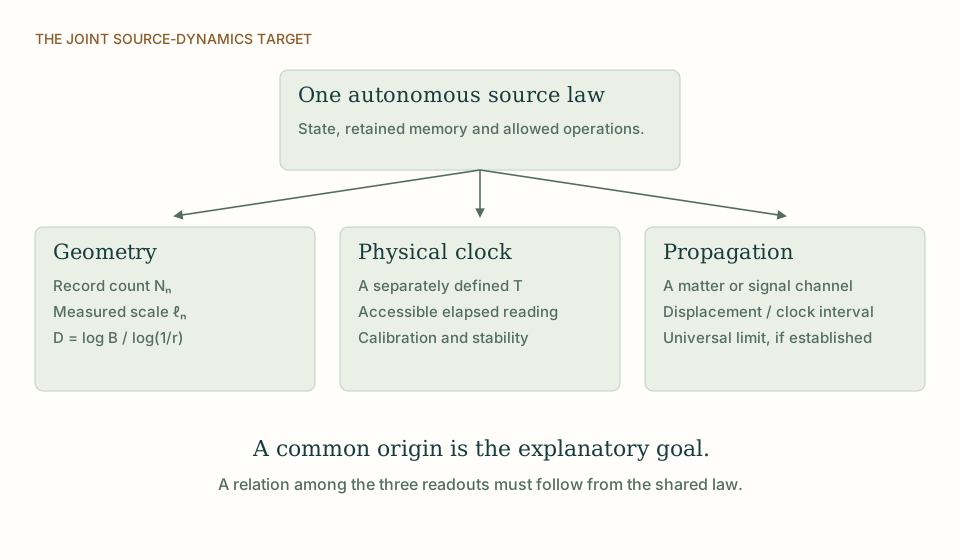
Geometry, clocks and propagation as independent readouts. A single source model should explain the relation between separately defined measurements. Sharing a diagram does not impose that relation. View full size ↗
03How Loop quantum gravity frames the problem
Loop quantum gravity quantizes geometric variables without fixing a background metric. Spin-network labels organize states, and geometric operators can have discrete spectra. Constraint dynamics and semiclassical states determine how those kinematical structures acquire physical meaning. The programme contains substantial mathematical results, but its candidate microscopic description is not experimentally established.
The useful comparison with DTT concerns the passage from algebraic carriers to physical geometry. Discrete eigenvalues alone do not determine a classical spacetime, just as a nested completion rule alone does not. The models can be compared through the construction of observables, the role of constraints and the emergence of semiclassical correlations, without equating loop labels with inner-time levels. [3][4]
04Where the mechanisms agree and differ
Loop quantum gravity raises a physical-clock question because coordinate time is not generally a gauge-invariant observable. Relational descriptions use one dynamical degree of freedom to label another. DTT also distinguishes a hidden production order from a readable clock record, so the frameworks can meet at the construction of observables rather than at an extra-time interpretation.
A chosen scalar clock in a reduced loop model need not coincide with an actual atomic transition or have universal redshift properties. Similarly, a DTT completion counter becomes a physical clock only after its interaction with matter is defined. The useful bridge is to compare how different clock choices describe the same observable process and whether their transformations preserve predictions. A temporal model could add an autonomous production law that selects a robust material clock without choosing it externally. However, quantum geometric discreteness does not by itself derive the equivalence principle, and neither does a six-level source hierarchy. The weak-field example below provides a common numerical benchmark. Reproducing its universal factor across distinct material probes is a stronger result than recovering it for a single convenient internal variable. [3][4]
05Worked example: assumptions, calculation and result
Take two identical stationary clocks separated vertically by h=1 m in a weak approximately uniform field g=9.81 m s⁻². To first order, the fractional frequency difference is gh/c². Using c≈3.00×10⁸ m s⁻¹ gives 1.09×10⁻¹⁶. Over one day this corresponds to about 9.4 picoseconds of differential elapsed time; the higher clock runs faster in this convention.
An illustrative nonuniversal model replaces the factor by (1+βₛ)gh/c² for clock species s. Comparing two species isolates (βₐ−βᵦ)gh/c² rather than the shared metric term. β is a phenomenological parameter here, not a DTT prediction. The calculation shows why a common source must constrain relative couplings: a universal rescaling can be absorbed into calibration, whereas species differences have observable content. [1][2]
Δν/ν≈ΔΦ/c²≈gh/c²=1.09×10⁻¹⁶ for h=1 m.
Weak-field, stationary-clock approximation; Φ is gravitational potential in m² s⁻². βₛ would be dimensionless.
06An independent operational check
Clock calibration removes an arbitrary overall frequency, so a proposed universal change in all clocks can be physically empty unless another independent observable changes with it. A differential comparison avoids that ambiguity. If two species share the same potential response, their calibrated frequency ratio remains constant; if their sensitivities differ, the ratio varies. A source theory can therefore be assessed through relations among dimensionless readings rather than an unobservable absolute tick. This also separates a common source mechanism from a common notation: independently chosen oscillators can be named alike while still having different physical sensitivities to motion, field strength or composition.
07What follows from the comparison
The strongest bridge to experiment is thus differential. A temporal model predicts something new when it fixes which differences between clocks survive calibration and how they depend on potential, motion or internal state. If all calibrated clocks reproduce metric proper time exactly, the model can still provide a microscopic explanation, but it has not thereby supplied a new redshift anomaly. MICROSCOPE and clock comparisons test different parts of this structure and cannot be interchanged.
THE SAME QUESTION, DIFFERENT STARTING POINTS
The comparison at a glance
Question
SMM/DTT
Loop quantum gravity
Starting physical structure
One nonspatial source; six nested inner functional levels produce records accessible through outer completion.
Quantum geometric states described through holonomies, fluxes and constraints.
The central mechanism in this topic
A completion counter must become a calibrated material clock through source dynamics.
Relational clock variables label physical observables within constrained quantum geometry.
How the claim is made operational
A source-to-record map must define geometry, material response and physical clocks with shared inputs.
Geometric operators, physical-state conditions and semiclassical reconstruction.
Meaning of agreement
Agreement is a compatibility result; a source-selected relation or fixed residual would add explanatory content.
The stated framework provides a benchmark within its own assumptions and established domain.
KEEP THE CONNECTION
Key ideas
The useful comparison concerns clock independence and universality, not the number of internal parameters.
The worked example establishes only the result stated under its explicit assumptions.
Six nested inner levels describe one generative organization; outer time orders accessible completion.
Develops the source construction or operational distinction used in this comparison.
Sources and further reading
References support the comparator and the specific mathematical or interpretive claims indicated. SMM/DTT connections are developed in the analysis above.