Einstein equations from effective dynamics: SMM/DTT and Emergent and entropic gravity
Can the large-scale response of generated records produce the Einstein field equations with the correct matter coupling and conservation law? This article compares the source-based construction with Emergent and entropic gravity, identifies their strongest point of contact, and works through a concrete example that separates a valid mathematical result from the further physical relation needed to explain observations.
Recovering the Einstein equations requires more than recognizing curvature in an effective action. The metric and matter variables must be defined, the variation must be legitimate, and the coefficient of the curvature term must have the physical meaning of Newton's constant. Additional terms can change propagation, degrees of freedom and boundary data even if the Einstein term is present.
The effective-field-theory viewpoint is useful because it separates a long-distance approximation from a claim about ultimate ontology. Many microscopic models can share the same leading action. Their differences appear in coefficients of additional operators, in the states they permit, or in nonlocal corrections. Therefore an Einstein limit would be a substantial compatibility result for DTT, but uniqueness of the temporal-source explanation would need further evidence. [1][2][3]
02The SMM/DTT contribution
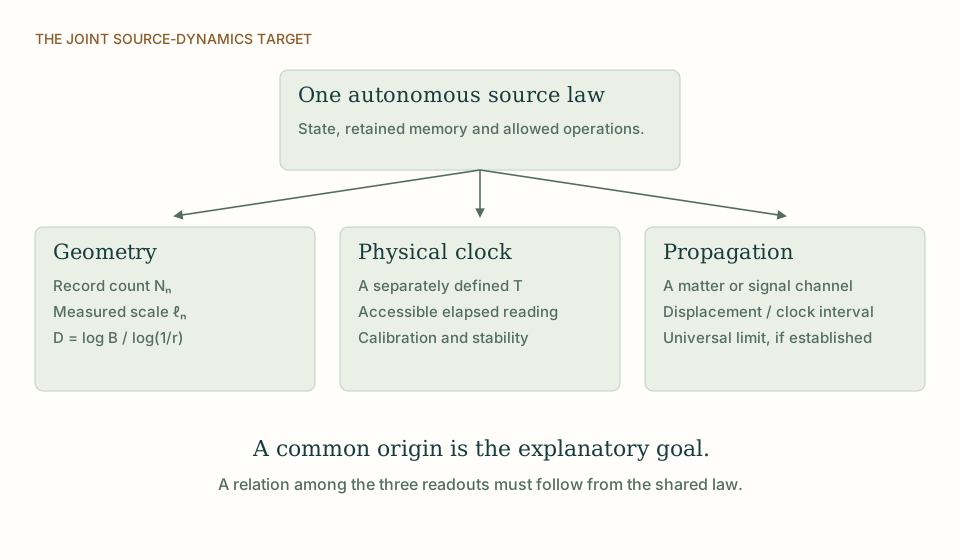
In SMM/DTT the metric is intended to summarize relations among completed records. The proposed single source should produce the material sector and the clock sector together, so their coupling is a central part of the derivation. The nested inner levels can organize how local comparisons are assembled; the outer record describes the geometry available to observers.
A spectral or thermodynamic construction offers an interface: an operator spectrum can define an action, while record-counting may motivate entropy. These routes are conditional until the operator, measure, normalization and matter map are fixed by source dynamics. Assigning an Einstein–Hilbert functional to the output is a valid model definition, but it is not yet an explanation of why the source selects that functional or its coupling constants.
Geometry, clocks and propagation as independent readouts. A single source model should explain the relation between separately defined measurements. Sharing a diagram does not impose that relation. View full size ↗
03How Emergent and entropic gravity frames the problem
Thermodynamic and entropic approaches ask whether gravitational equations describe collective information or entropy response. Jacobson's local-horizon argument and Verlinde's entropic-force proposal are distinct constructions, with different assumptions and scopes. Their common lesson is that a familiar gravitational equation can emerge conditionally from nongeometric-looking inputs.
For DTT this creates an attractive bridge from retained histories to macroscopic geometry. However, an entropy count, a temperature and an energy normalization are physical ingredients that need justification. The comparison is strongest when a temporal model explains one of those ingredients and weakest when it simply imports all of them under the name of completion. [2][4]
04Where the mechanisms agree and differ
Jacobson's derivation is a particularly close comparison because it obtains the Einstein equation as a consistency condition on local horizon thermodynamics. The argument assumes an area entropy density and the Clausius relation for all relevant local horizons. DTT could contribute by deriving the microscopic meaning and normalization of that entropy density from distinguishable completed histories.
The key distinction is between supplying an interpretation and supplying a calculation. Calling hidden source states horizon information does not fix how many physical states correspond to a given area or why their energy flux has the required temperature relation. Six nested inner levels describe functional organization, not a universal entropy coefficient. The effective-action calculation below provides a second route to the same macroscopic equation and makes the normalization problem explicit. If a source model yields both the correct entropy coefficient and the correct curvature coefficient independently, their agreement would be a strong result. If either is chosen to reproduce the other, the relation remains conditional. This comparison therefore offers a focused advance: a temporal derivation of one thermodynamic input that an established gravitational argument currently assumes. [2][4]
05Worked example: assumptions, calculation and result
Use natural units c=ħ=1 and consider S=∫d⁴x√−g[(M²/2)R−ρΛ+Lₘ]. With the usual definition Tₐᵦ=−2(δSₘ/δgᵃᵇ)/√−g and suitable boundary terms, variation gives M²Gₐᵦ+ρΛgₐᵦ=Tₐᵦ. Thus M²=1/(8πG) and Λ=ρΛ/M² reproduce the conventional Einstein equation.
The Bianchi identity ∇ᵃGₐᵦ=0 implies ∇ᵃTₐᵦ=0 when M and ρΛ are constant. If a proposed temporal rate makes M position dependent, derivatives of M enter the variation and the simple equation is no longer correct. This small calculation makes a useful diagnostic: a varying generative parameter cannot simply be inserted into a constant-coupling equation without accounting for its dynamics and energy exchange. [1][2][3]
M²Gₐᵦ+ρΛgₐᵦ=Tₐᵦ; M²=1/(8πG); Λ=ρΛ/M² (c=ħ=1).
M has mass dimension 1, R dimension 2, and ρΛ dimension 4. Appropriate boundary conditions and boundary terms are understood.
06An independent operational check
An effective field redefinition can move terms between the apparent metric and matter sectors without changing observables. This is why the presence of a preferred-looking term in one formula is not enough to identify a new physical effect. The comparison becomes robust when it uses scattering, clock ratios or curvature responses that survive such redefinitions. A source model can be genuinely restrictive by fixing these invariant combinations even if its intermediate variables differ from conventional metric variables. The explanatory claim then concerns a relation among measurements, not the cosmetic form of an action written in a particular parametrization.
07What follows from the comparison
The promising target is an effective action whose coefficients and constraints descend from the same microscopic rule as the retained record geometry. One can then ask whether extra terms are suppressed in a controlled limit, whether positive-energy states remain stable, and whether the effective stress tensor is conserved. These are concrete mathematical questions; they strengthen the proposal without requiring a premature claim of complete quantum gravity.
THE SAME QUESTION, DIFFERENT STARTING POINTS
The comparison at a glance
Question
SMM/DTT
Emergent and entropic gravity
Starting physical structure
One nonspatial source; six nested inner functional levels produce records accessible through outer completion.
Collective entropy and information variables in a specified thermodynamic construction.
The central mechanism in this topic
Source history counting could determine horizon entropy and energy normalization.
Local horizon thermodynamics yields Einstein dynamics under explicit entropy and equilibrium assumptions.
How the claim is made operational
A source-to-record map must define geometry, material response and physical clocks with shared inputs.
Entropy-response laws, energy/temperature assignments and effective gravitational relations.
Meaning of agreement
Agreement is a compatibility result; a source-selected relation or fixed residual would add explanatory content.
The stated framework provides a benchmark within its own assumptions and established domain.
KEEP THE CONNECTION
Key ideas
Deriving one independent thermodynamic input would be a substantive contribution to the emergence of gravity.
The worked example establishes only the result stated under its explicit assumptions.
Six nested inner levels describe one generative organization; outer time orders accessible completion.
Develops the source construction or operational distinction used in this comparison.
Sources and further reading
References support the comparator and the specific mathematical or interpretive claims indicated. SMM/DTT connections are developed in the analysis above.