Introduce the algebra, Hilbert space, and Dirac-type operator used by the temporal spectral model. Explain the different jobs of observables, states, and spectral data.
The spectral-triple draft translates recurrent generative operations into shifts, frequency operators and spectra, while completed records are intended to support empirical ordering and distance. This is a mathematical interface for SMM/DTT rather than a complete source dynamics. Its three paired frequency labels represent a specified inner spectral sector. They must not be confused with six independently variable temporal coordinates: the six inner stages of the conceptual programme are nested generative roles, and outer completion is their record interface. A derivation still has to show why this particular operator representation is selected and how its records become physical displacements.
02The three ingredients
A spectral triple consists of an algebra A represented by bounded operators on a Hilbert space H, together with a densely defined self-adjoint operator D. The algebra describes available observables and operations, H carries the represented states, and D supplies differential or spectral information. In a compact model the resolvent condition controls the accumulation of high frequencies; bounded commutators with a chosen smooth subalgebra provide a differential regularity condition. Writing down three named objects is not enough: domains, representation and these conditions must be checked.
(1+D²)^(−1/2) compact
[D,a] bounded for a in the chosen smooth algebra
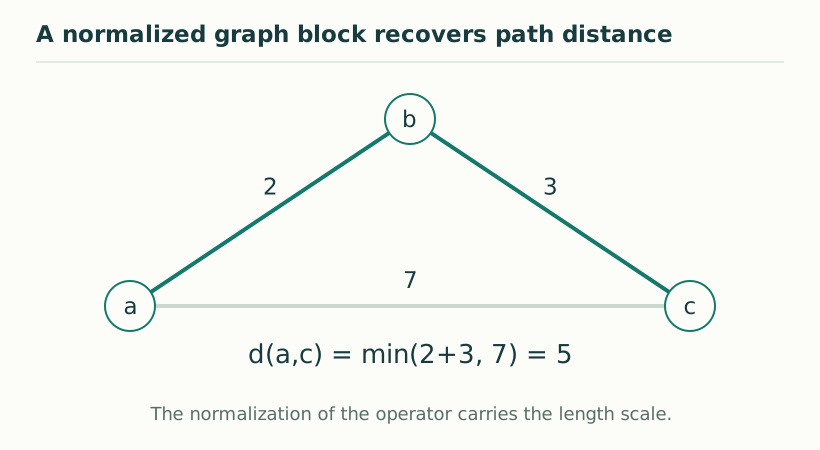
Figure 1. A normalized graph block recovers path distance. For the specified normalized spectral block, the distance equals weighted shortest-path distance. Here the illustrative route a–b–c has length 2+3 = 5, shorter than the direct edge of length 7. View full size ↗
03A temporal shift example
On ℓ²(ℤ), define N|n⟩=n|n⟩ and U|n⟩=|n+1⟩. The shift U is unitary and bounded, while N is unbounded. Their commutator is [N,U]=U. A safe smooth algebra uses finite sums f_k(N)U^k with rapidly decreasing coefficient sequences f_k. The unbounded N belongs to the generator data rather than being incorrectly treated as a bounded algebra element. In a nonunital crossed-product convention the bare shift acts in the multiplier algebra; the convention must be stated.
[N,f(N)U^k]=k f(N)U^k
04A direct calculation on one state
Apply NU and UN to |n⟩. The first gives (n+1)|n+1⟩ and the second n|n+1⟩. Their difference is U|n⟩. This elementary order sensitivity is the noncommutative seed of the construction, but it does not mean that physical positions are already noncommuting. At this stage n labels a frequency or event representation, and the source-to-space interpretation remains to be supplied. The distinction avoids silently turning an algebraic index into an observed coordinate.
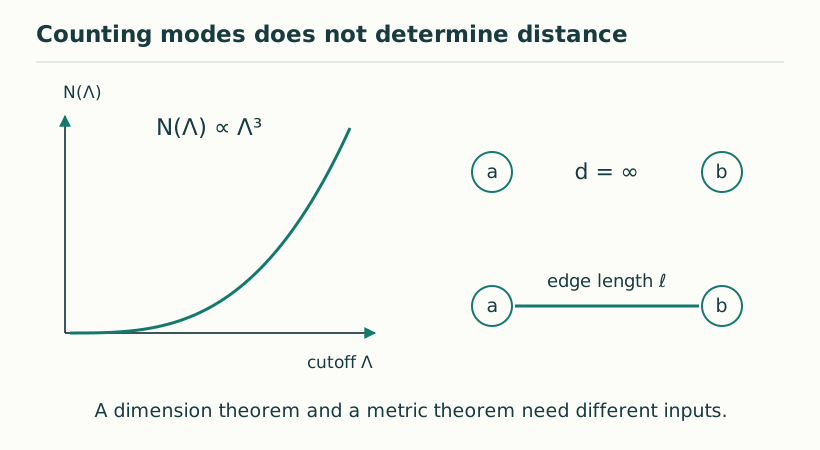
Figure 2. Counting modes does not determine distance. Spectral growth concerns how many modes lie below a cutoff. Distance concerns how observables vary under a normalized operator. The draft gives explicit examples in which the former is finite-dimensional while diagonal-state distances are infinite. View full size ↗
05Compactification and physical scope
A compact outer circle gives discrete Fourier modes and helps prove compact resolvent for an auxiliary product model. An unbounded outer time line instead calls for local compactness or a trace per unit time. These choices change which spectral exponent is being counted. They are regulators or mathematical realizations, not evidence that physical outer time is literally periodic. The SMM/DTT objective is to obtain an operator model with explicit temporal roles, then test distance and propagation independently. The spectral triple is a useful reconstruction interface precisely because it exposes those separate requirements.
06A faithful algebra representation matters
The algebra describes operations only through its represented action on H. If distinct algebra elements act identically, the representation hides distinctions that an intended physical interpretation may require. The spectral construction normally assumes faithfulness, and the chosen smooth subalgebra must remain rich enough for the commutator and state-distance questions. This is analogous to completion in SMM/DTT: two source histories can be identified only when the actual test language cannot distinguish them. An operator model should therefore explain which distinctions its representation keeps, which its completion erases, and whether later allowed operations respect that quotient. Otherwise the formal algebra can suggest more observable structure than the model actually realizes.
07Three diagnostics with different jobs
Spectral counting measures how the number of modes grows with frequency. A commutator seminorm measures which observables can vary between states while remaining Lipschitz bounded. An operational calibration connects these mathematical states and scales to actual records, distances and clocks. None of the three substitutes for the others. A compact auxiliary operator can have a clear counting exponent and nevertheless give infinite distances between selected localized states. Likewise a finite graph can have an exact distance without proving a smooth manifold limit or Lorentzian dynamics. Keeping these tests separate makes the reconstruction more informative and prevents a numerical plateau from being mistaken for complete spatial emergence.
Operator normalization is physical data once a spectral construction is used for measurement. Replacing D by aD multiplies its eigenvalues by a but divides its Connes distances by |a|. The counting exponent can remain unchanged while all calibrated lengths change. Likewise a bounded finite multiplicity changes a leading counting coefficient without changing its exponent. A proposed temporal explanation of geometry should therefore state both dimensionless structural results and dimensional calibrations. Agreement of an exponent with three is useful, but it cannot fix a ruler, a clock or their conversion by itself.
KEEP THE CONNECTION
Key ideas
The algebra contains bounded operations; unbounded generators need domains.
The shift–number commutator is explicit and reproducible.
Compact auxiliary time and physical outer time have different status.
Scope of the argument. Constructed operator model; no automatic derivation of empirical geometry, particle data or Lorentzian spacetime.
Sources & further reading
dual_temporal_spectral_triples_v3.pdf — working draftpp. 6–12, §§3–6
Source editions and catalogue entries
Working manuscript
Complex-Time Spectral Triples and the Separation of Spectral Dimension from Metric Distance
Draft file: dual_temporal_spectral_triples_v3.pdf
Working manuscript. Article-level references identify the consulted sections and the scope of the interpretation. No public URL was supplied for this exact manuscript version.