Explain how a positive-time generator can select a compatible complex structure on the dynamic sector. Make clear why zero-frequency modes need separate treatment.
The spectral-triple draft translates recurrent generative operations into shifts, frequency operators and spectra, while completed records are intended to support empirical ordering and distance. This is a mathematical interface for SMM/DTT rather than a complete source dynamics. Its three paired frequency labels represent a specified inner spectral sector. They must not be confused with six independently variable temporal coordinates: the six inner stages of the conceptual programme are nested generative roles, and outer completion is their record interface. A derivation still has to show why this particular operator representation is selected and how its records become physical displacements.
02Phase on a real Hilbert space
A real Hilbert representation does not initially contain a preferred multiplication by i. An admissible complex structure is a real-linear operator J satisfying J²=−I, J* =−J and compatibility with the represented operations. Once chosen, complex multiplication can be defined by (a+ib)x=ax+bJx. There can be many such J or none, depending on the representation. Classifying compatible choices therefore differs from physically selecting one of them.
J²=−I, J* =−J
JU(g)=U(g)J for all represented g
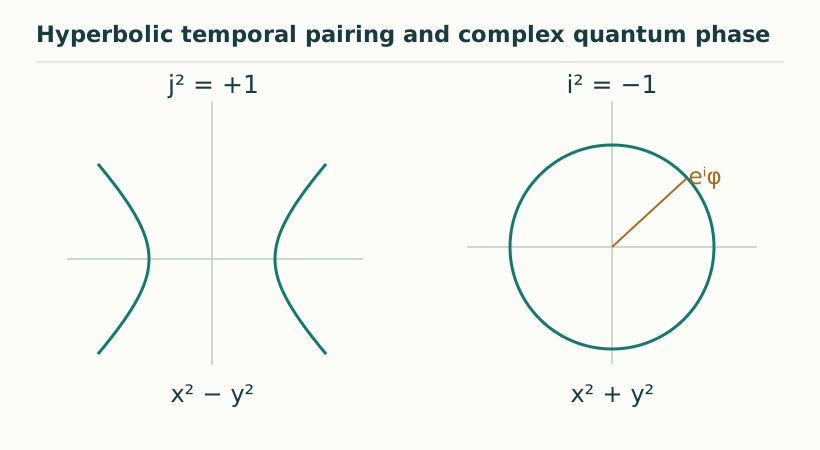
Figure 1. Hyperbolic temporal pairing and complex quantum phase. The split-complex unit j² = +1 supports a hyperbolic quadratic form. The ordinary complex unit i² = −1 supports circular phase rotations. A reconstruction must specify the bridge; the two units cannot simply be interchanged. View full size ↗
03The polar-selection argument
Let an oriented orthogonal flow have skew-adjoint generator A. On H_dyn=(ker A)⊥, write A=J_A|A| with |A|=(A*A)^(1/2). Skew-adjointness makes the polar factor an orthogonal complex structure on that support. Requiring a nonnegative magnitude fixes the factor uniquely there. If A commutes with the observable representation in the appropriate operator sense, functional calculus preserves that compatibility. If it does not, its polar phase need not be a symmetry-compatible phase unit.
A=J_A|A| on (ker A)⊥
04A rotation example with a zero mode
On a real plane take A=ωJ₀ with J₀(x,y)=(−y,x) and ω>0. Then |A|=ωI and J_A=J₀. Reversing the flow orientation gives −J₀. Now append a stationary real coordinate on which A=0. The flow supplies no phase on that coordinate; indeed an isolated one-dimensional real space cannot carry a square root of −I. This example shows why zero-frequency sectors cannot be filled in by the polar theorem without additional structure.
05Discrete recurrence introduces branch data
A one-tick orthogonal update W may be written exp(εA), but the logarithm is not globally unique. Rotations differing by full turns have the same one-tick operator. A spectral arc or frequency range must be chosen before a unique generator and its orientation can be recovered. For SMM/DTT, positive completed time can motivate an orientation, yet the actual phase selection depends on the specified source representation and dynamic sector. The theorem gives a clean conditional bridge; it does not establish that every recurrent source automatically generates ordinary quantum mechanics.
06The phase orientation is linked to the chosen time direction
Polar selection uses the sign of A. Reversing the flow sends A to −A and selects −J_A on the same dynamic support, while the positive magnitude |A| remains unchanged. Thus the theorem does not extract an absolute orientation from an unoriented recurrence set. The outer record law can provide a candidate positive direction, but its relation to the inner generator must be specified. This connects phase selection with the broader DTT completion problem: a recurrence alone is symmetric under reversal, whereas an ordered archive can distinguish accepted forward completions. A rigorous joint model should establish that compatibility explicitly.
07Three diagnostics with different jobs
Spectral counting measures how the number of modes grows with frequency. A commutator seminorm measures which observables can vary between states while remaining Lipschitz bounded. An operational calibration connects these mathematical states and scales to actual records, distances and clocks. None of the three substitutes for the others. A compact auxiliary operator can have a clear counting exponent and nevertheless give infinite distances between selected localized states. Likewise a finite graph can have an exact distance without proving a smooth manifold limit or Lorentzian dynamics. Keeping these tests separate makes the reconstruction more informative and prevents a numerical plateau from being mistaken for complete spatial emergence.
Operator normalization is physical data once a spectral construction is used for measurement. Replacing D by aD multiplies its eigenvalues by a but divides its Connes distances by |a|. The counting exponent can remain unchanged while all calibrated lengths change. Likewise a bounded finite multiplicity changes a leading counting coefficient without changing its exponent. A proposed temporal explanation of geometry should therefore state both dimensionless structural results and dimensional calibrations. Agreement of an exponent with three is useful, but it cannot fix a ruler, a clock or their conversion by itself.
KEEP THE CONNECTION
Key ideas
Polar decomposition selects a phase on nonzero-frequency dynamics.
Zero modes and logarithm branches need additional treatment.
Symmetry compatibility must be checked for the selected generator.
Scope of the argument. Conditional real-Hilbert phase selection; zero modes, orientation and discrete logarithm branches remain explicit inputs.
Sources & further reading
dual_temporal_spectral_triples_v3.pdf — working draftpp. 6–8, §4, Theorem 4.3 and Corollary 4.4
Source editions and catalogue entries
Working manuscript
Complex-Time Spectral Triples and the Separation of Spectral Dimension from Metric Distance
Draft file: dual_temporal_spectral_triples_v3.pdf
Working manuscript. Article-level references identify the consulted sections and the scope of the interpretation. No public URL was supplied for this exact manuscript version.