Gravitational waves and temporal geometry: SMM/DTT and Causal set theory
What would a temporal origin of geometry imply for the speed, polarization and phase evolution of gravitational waves? This article compares the source-based construction with Causal set theory, identifies their strongest point of contact, and works through a concrete example that separates a valid mathematical result from the further physical relation needed to explain observations.
Gravitational waves test dynamics directly: a theory must describe their production, propagation and detection through material instruments. In general relativity their weak-field vacuum limit contains two transverse tensor polarizations propagating on the metric null cone. Modified gravity can change that pattern, but a microscopic theory need not produce any observable deviation at accessible frequencies.
A temporal interpretation of curvature becomes predictive only after its effective wave operator is known. Claims of dispersion, echoes or additional polarizations require a particular mechanism and boundary conditions. A finite inner update frequency alone does not determine whether a gravitational wave is dispersive; it may disappear entirely from the long-wavelength limit or enter only through highly suppressed operators. [1][2][3]
02The SMM/DTT contribution
SMM/DTT seeks to interpret geometry as the organization of completed records. A gravitational wave could then be a propagating collective change in relational timing and distance rather than a deformation of a pre-existing substance. This can be a useful microscopic picture if the same source update also governs how mirrors, atoms and clocks respond.
The six nested inner levels should be understood as the generative organization supporting this effective response. They do not imply six gravitational-wave polarizations. Observable polarizations follow from the constraints and physical degrees of freedom of the effective field equations. A clear derivation could recover the standard two modes and then identify a restricted residual correction whose coefficient is fixed by the temporal dynamics.
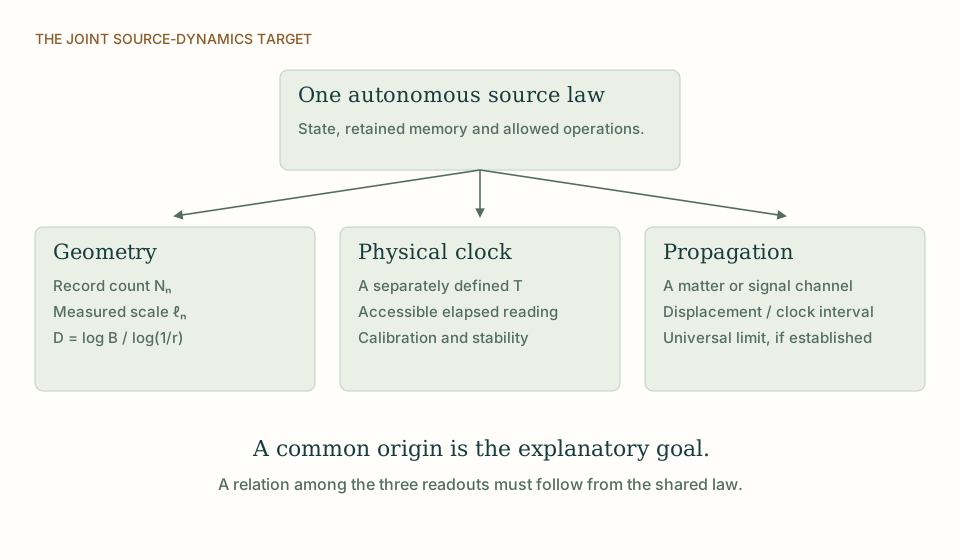
Geometry, clocks and propagation as independent readouts. A single source model should explain the relation between separately defined measurements. Sharing a diagram does not impose that relation. View full size ↗
03How Causal set theory frames the problem
Causal set theory replaces continuum spacetime by a locally finite partial order. Order represents causal precedence and counting supplies a volume measure in an appropriate continuum approximation. A stochastic embedding can preserve Lorentz symmetry statistically without introducing a fixed regular grid. The difficult dynamical question is why the resulting order should approximate a suitable manifold.
This is close to DTT in giving event structure explanatory priority over an assumed spatial stage. The important difference is that a partial order is already an explicit relational object, whereas a source ontology must explain how records and their order are generated. A total sequence of source operations and the partial order accessible to observers are not automatically identical. [4]
04Where the mechanisms agree and differ
Causal set discreteness can coexist with Lorentz-compatible continuum behavior, so it provides no automatic reason to expect gravitational waves to outrun or lag light. The relevant physics lies in the effective propagation operator and its nonlocal or scale-dependent terms. DTT faces the same question when it assigns a temporal origin to the spacetime metric.
A source-generated causal order may determine which events can influence each other, but a wave equation also needs amplitudes, polarization structure and coupling to matter. The six nested levels could organize these operations without creating extra observable times. A useful bridge would compute response functions on the generated order and compare their long-wavelength poles with the metric null cone. The arrival-time estimate below then applies to a particular difference between those poles and electromagnetic propagation, not to a generic delay in producing a record. This distinction is important because hidden generation can be sequential while accessible signals remain relativistically causal. DTT's positive contribution would be a common derivation of order, clock and wave response, making any surviving correction a constrained consequence rather than an adjustable lag. [4]
05Worked example: assumptions, calculation and result
For a simple nondispersive propagation comparison, take a source distance of 40 megaparsecs and an arrival-time difference of 1.7 s. Since 1 Mpc≈3.086×10²² m, the travel time is approximately 4.12×10¹⁵ s. Dividing gives |Δv|/c≈4.1×10⁻¹⁶ if the entire delay is attributed to propagation.
This arithmetic is only an illustrative inference. Electromagnetic and gravitational signals can leave the source at different times, and cosmological propagation requires a more careful treatment. The published GW170817 analysis incorporates astrophysical assumptions in its bounds. A DTT wave-speed claim must specify those same assumptions and cannot equate the observed arrival delay directly with an intrinsic inner-time lag. [1][2][3]
Δv/c≈Δt/(D/c). For D=40 Mpc and Δt=1.7 s, the propagation-only estimate is 4.1×10⁻¹⁶.
D is the source distance in this approximation; the sign and magnitude of an intrinsic emission lag are separate inputs.
06An independent operational check
A proposed dispersion relation can be tested internally before fitting data. Its frequency must remain real for the intended wave numbers, its energy should be bounded in the physical sector, and its group velocity should be interpreted separately from its phase velocity. A higher-derivative term may introduce an extra mode or an instability if treated beyond the effective theory's domain. The source programme is strongest when it states that domain and derives the coefficient there. These checks connect microscopic temporal structure to a viable propagating signal; they also prevent an arbitrary frequency-dependent delay from being mistaken for a complete gravitational-wave theory.
07What follows from the comparison
The strongest experimental target is a correlated signature: the same effective coefficient might affect wave phase, matter clocks or another transport probe. Agreement among these effects would be more informative than fitting a single unusual signal. Until a source-derived coefficient exists, gravitational-wave observations provide consistency requirements and a way to translate possible models into bounds, rather than existing confirmation of temporal geometry.
THE SAME QUESTION, DIFFERENT STARTING POINTS
The comparison at a glance
Question
SMM/DTT
Causal set theory
Starting physical structure
One nonspatial source; six nested inner functional levels produce records accessible through outer completion.
Locally finite causal order with element counting as an approximate volume measure.
The central mechanism in this topic
Source generation should jointly fix causal order, clock calibration and wave response.
Order-based propagation operators are tested against a local Lorentzian limit.
How the claim is made operational
A source-to-record map must define geometry, material response and physical clocks with shared inputs.
Order invariants, stochastic dynamics and continuum-approximation criteria.
Meaning of agreement
Agreement is a compatibility result; a source-selected relation or fixed residual would add explanatory content.
The stated framework provides a benchmark within its own assumptions and established domain.
KEEP THE CONNECTION
Key ideas
The measurable cone is determined by response functions, not by a raw count of generation steps.
The worked example establishes only the result stated under its explicit assumptions.
Six nested inner levels describe one generative organization; outer time orders accessible completion.
Develops the source construction or operational distinction used in this comparison.
Sources and further reading
References support the comparator and the specific mathematical or interpretive claims indicated. SMM/DTT connections are developed in the analysis above.