Quaternions and three-dimensional readout: SMM/DTT and Spin networks and spin foams
Does a quaternionic source explain spatial dimensionality, or does it supply an algebraic carrier that still needs geometric interpretation? This article compares the source-based construction with Spin networks and spin foams, identifies their strongest point of contact, and works through a concrete example that separates a valid mathematical result from the further physical relation needed to explain observations.
The quaternion algebra has one scalar direction and three imaginary directions. Unit quaternions act on its imaginary part by conjugation and implement ordinary three-dimensional rotations. This makes quaternions a natural language for a rank-three readout and for the relation between SU(2) and SO(3).
The mathematical fact does not yet say that physical space is a three-dimensional manifold. A carrier is a space of possible values; a geometry additionally relates many records, defines neighborhoods and determines distances. Nor does using quaternionic matrices require a fundamentally quaternionic quantum theory: ordinary complex Hilbert spaces can represent the same rotational structure. Keeping these questions distinct protects the genuine algebraic content of the construction. [1][2]
02The SMM/DTT contribution
SMM/DTT can use a quaternionic carrier to explain how a single generative organization produces distinguishable spatial directions. The six nested inner functional levels organize generation and comparison; the seventh role retains an outer record. This provides a possible source-to-readout story in which three directions are selected by algebraic closure rather than postulated as independent primitive axes.
The selection is conditional on the carrier assumptions. The existence of real, complex, quaternionic and other algebras means that the source axioms must explain why the quaternionic option is physically required. Once selected, an inner product and compatible transport can turn its three imaginary directions into a candidate spatial frame. A continuum of positions and a universal metric remain additional reconstruction steps.
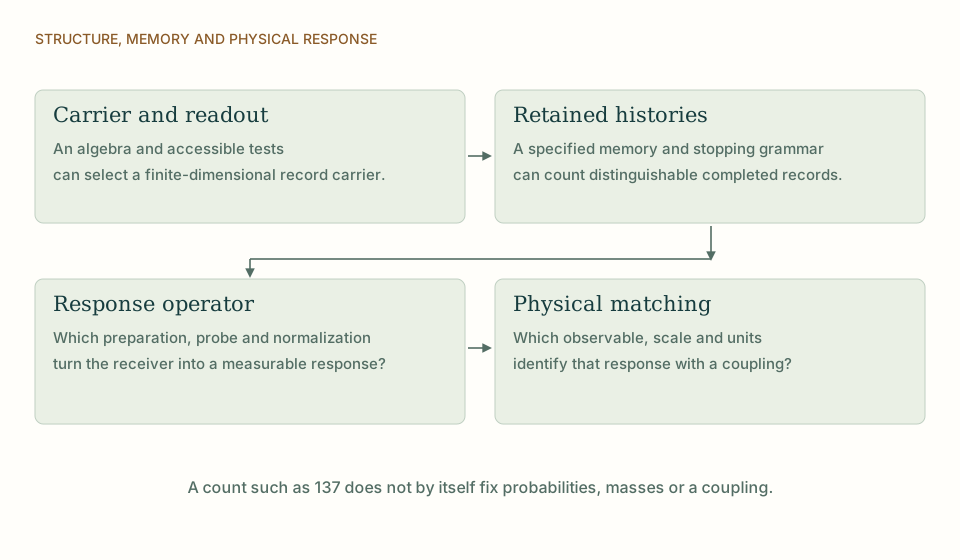
From carrier structure to a measurable response. Representation dimension, a chosen retention grammar, a response operator and physical calibration are separate stages of the constants programme. View full size ↗
03How Spin networks and spin foams frames the problem
Spin networks label quantum geometric states by representations and invariant intertwiners. Spin foams organize amplitudes for transitions between such boundary states. These structures are not automatically networks of ordinary matter particles, even when the same representation groups appear in particle physics. Constraints determine which labels encode geometric degrees of freedom.
DTT can use this comparison to clarify how local carriers are sewn into a global record. The crucial questions are which amplitudes the sewing rule assigns, which redundancies are removed, and what continuum observables emerge. A completed history resembles a boundary-to-boundary construction only after those maps have been defined; visual similarity between diagrams cannot establish equivalence. [2][3]
04Where the mechanisms agree and differ
Spin-network geometry uses SU(2) representation theory and invariant tensors, while unit quaternions realize SU(2) as an algebraic group. This gives DTT's quaternionic readout a precise mathematical connection to network-based quantum geometry. Both can express rotationally covariant local data without choosing a fixed background orientation.
The difference is that a local quaternionic vector does not specify the graph, the intertwiners or the geometry of a region. Six nested inner levels may explain how local records are produced, but their sewing into a spatial network remains a separate construction. The conjugation calculation below shows why the vector readout is blind to the sign of its quaternionic lift. A spin network retains representation information that may distinguish different lifts or coupling channels. A useful DTT completion rule would state exactly which of those distinctions survive outer observation and calculate the resulting invariant space. It could then compare geometric operators and transport between many records. This would turn a strong algebraic affinity into an observable correspondence. Without the network and metric map, the result remains rank-three carrier selection rather than a derivation of extended three-dimensional space. [2][3]
05Worked example: assumptions, calculation and result
Let q=cos(θ/2)+k sin(θ/2) be a unit quaternion, and let the readout vector be x=i. Quaternionic conjugation gives q i q⁻¹=i cosθ+j sinθ. At θ=π/2, the i direction rotates into j. The norm is preserved because conjugation by a unit quaternion preserves the quadratic norm.
Both q and −q produce the same vector rotation, since their signs cancel in qxq⁻¹. This is the double-cover relation between unit quaternions and ordinary rotations. It explains why a three-dimensional vector readout can be insensitive to a sign that remains meaningful for a spinor. It does not establish a physical lattice spacing, a volume measure or an electromagnetic coupling. [1][2]
q=cos(θ/2)+k sin(θ/2); q i q⁻¹=i cosθ+j sinθ; q and −q give the same vector rotation.
Here i,j,k are quaternion units with i²=j²=k²=ijk=−1. They are unrelated to the split-complex unit used in hyperbolic time notation.
06An independent operational check
A local frame also carries gauge freedom: rotating all three readout basis vectors together changes coordinates without changing the norm of a physical vector. To obtain curvature, the model must compare frames at different records and allow their transport around a loop to have a nontrivial mismatch. A single quaternion basis cannot do this alone. This gives the source a concrete task beyond choosing the number three: it must generate a connection among records. If that connection and the metric arise from the same completion rule, the quaternionic algebra becomes part of a geometric theory rather than merely a convenient representation of rotations.
07What follows from the comparison
A useful next bridge is to connect three independent tests: rotational carrier rank, metric reconstruction and propagation. If the same completion dynamics passes all three, the quaternionic readout becomes part of an explanation of space. If only the first is established, it should be presented as an algebraic result with a clear physical development path.
THE SAME QUESTION, DIFFERENT STARTING POINTS
The comparison at a glance
Question
SMM/DTT
Spin networks and spin foams
Starting physical structure
One nonspatial source; six nested inner functional levels produce records accessible through outer completion.
Representation-labeled graphs, invariant intertwiners and transition amplitudes.
The central mechanism in this topic
Completion selects which quaternionic carrier distinctions survive in a relational record.
SU(2) labels and intertwiners organize many local pieces of quantum geometry.
How the claim is made operational
A source-to-record map must define geometry, material response and physical clocks with shared inputs.
Gauge-invariant sewing, constraint implementation and semiclassical geometric amplitudes.
Meaning of agreement
Agreement is a compatibility result; a source-selected relation or fixed residual would add explanatory content.
The stated framework provides a benchmark within its own assumptions and established domain.
KEEP THE CONNECTION
Key ideas
The bridge is invariant sewing and geometric observables, not the rank of one local carrier alone.
The worked example establishes only the result stated under its explicit assumptions.
Six nested inner levels describe one generative organization; outer time orders accessible completion.
Develops the source construction or operational distinction used in this comparison.
Sources and further reading
References support the comparator and the specific mathematical or interpretive claims indicated. SMM/DTT connections are developed in the analysis above.