Three-dimensional differences between equal-trace records
Show how equal-trace record differences form a three-dimensional sector in this construction. Explain the additional interpretation needed to call that sector physical spatial displacement.
The complexification manuscript starts with source histories and a selected ordinary complex structure, then asks what remains after a specified completion protocol. Packets are represented in a two-dimensional complex carrier. The retained tests are quadratic in each packet, add responses from separate writes and do not retain their relative phases. Complete tests then identify a history with a positive Hermitian two-by-two matrix. This is a precise operational quotient of supplied histories. It is not a claim that every physical detector follows this protocol, or that source unity alone forces the carrier, tests and retention rule.
02Separate trace from directional difference
Write any Hermitian two-by-two matrix as X=tI+A, where t=tr X/2 and A is traceless. The diagonal traceless component is one real number, and the off-diagonal entry supplies two more, so the traceless sector has real dimension three. For equal-trace records X and Y, their difference lies entirely in this sector. A natural inner product is tr(AB)/2, positive because the eigenvalues of a Hermitian matrix are real.
A=x₁σ₁+x₂σ₂+x₃σ₃
⟨A,B⟩=½tr(AB), ||A||²=x₁²+x₂²+x₃²
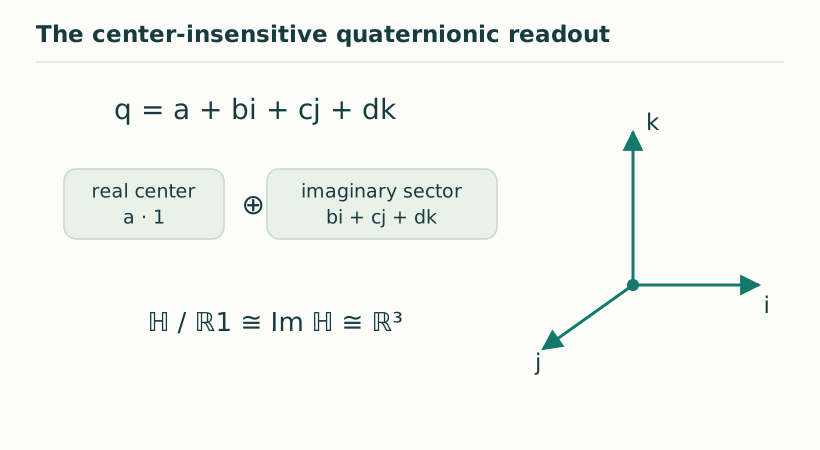
Figure 1. The center-insensitive quaternionic readout. Under the stated associative positive-norm and noncommutation hypotheses, the carrier is quaternionic. Quotienting the real center leaves the three-dimensional imaginary sector. This is a conditional readout result, not a standalone spatial dynamics. View full size ↗
03The determinant calculation
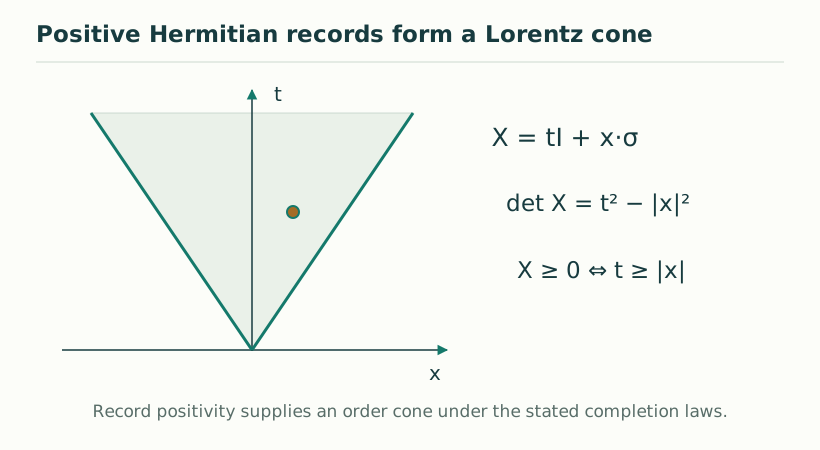
A traceless Hermitian two-by-two matrix has eigenvalues ±r, with r²=tr(A²)/2. Therefore X=tI+A has eigenvalues t±r. Their product is t²−r², and both are nonnegative exactly when t≥r. The positive-record cone is consequently a Lorentz cone in a four-dimensional difference carrier, while each equal-trace slice has a Euclidean three-dimensional metric. This signature is exact for the supplied rank-two complex record model.
det X=t²−||A||²
X≥0 ⇔ t≥||A||
04An explicit pair of records
Take X=2I+σ₁ and Y=2I−σ₁. Both have eigenvalues 3 and 1 and are positive. They share t=2, while X−Y=2σ₁ has traceless norm two. Their individual determinants are three. This example distinguishes an equal-cost spatial candidate difference from the positive order of whole records: neither difference is positive, so neither is obtained from the other by merely appending positive packets. The algebra already separates lateral comparison from future completion.
Figure 2. Positive Hermitian records form a Lorentz cone. Writing a Hermitian 2×2 record as X = tI + x·σ gives det X = t² − |x|². Positivity is equivalent to t ≥ |x|. The diagram is a two-dimensional section of the four-dimensional cone. View full size ↗
05Why internal dimension is not yet physical spatial dimension
A three-dimensional test carrier can be placed at every vertex of graphs having many different growth dimensions. Its internal algebra alone does not choose which vertices are neighbours or how far they are apart. To identify A with actual displacement, the source law must derive a map between record differences and measured transitions, with controlled distance comparisons and stable dynamics. This distinction is central to SMM/DTT’s goal of generating space: obtaining the right number of algebraic components is a promising ingredient, but physical locality and large-scale dimension require an additional, checkable reconstruction.
06Atomic records and intervals from pairs
A single nonzero packet gives a rank-one matrix zz† with zero determinant, so it lies on the null boundary of the positive cone. A sum of two nonparallel packets can have positive determinant. More generally, the determinant of the summed record is the sum of squared two-column determinants of packet pairs, by Cauchy–Binet. This makes the interval-like quantity relational: it depends on how packet directions span the carrier, not merely how much norm is present. Calling its square root a measured proper time or its determinant a mass requires extra physical identification, but the algebra provides a concrete candidate relation for a source-completion model.
07The conceptual bridge and its remaining calibration
DTT distinguishes inner recurrence from outer completion; this model makes the distinction concrete by showing which source information survives in records. The six nested inner stages describe generative organization, while outer completion is the public interface. Their interpretation does not add six independent clock coordinates to the matrix construction. To turn the derived record carrier into physical spacetime, one must additionally identify accessible events, spatial differences, clock readings and compatible future dynamics. Lorentz-cone algebra is a valuable intermediate result, but it does not by itself supply observer-equivalent apparatus, matter propagation or Einstein’s equations. The article keeps those interfaces explicit.
Exact cone reconstruction assumes arbitrary nonnegative packet weights and sufficiently rich directional controls. With only finitely many packet directions, the attainable unit-cost section is their convex hull, generally a polyhedron rather than a round ball. For example six axial directions give an octahedron, whose diagonal reach differs from its axial reach. Thus the quaternionic or complex carrier alone does not guarantee isotropic attainable geometry. A physically complete completion apparatus must explain its directional resolution, allowed amplitudes and refinement law, in addition to the algebraic dimension of its possible records.
KEEP THE CONNECTION
Key ideas
Equal-trace Hermitian differences have exactly three real components.
The determinant gives a Lorentz cone for positive completion.
Algebraic rank three is not by itself a proof of three-dimensional physical locality.
Scope of the argument. Exact record-space dimension and signature; empirical spatial identification remains conditional.
Sources & further reading
complexification_from_temporal_completion_v9.pdf — working draftpp. 13–16, Theorem 5.2; temporal_locality_v8(1).pdf pp. 23–24 for the internal-rank countermodel
Source editions and catalogue entries
Working manuscript
Complexification from temporal completion — working draft v9
Working manuscript. Article-level references identify the consulted sections and the scope of the interpretation. No public URL was supplied for this exact manuscript version.