Quadratic completion and phase-insensitive records
Introduce the conditions under which independent packets contribute additively to a quadratic record. Explain why invariance under packet phases is a substantive assumption about observation.
The complexification manuscript starts with source histories and a selected ordinary complex structure, then asks what remains after a specified completion protocol. Packets are represented in a two-dimensional complex carrier. The retained tests are quadratic in each packet, add responses from separate writes and do not retain their relative phases. Complete tests then identify a history with a positive Hermitian two-by-two matrix. This is a precise operational quotient of supplied histories. It is not a claim that every physical detector follows this protocol, or that source unity alone forces the carrier, tests and retention rule.
02What an outer record retains
Let a history be a finite list of packet vectors z_r in ℂ². A rank-one packet contributes z_rz_r†, which is positive and unchanged under z_r→e^(iθ_r)z_r. The specified record sums these contributions. This rule forgets the independent phase of each write while retaining its intensity and orientation in the complex carrier. It is stronger than invariance under a single common phase: it discards interference between different packet entries.
X_h=Σ_r z_rz_r†
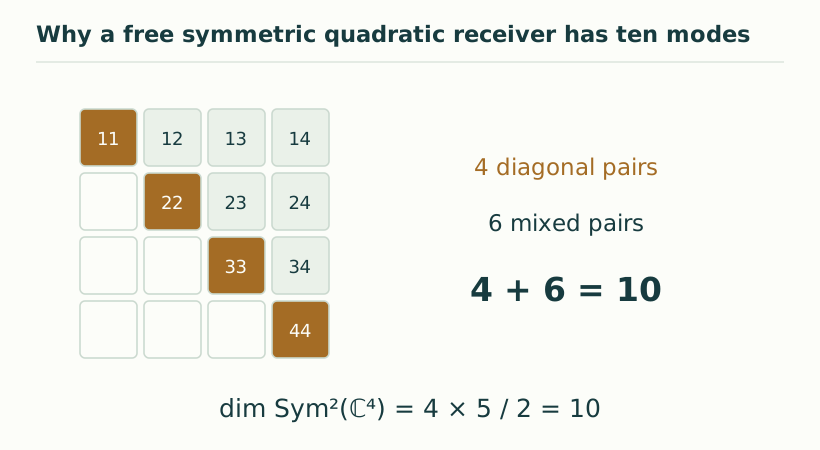
Figure 1. Why a free symmetric quadratic receiver has ten modes. A four-dimensional complex input has 4 diagonal quadratic modes and 6 unordered off-diagonal modes. Thus dim Sym²(ℂ⁴) = 4(4+1)/2 = 10. Selecting this receiver remains a model assumption. View full size ↗
03Why additivity must be stated
A coherent detector could instead combine amplitudes first and form (Σ_rz_r)(Σ_sz_s)†. That expression contains cross terms z_rz_s†. The additive completion rule excludes those terms by hypothesis. Phase-insensitive retention, independently completed writes or averaging over uncontrolled relative phases can motivate the rule, but each is a physical mechanism requiring specification. Neither a single source nor repeated recurrence alone proves that every record is incoherent in this sense.
04The simplest interference comparison
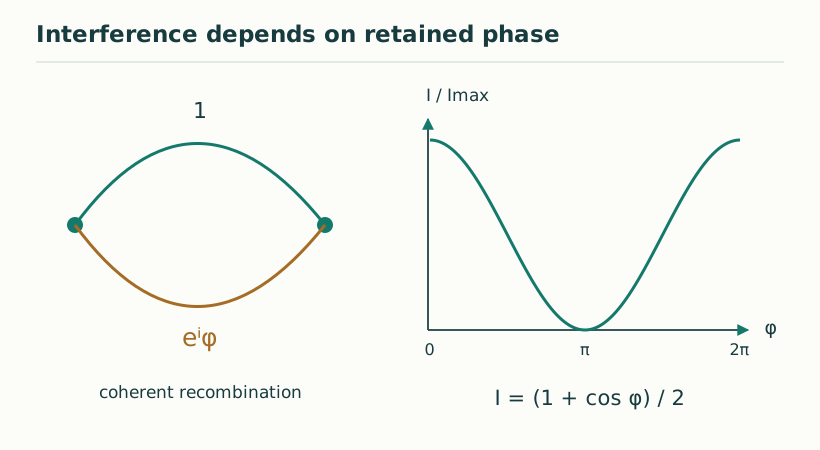
Take two identical packets z and z. Additive completion yields 2zz†. Coherent addition gives 4zz†. Replace the second packet by −z: additive completion is still 2zz†, whereas coherent addition is zero. These outcomes distinguish two different apparatus or retention protocols. An article about completion should not present their difference as an algebraic contradiction; it is a direct statement that different information survives. A later continuation sensitive to erased relative phase would invalidate the proposed completed state as a sufficient predictor.
Figure 2. Interference depends on retained phase. The ideal two-path law I(φ) = |1 + eⁱφ|²/4 = (1 + cos φ)/2 is an illustrative quantum baseline. A temporal interpretation must specify which histories retain coherence and how the phase is controlled. View full size ↗
05How the quotient is derived
For each available Hermitian effect E, the test response is tr(EX_h). If the effects span the Hermitian space, equality of all responses implies equality of X_h. Appending the same packet list to two histories adds the same matrix to both, so equality remains stable under that declared future operation. Hence the positive matrix is an exact sufficient record for this test language. The phrase “for this test language” matters: source-dependent future preparation, coherent recombination or nonlinear tests can require a larger state. This is the precise SMM/DTT bridge from hidden history to publicly retained completion.
06Identical writes explain a precise part of additivity
When one completed packet is repeated N times with no retained inter-write phase, the record is Nzz†. Its magnitude scales linearly with the number of accepted writes. This is distinct from scaling the amplitude of one coherent packet by N, whose quadratic response scales as N². An experimental interpretation should specify whether the apparatus counts separately completed events or receives one coherent superposition. The distinction becomes important when a source cycle is subdivided into nested stages: subdivision alone does not justify treating the stages as incoherent independent records. The completion boundary must specify where phase information becomes unavailable and why.
07The conceptual bridge and its remaining calibration
DTT distinguishes inner recurrence from outer completion; this model makes the distinction concrete by showing which source information survives in records. The six nested inner stages describe generative organization, while outer completion is the public interface. Their interpretation does not add six independent clock coordinates to the matrix construction. To turn the derived record carrier into physical spacetime, one must additionally identify accessible events, spatial differences, clock readings and compatible future dynamics. Lorentz-cone algebra is a valuable intermediate result, but it does not by itself supply observer-equivalent apparatus, matter propagation or Einstein’s equations. The article keeps those interfaces explicit.
Exact cone reconstruction assumes arbitrary nonnegative packet weights and sufficiently rich directional controls. With only finitely many packet directions, the attainable unit-cost section is their convex hull, generally a polyhedron rather than a round ball. For example six axial directions give an octahedron, whose diagonal reach differs from its axial reach. Thus the quaternionic or complex carrier alone does not guarantee isotropic attainable geometry. A physically complete completion apparatus must explain its directional resolution, allowed amplitudes and refinement law, in addition to the algebraic dimension of its possible records.
Working manuscript. Article-level references identify the consulted sections and the scope of the interpretation. No public URL was supplied for this exact manuscript version.