Explain why the split-complex pairing used for temporal roles differs from the ordinary complex scalar selected for phase. Avoid treating two algebraic uses of complex language as identical.
The complexification manuscript starts with source histories and a selected ordinary complex structure, then asks what remains after a specified completion protocol. Packets are represented in a two-dimensional complex carrier. The retained tests are quadratic in each packet, add responses from separate writes and do not retain their relative phases. Complete tests then identify a history with a positive Hermitian two-by-two matrix. This is a precise operational quotient of supplied histories. It is not a claim that every physical detector follows this protocol, or that source unity alone forces the carrier, tests and retention rule.
02Two algebras answer different questions
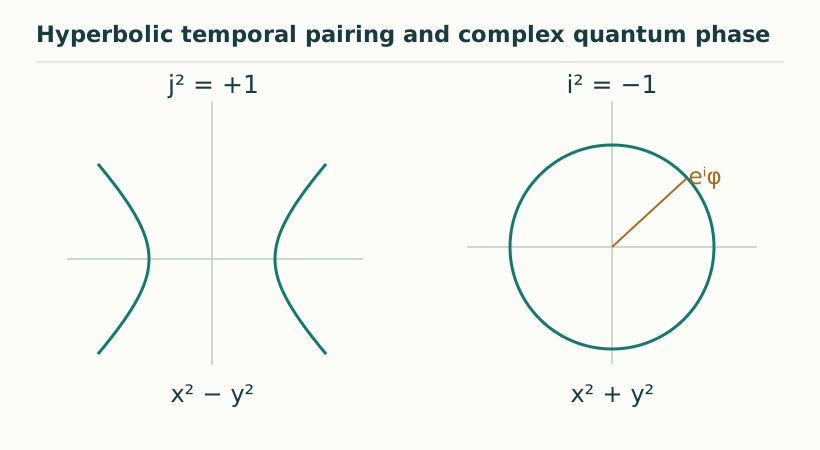
Split-complex notation uses a unit j with j²=+1. A temporal pair t_in+jt_out has a quadratic norm t_in²−t_out² and zero divisors when its components coincide up to sign. Ordinary complex phase uses i²=−1, or a real-linear operator J with J²=−I. Its exponential is recurrent: exp(θJ)=cosθ I+sinθ J. These structures cannot be identified by a change of terminology because their algebraic products and invariant quadratic forms differ.
j²=+1, (a+jb)(a−jb)=a²−b²
J²=−I, e^(θJ)=cosθ I+sinθ J
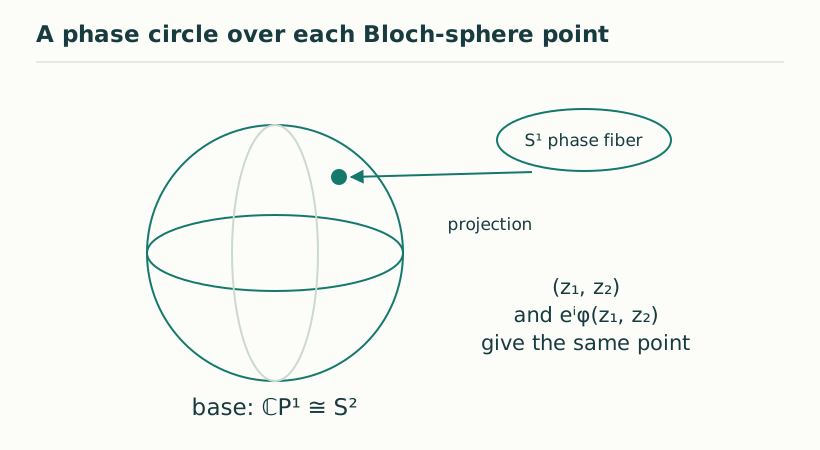
Figure 1. A phase circle over each Bloch-sphere point. For a normalized spinor (z₁,z₂), a common phase leaves the point of ℂP¹ ≅ S² unchanged. The Hopf bundle has total space S³; the drawing is a schematic of its fibers, not an embedding of S³ in ordinary three-space. View full size ↗
03How ordinary phase can be selected
On a real Hilbert carrier, compatible complex structures must commute with the represented source operations and be skew-adjoint square roots of −I. A suitably oriented skew-adjoint dynamical generator A selects its polar phase on the nonzero-frequency sector: A=J_A|A|. This uses a specified flow and orientation. Zero modes require separate treatment, and compatibility with every retained symmetry must be checked. The result supplies a recurrent phase action without assuming that the split-complex temporal unit is the quantum scalar.
04A two-dimensional example
On a real plane, J sends (x,y) to (−y,x). Applying it twice gives (−x,−y), and exp(θJ) rotates the plane. By contrast the split-complex multiplication matrix exchanging x and y squares to the identity; its exponential contains coshθ and sinhθ. A circle rotation and a hyperbolic boost are visibly different operations. A source model may contain both, but it must state which acts on recurrence and which describes the pairing of temporal roles.
Figure 2. Hyperbolic temporal pairing and complex quantum phase. The split-complex unit j² = +1 supports a hyperbolic quadratic form. The ordinary complex unit i² = −1 supports circular phase rotations. A reconstruction must specify the bridge; the two units cannot simply be interchanged. View full size ↗
05Where the Lorentzian sign actually enters this record model
After ordinary complex packets are completed, their Hermitian matrix X has determinant t²−|x|². This gives the Lorentz-cone signature through the determinant of the record, not through replacing J²=−I by j²=+1. The construction therefore distinguishes phase selection, temporal notation and spacetime-like signature. Maintaining this distinction prevents a circular derivation in which the desired metric sign is silently inserted as the quantum phase rule. It also clarifies what must be related by a future physical source law: recurrence orientation, completion cost and measured outer duration.
06A real carrier still needs a positive observational structure
Selecting J allows complex scalar notation, but it does not automatically supply quantum probabilities. The completion construction additionally uses positive quadratic responses, complete tests and additive retention. A representation with J²=−I can support many different measurement rules. Conversely, a Lorentzian determinant on records does not determine a unique Hilbert-space phase orientation. Treating these as separate steps is productive: the source dynamics selects recurrence, the test apparatus selects retained positive information, and a calibration law interprets completed geometry. A fundamental SMM/DTT result would derive compatible versions of all three from one source rule rather than equating their distinct algebraic symbols.
07The conceptual bridge and its remaining calibration
DTT distinguishes inner recurrence from outer completion; this model makes the distinction concrete by showing which source information survives in records. The six nested inner stages describe generative organization, while outer completion is the public interface. Their interpretation does not add six independent clock coordinates to the matrix construction. To turn the derived record carrier into physical spacetime, one must additionally identify accessible events, spatial differences, clock readings and compatible future dynamics. Lorentz-cone algebra is a valuable intermediate result, but it does not by itself supply observer-equivalent apparatus, matter propagation or Einstein’s equations. The article keeps those interfaces explicit.
Exact cone reconstruction assumes arbitrary nonnegative packet weights and sufficiently rich directional controls. With only finitely many packet directions, the attainable unit-cost section is their convex hull, generally a polyhedron rather than a round ball. For example six axial directions give an octahedron, whose diagonal reach differs from its axial reach. Thus the quaternionic or complex carrier alone does not guarantee isotropic attainable geometry. A physically complete completion apparatus must explain its directional resolution, allowed amplitudes and refinement law, in addition to the algebraic dimension of its possible records.
KEEP THE CONNECTION
Key ideas
Split-complex temporal pairing differs from ordinary quantum phase.
A polar generator can select phase only on its supported dynamic sector.
The record determinant supplies a separate Lorentzian quadratic form.
Scope of the argument. Algebraic distinction and conditional phase selection; neither temporal notation alone nor a selected scalar establishes physical spacetime.
Sources & further reading
complexification_from_temporal_completion_v9.pdf — working draftcomplexification_from_temporal_completion_v9.pdf pp. 12–16; dual_temporal_spectral_triples_v3.pdf pp. 5–8 for polar selection
Source editions and catalogue entries
Working manuscript
Complexification from temporal completion — working draft v9
Working manuscript. Article-level references identify the consulted sections and the scope of the interpretation. No public URL was supplied for this exact manuscript version.