Explain how complete tests identify records with positive two-by-two Hermitian matrices in the draft. Relate record positivity to admissible observations rather than a chosen spatial coordinate system.
The complexification manuscript starts with source histories and a selected ordinary complex structure, then asks what remains after a specified completion protocol. Packets are represented in a two-dimensional complex carrier. The retained tests are quadratic in each packet, add responses from separate writes and do not retain their relative phases. Complete tests then identify a history with a positive Hermitian two-by-two matrix. This is a precise operational quotient of supplied histories. It is not a claim that every physical detector follows this protocol, or that source unity alone forces the carrier, tests and retention rule.
02The positive record cone
A Hermitian two-by-two matrix has four real components. It is a valid completed record when all its eigenvalues are nonnegative. Every sum of packet outer products satisfies this condition. Conversely, the spectral decomposition of a positive matrix constructs packets realizing it: multiply each normalized eigenvector by the square root of its eigenvalue. The least number of nonzero packets needed is the matrix rank. This establishes the reachable record cone under arbitrary nonnegative packet scaling.
X=Σ_aλ_av_av_a†, λ_a≥0
z_a=√λ_av_a, minimum packet number=rank X
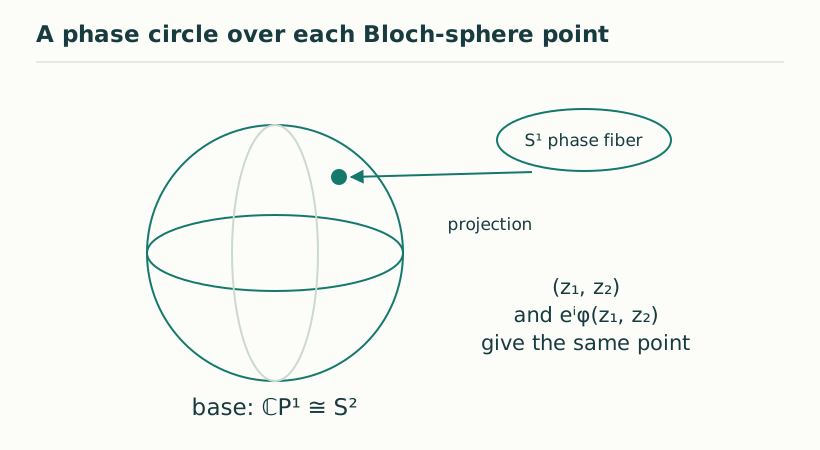
Figure 1. A phase circle over each Bloch-sphere point. For a normalized spinor (z₁,z₂), a common phase leaves the point of ℂP¹ ≅ S² unchanged. The Hopf bundle has total space S³; the drawing is a schematic of its fibers, not an embedding of S³ in ordinary three-space. View full size ↗
03Complete tests recover the record
A test effect E produces the scalar tr(EX). If the effects span the real Hermitian space, their values separate all records. Four suitably independent scalar tests suffice; fewer than four linear tests cannot distinguish every positive two-by-two matrix. Positivity does not remove this requirement because sufficiently large multiples of the identity allow small perturbations in every Hermitian direction while remaining positive. Thus completeness is a property of the apparatus family, not an automatic consequence of naming a matrix a record.
04A finite tomography example
Write X=tI+x·σ using the Pauli matrices. Choose four unit vectors n_a pointing to tetrahedral directions and effects P_a=(I+n_a·σ)/2. The responses are y_a=t+n_a·x. Their sum recovers t, and their weighted directional sum recovers x. For X=I, all four responses equal one; a directional bias produces unequal values. The tetrahedron belongs to test space and need not represent four spatially separated detectors.
t=¼Σ_ay_a, x=¾Σ_ay_an_a
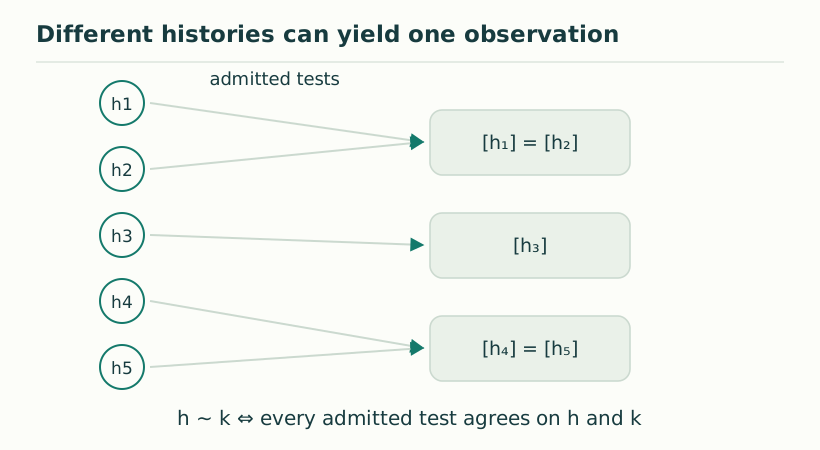
Figure 2. Different histories can yield one observation. The observational equivalence h ∼ k means that all admitted tests give the same result. Changing the test language can split an equivalence class and expose previously hidden distinctions. View full size ↗
05Completion order and physical interpretation
Appending packets adds a positive matrix. One record can therefore follow another by positive completion exactly when their difference is positive semidefinite. This order is cancellative: adding the same completed record does not merge unequal matrices. It provides the algebraic foundation of a future cone in the difference space. Calling the records events still requires a retained archive and a relational interpretation; calling their positive order causality requires matching allowed physical transitions. The SMM/DTT contribution is the explicit route from histories and tests to this ordered carrier, not the unsupported identification of every positive matrix with an actual spacetime event.
06Noise tests the quality of completeness
Four independent effects give an invertible linear reconstruction matrix, but nearly dependent effects can amplify small measurement errors. The tetrahedral arrangement is useful because its symmetry gives well-controlled coefficients; another spanning family remains complete but may be poorly conditioned. Thus exact algebraic separation and robust operational reconstruction are different requirements. In an SMM/DTT implementation one should report detector gains, the actual effect matrix and an error norm, then propagate that error to trace and directional components. Otherwise an apparently well-defined record cone may contain large uncertainty near its boundary, where positivity or causal classification can change under small perturbations.
07The conceptual bridge and its remaining calibration
DTT distinguishes inner recurrence from outer completion; this model makes the distinction concrete by showing which source information survives in records. The six nested inner stages describe generative organization, while outer completion is the public interface. Their interpretation does not add six independent clock coordinates to the matrix construction. To turn the derived record carrier into physical spacetime, one must additionally identify accessible events, spatial differences, clock readings and compatible future dynamics. Lorentz-cone algebra is a valuable intermediate result, but it does not by itself supply observer-equivalent apparatus, matter propagation or Einstein’s equations. The article keeps those interfaces explicit.
Exact cone reconstruction assumes arbitrary nonnegative packet weights and sufficiently rich directional controls. With only finitely many packet directions, the attainable unit-cost section is their convex hull, generally a polyhedron rather than a round ball. For example six axial directions give an octahedron, whose diagonal reach differs from its axial reach. Thus the quaternionic or complex carrier alone does not guarantee isotropic attainable geometry. A physically complete completion apparatus must explain its directional resolution, allowed amplitudes and refinement law, in addition to the algebraic dimension of its possible records.
KEEP THE CONNECTION
Key ideas
Positive matrices are exactly the records reachable by the supplied packets.
Four independent linear probes can separate the four real components.
Positive append order becomes a candidate future order after further physical identification.
Scope of the argument. Operational reconstruction under complete quadratic tests; physical events and causal transitions require an archive interface.
Sources & further reading
complexification_from_temporal_completion_v9.pdf — working draftpp. 12–15, Theorem 4.5 and Propositions 5.3–5.4
Source editions and catalogue entries
Working manuscript
Complexification from temporal completion — working draft v9
Working manuscript. Article-level references identify the consulted sections and the scope of the interpretation. No public URL was supplied for this exact manuscript version.