Explore the archive and sampling assumptions used to connect normalized record counts with homogeneous four-volume. Compare a Poisson benchmark with the separately specified autonomous sampler.
The complexification manuscript starts with source histories and a selected ordinary complex structure, then asks what remains after a specified completion protocol. Packets are represented in a two-dimensional complex carrier. The retained tests are quadratic in each packet, add responses from separate writes and do not retain their relative phases. Complete tests then identify a history with a positive Hermitian two-by-two matrix. This is a precise operational quotient of supplied histories. It is not a claim that every physical detector follows this protocol, or that source unity alone forces the carrier, tests and retention rule.
02An archive requires a sampling law
Recovering a four-dimensional record carrier does not determine how densely actual records populate it. The draft therefore introduces a separate archive rule. On a coordinate grid with spacing ε, count records in a region A and multiply the count by ε⁴. In the limit of fine grids, this normalized count approaches four-volume for suitably regular regions. The factor ε⁴ and the uniform grid are explicit ingredients. Without a sampling law, raw record counts can describe many different measures on the same cone.
μ_ε(A)=ε⁴ # (Λ_ε∩A)
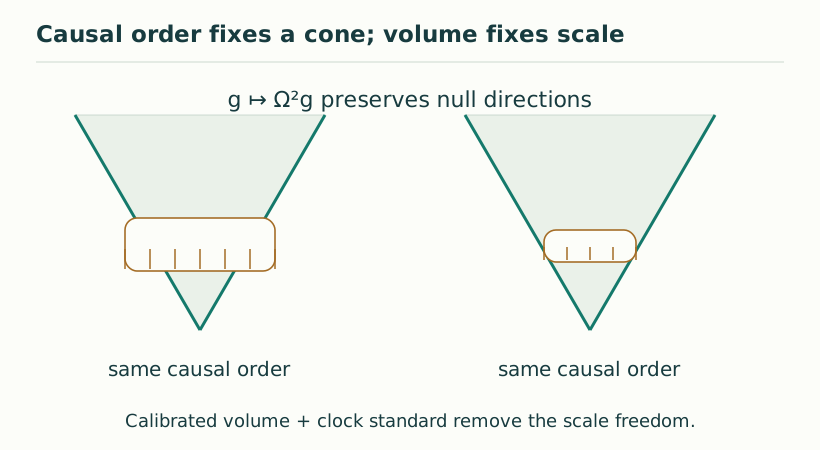
Figure 1. Causal order fixes a cone; volume fixes scale. A causal cone determines conformal geometry, while a calibrated volume law can fix the remaining scale. A physical interpretation as observer boosts requires the separate clock and detector covariance assumptions. View full size ↗
03The Riemann-sum derivation
Associate a coordinate cell of volume ε⁴ with each grid point. Interior cells account for the region up to cells intersecting its boundary. If that boundary has zero four-dimensional measure, the discrepancy vanishes as ε tends to zero. The result is a measure-reconstruction theorem under a declared grid. It does not claim that the source dynamics preferentially generates uniform archives or that every finite grid is Lorentz invariant. Continuum symmetry and finite sampling symmetry must be distinguished.
04Count a causal interval
For an interval with endpoints separated by τ in the rest-frame trace direction, its spatial cross-section at t is a ball of radius min(t,τ−t). Integrating its three-volume from zero to τ gives πτ⁴/24. A fine uniform record archive should therefore have approximately πτ⁴/(24ε⁴) entries inside it. For τ=2 and ε=0.1, the leading estimate is about 20,944 records; finite-boundary errors remain. The fourth-power scaling is a measurable diagnostic of this archive law.
V([0,τI])=(4π/3)∫₀^τ min(t,τ−t)³dt=πτ⁴/24
05Poisson and autonomous archives are different hypotheses
A Poisson archive with density λ has mean count λV and variance λV for a region of volume V. An autonomous sampler may have correlations, finite memory or a prescribed sequence, so it need not satisfy that variance law even if its mean density is uniform. Counting alone can therefore test more than dimension: correlations between disjoint regions constrain the mechanism. The SMM/DTT challenge is to derive a persistent archive and its statistics from the same source rule that creates records, rather than adding a continuum measure after the fact.
06Serial preparation does not force independent sampling
One active source can write an archive in a deterministic order, a correlated order or an order driven by fresh randomness. All can have the same average density. To claim a Poisson benchmark, the model must supply the relevant independence and count law; to claim an autonomous archive, it must specify retained seeds, memory and reset costs. A finite serial realization of a grid proves that records can be prepared, but it does not prove their spontaneous production with a Lorentz-invariant joint distribution. The source programme should therefore compare both mean volume and higher count statistics before identifying a sampling construction with physical vacuum geometry.
07The conceptual bridge and its remaining calibration
DTT distinguishes inner recurrence from outer completion; this model makes the distinction concrete by showing which source information survives in records. The six nested inner stages describe generative organization, while outer completion is the public interface. Their interpretation does not add six independent clock coordinates to the matrix construction. To turn the derived record carrier into physical spacetime, one must additionally identify accessible events, spatial differences, clock readings and compatible future dynamics. Lorentz-cone algebra is a valuable intermediate result, but it does not by itself supply observer-equivalent apparatus, matter propagation or Einstein’s equations. The article keeps those interfaces explicit.
Exact cone reconstruction assumes arbitrary nonnegative packet weights and sufficiently rich directional controls. With only finitely many packet directions, the attainable unit-cost section is their convex hull, generally a polyhedron rather than a round ball. For example six axial directions give an octahedron, whose diagonal reach differs from its axial reach. Thus the quaternionic or complex carrier alone does not guarantee isotropic attainable geometry. A physically complete completion apparatus must explain its directional resolution, allowed amplitudes and refinement law, in addition to the algebraic dimension of its possible records.
KEEP THE CONNECTION
Key ideas
Record geometry does not determine record density.
Normalized grid counts recover volume under explicit sampling assumptions.
Fluctuations distinguish Poisson and correlated autonomous archives.
Scope of the argument. Conditional measure reconstruction; archive preparation and homogeneous sampling are supplied, not consequences of the cone alone.
Sources & further reading
complexification_from_temporal_completion_v9.pdf — working draftpp. 21–25, Theorem 6.7 and archive sampling discussion
Source editions and catalogue entries
Working manuscript
Complexification from temporal completion — working draft v9
Working manuscript. Article-level references identify the consulted sections and the scope of the interpretation. No public URL was supplied for this exact manuscript version.