Planck constant and action quantization: SMM/DTT and Spin networks and spin foams
What can a generative time model explain about a universal quantum of action, and what would count as predicting Planck’s constant? This article compares the source-based construction with Spin networks and spin foams, identifies their strongest point of contact, and works through a concrete example that separates a valid mathematical result from the further physical relation needed to explain observations.
Planck's constant links action to quantum phase and energy to frequency. Its numerical SI value is fixed by the definition of the units, so a fundamental theory does not gain physical content by reproducing that number without explaining its unit conventions. Meaningful questions concern the universality of the action scale, dimensionless ratios, and why the same phase normalization governs different physical systems.
Periodic motion can quantize an action variable under suitable quantum conditions, but periodicity alone does not specify the dimensional size of the quantum. This is analogous to a musical instrument: integer harmonics determine ratios while the instrument's scale fixes their frequencies. A temporal theory must explain both the phase structure and the source of any dimensional normalization. [1][2][3]
02The SMM/DTT contribution
SMM/DTT can interpret quantum phase as coherence retained across inner production and outer completion. Its six nested inner levels give a possible organization to the preparation of a cycle, while the seventh role records its completion. A universal phase cost per completed process would be a substantial unification if it applied to all matter carriers through one source law.
A proposed least action per tick is nevertheless a physical postulate unless derived from a defined energy budget and dynamics. A statistical information bound cannot create joule-seconds from dimensionless data. It may constrain an already dimensioned action scale or its precision. The positive target is an invariance or conservation principle that prevents different species from acquiring independently adjustable quantum phase normalizations.
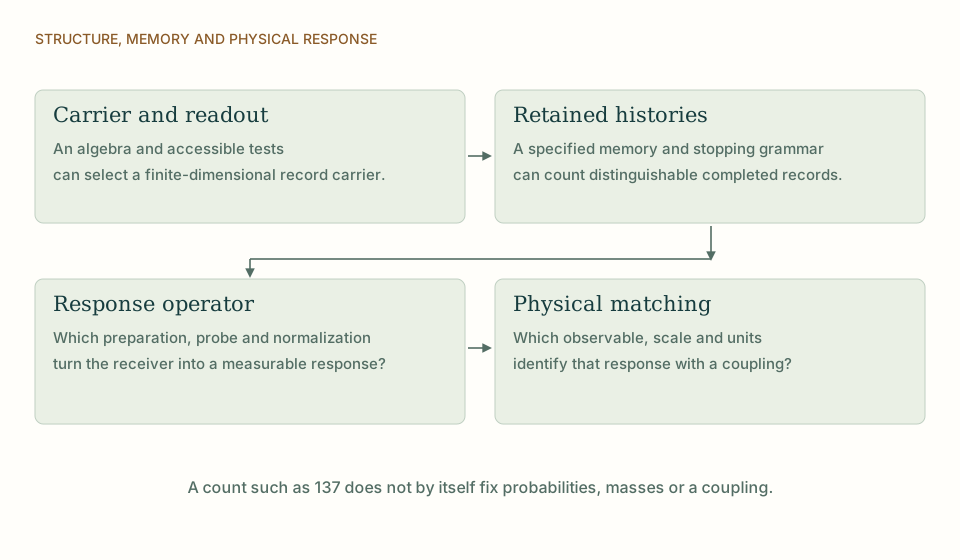
From carrier structure to a measurable response. Representation dimension, a chosen retention grammar, a response operator and physical calibration are separate stages of the constants programme. View full size ↗
03How Spin networks and spin foams frames the problem
Spin networks label quantum geometric states by representations and invariant intertwiners. Spin foams organize amplitudes for transitions between such boundary states. These structures are not automatically networks of ordinary matter particles, even when the same representation groups appear in particle physics. Constraints determine which labels encode geometric degrees of freedom.
DTT can use this comparison to clarify how local carriers are sewn into a global record. The crucial questions are which amplitudes the sewing rule assigns, which redundancies are removed, and what continuum observables emerge. A completed history resembles a boundary-to-boundary construction only after those maps have been defined; visual similarity between diagrams cannot establish equivalence. [4][5]
04Where the mechanisms agree and differ
Quantum geometric spectra often contain the Planck area, which combines ħ with G and c. This does not mean that a spin-network count derives any of those constants separately. DTT's temporal tick proposals encounter the same issue when a geometric or temporal quantum is converted into action through an assumed energy scale.
A useful comparison asks what is truly independent. If the area gap is defined using the measured Planck length, recovering ħ from that gap and the same G and c is an identity. Six nested inner levels could organize quantized geometric records, but their dimensionless count cannot fix an action in joule-seconds without a physical normalization. The ring calculation below isolates the valid quantization statement. A source model would add explanatory content by deriving a dimensionless relation between a geometric gap, a material energy and a generated clock period, with at least two of these independently defined. That could connect quantum geometry to universal action. The comparison therefore encourages a dependency audit: which constants enter the definition of the microscopic variables, and which relations emerge only after the dynamics is solved? [4][5]
05Worked example: assumptions, calculation and result
For a particle on a ring, single-valuedness of the wave function requires exp(i∮p dq/ħ)=1. Hence J=∮p dq=2πnħ=nh. The integer follows from periodic phase consistency. If the circumference is L and momentum is constant, pₙ=nh/L.
For n=1 and L doubled, the allowed momentum halves. The calculation predicts a scaling relation once h is supplied, but it does not determine h. More generally, replacing the phase denominator by an arbitrary constant κ of action units would produce J=2πnκ. A DTT derivation must therefore explain why κ is universal and how its scale relates to independent physical quantities; the integer winding condition alone cannot select it. [1][2][3]
e^(iJ/ħ)=1 ⇒ J=2πnħ=nh; pₙ=nh/L on a ring.
J, ħ and h have action units. L is a length, n is an integer, and the simple ring assumes periodic scalar boundary conditions.
06An independent operational check
An energy-time product is unchanged when the time unit is enlarged and the energy unit is correspondingly reduced in a chosen convention. This illustrates why physical content resides in dimensionless phase differences such as ΔS/ħ. A source model can predict those differences or relate them across systems even when it does not determine an SI numeral. The same principle applies to statistical arguments: a Fisher-information inequality can constrain estimation precision, but its dimensional action scale must come from the model's energy and clock definitions. A universal phase law would therefore be a substantial achievement, provided those definitions are independent and operational.
07What follows from the comparison
The strongest result may be a universal action relation rather than a numerical SI prediction. If one autonomous source enforces the same phase scale for photons, fermions and material clocks, it removes a genuine freedom. A second independent prediction, such as a dimensionless spectral ratio or a controlled correction, would then show that the construction has physical consequences beyond unit choice.
THE SAME QUESTION, DIFFERENT STARTING POINTS
The comparison at a glance
Question
SMM/DTT
Spin networks and spin foams
Starting physical structure
One nonspatial source; six nested inner functional levels produce records accessible through outer completion.
Representation-labeled graphs, invariant intertwiners and transition amplitudes.
The central mechanism in this topic
Independent geometric, energy and clock observables must be linked by a derived relation.
Planck-scale geometric spectra contain the conventional quantum and gravitational normalizations.
How the claim is made operational
A source-to-record map must define geometry, material response and physical clocks with shared inputs.
Gauge-invariant sewing, constraint implementation and semiclassical geometric amplitudes.
Meaning of agreement
Agreement is a compatibility result; a source-selected relation or fixed residual would add explanatory content.
The stated framework provides a benchmark within its own assumptions and established domain.
KEEP THE CONNECTION
Key ideas
A dimensional constant cannot be derived by solving an identity that already used it in the microscopic scale.
The worked example establishes only the result stated under its explicit assumptions.
Six nested inner levels describe one generative organization; outer time orders accessible completion.
Develops the source construction or operational distinction used in this comparison.
Sources and further reading
References support the comparator and the specific mathematical or interpretive claims indicated. SMM/DTT connections are developed in the analysis above.