Newton constant and gravitational coupling: SMM/DTT and Supersymmetry
How could a temporal-source model determine gravitational strength rather than merely rewrite it in terms of another free scale? This article compares the source-based construction with Supersymmetry, identifies their strongest point of contact, and works through a concrete example that separates a valid mathematical result from the further physical relation needed to explain observations.
Newton's constant connects mass-energy to gravitational response. In an effective action it is the normalization of the leading curvature term. Like other dimensional constants, its numerical value depends on units. A more invariant target is a dimensionless gravitational coupling at a specified energy or a ratio between gravitational and matter scales.
A proposed geometric derivation often introduces a compactification radius, a cutoff, or a number of microscopic states. The calculation is predictive only if those inputs are fixed independently and the resulting normalization is stable under quantum corrections. A dimensional combination with the units of G is necessary, but dimensional analysis alone permits an arbitrary dimensionless coefficient. [1][2][3]
02The SMM/DTT contribution
DTT suggests that gravitational response may measure the cost or deformation of generating spatial relations. The same source should then determine matter energy, clock readings and the effective curvature action. This is an attractive unification target because it connects gravitational coupling to the production of the metric itself.
The six nested inner levels are functional organization, not an automatic source of a numerical Newton constant. A spectral action, induced-gravity model or temporal elasticity law can provide a calculational bridge, but its normalization must be traced to the source. Otherwise replacing G with an unknown stiffness or spectral cutoff leaves the explanatory freedom unchanged.
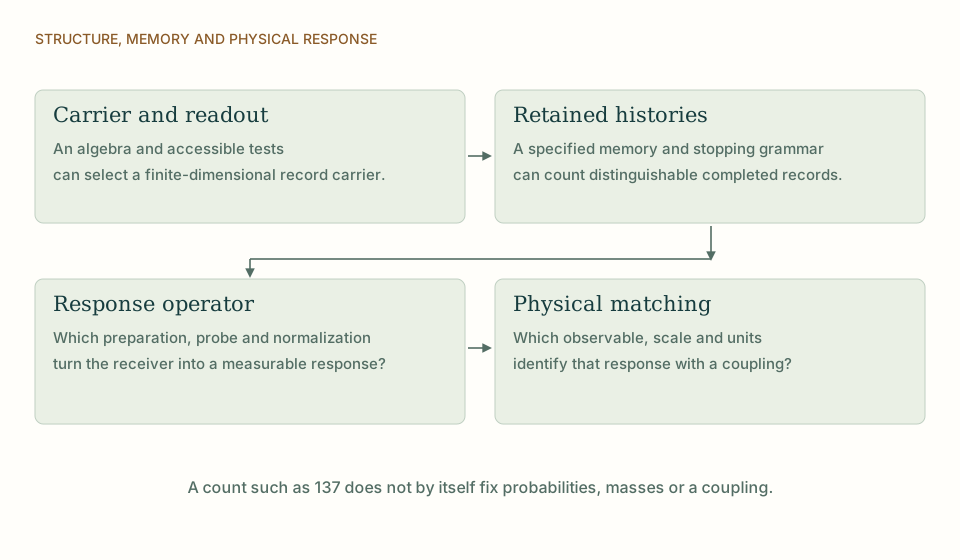
From carrier structure to a measurable response. Representation dimension, a chosen retention grammar, a response operator and physical calibration are separate stages of the constants programme. View full size ↗
03How Supersymmetry frames the problem
Supersymmetry relates bosonic and fermionic degrees of freedom through a graded algebra whose anticommutators include spacetime translations. It is more specific than a general balance of opposites or a numerical equality between state counts. Supersymmetric models require supermultiplets and interactions that respect the algebra, followed by a defined breaking mechanism when the symmetry is not manifest in the spectrum.
DTT's relation between generative and completed roles is not itself a supersymmetry transformation. The constructive question is whether a proposed source representation realizes the relevant graded operators and their action on physical states. If it does, the resulting mass and coupling relations are calculable; if it does not, the comparison remains a conceptual analogy. [4]
04Where the mechanisms agree and differ
Supersymmetry can be extended to supergravity, where local supersymmetry includes gravitational fields, but this does not automatically determine Newton's constant. The gravitational normalization remains part of the action. DTT's temporal-source proposal can be compared with such a unified dynamical structure only after its own state space and symmetry generators are explicit.
The six nested inner levels are not a supergravity multiplet, and a balance between generative and completed sectors does not fix the Planck scale. The coefficient calculation below shows that microscopic multiplicities and energy scales remain independent unless the source constrains them. A meaningful temporal result might relate a supersymmetry-breaking scale, a material clock scale and the curvature response, or demonstrate that a common phase symmetry protects a gravitational coupling relation. It would need to preserve the graded constraints and account for all additional fields. Without that structure, invoking supersymmetry merely shifts the unknown gravitational coefficient into another sector. The useful comparison is therefore about a calculable relation among scales and a mechanism protecting it, not a general expectation that a more symmetric source must determine every constant. [4]
05Worked example: assumptions, calculation and result
In four dimensions and natural units, write the leading action as (M²/2)∫√−g R d⁴x. Comparison with the Einstein–Hilbert normalization gives G=1/(8πM²). If a microscopic model predicts M²=Nμ² for some number N of comparable contributions and a mass scale μ, then G=1/(8πNμ²).
Doubling N halves G at fixed μ; doubling μ quarters G. This simple dependence shows that the coefficient cannot be inferred from the existence of a curvature term alone. A dimensionless strength at energy E is αG(E)=GE² in these units. Such a ratio can be compared across models without choosing kilograms or meters, but only after E is identified with a physical matter or scattering scale. [1][2][3]
G=1/(8πM²); if M²=Nμ², G=1/(8πNμ²). αG(E)=GE² in ħ=c=1 units.
M, μ and E have energy units in the natural-unit convention. In SI, αG=Gm²/(ħc) for a mass m.
06An independent operational check
The vacuum term and the curvature term must be tracked separately. A model can produce a plausible coefficient of R while leaving a large additive vacuum energy. Normalized transition probabilities may be insensitive to that additive constant, but gravity couples to the effective stress-energy associated with it. Thus a successful response calculation for G does not automatically solve the cosmological constant problem. This separation is particularly useful for temporal spectral proposals: the same operator can contribute several effective coefficients, and each requires its own matching and stability argument. A common source is valuable when it constrains their relations, not when distinct coefficients are conflated.
07What follows from the comparison
A strong temporal derivation would reduce the freedom in M relative to a separately defined matter scale and preserve covariant energy accounting. This is where comparisons with spectral actions and renormalization are useful: they show how an attractive geometric coefficient can still depend on cutoffs, field content and matching conditions. Making those dependencies explicit turns a dimensional argument into a testable theoretical claim.
THE SAME QUESTION, DIFFERENT STARTING POINTS
The comparison at a glance
Question
SMM/DTT
Supersymmetry
Starting physical structure
One nonspatial source; six nested inner functional levels produce records accessible through outer completion.
A graded symmetry algebra relating bosonic and fermionic field representations.
The central mechanism in this topic
A source symmetry must yield a quantitative, protected relation among gravitational and material scales.
Supersymmetric gravitational theories still require an overall gravitational normalization.
How the claim is made operational
A source-to-record map must define geometry, material response and physical clocks with shared inputs.
Supercharges, supermultiplets, invariant interactions and controlled symmetry breaking.
Meaning of agreement
Agreement is a compatibility result; a source-selected relation or fixed residual would add explanatory content.
The stated framework provides a benchmark within its own assumptions and established domain.
KEEP THE CONNECTION
Key ideas
More symmetry can constrain coefficients, but the source must demonstrate the actual scale relation.
The worked example establishes only the result stated under its explicit assumptions.
Six nested inner levels describe one generative organization; outer time orders accessible completion.
Develops the source construction or operational distinction used in this comparison.
Sources and further reading
References support the comparator and the specific mathematical or interpretive claims indicated. SMM/DTT connections are developed in the analysis above.