Introduce the constants program as a chain from completion dynamics to response and then physical matching. Identify which quantities are structural, calibrated, or still free.
01A program of derivation needs a dependency structure
The SMM/DTT constants program seeks a common origin for phase, propagation, masses, gravity, and vacuum curvature. A dependency map records what must be supplied before each proposed result can be calculated. It distinguishes conceptual motivation, mathematical deduction, physical matching, and empirical calibration.
This distinction prevents a collection of individually plausible formulas from being mistaken for one closed theory. If the action scale, electron gap, electromagnetic stiffness, and curvature coefficient are independently adjustable, using one vocabulary for them does not make them consequences of one source.
02Begin with dimensionless source outputs
A candidate microscopic model should define its carrier, history composition, retained memory, update, and completion instrument. From that model one may calculate dimensionless quantities such as a stiffness K, matter gaps εe and εp, a propagation coefficient υ, and geometric coefficients κ and r.
These outputs have different operational meanings. A gap from an auxiliary transfer comparator is not automatically an electron mass gap. A containing propagation bound is not automatically a sharp signal speed. A coefficient of a Euclidean quadratic form is not automatically the Lorentzian gravitational coefficient. Each proposed identification needs its own argument.
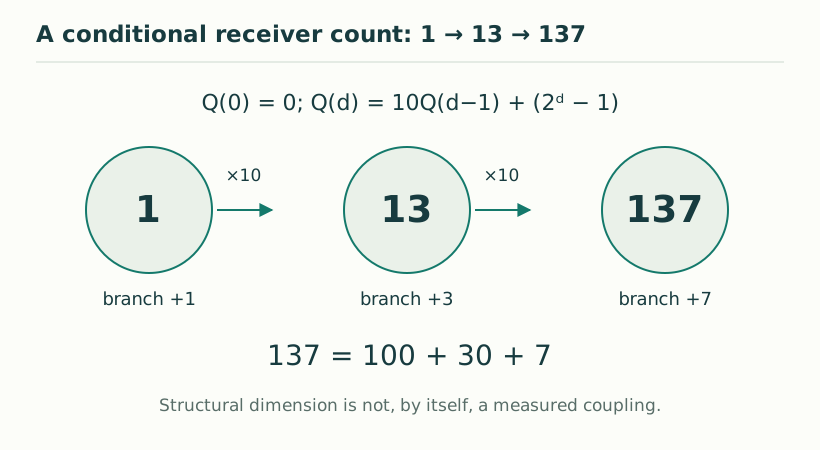
Figure 1. A conditional receiver count: 1 → 13 → 137. For the selected finite grammar Q(0) = 0 and Q(d) = 10Q(d−1) + (2ᵈ − 1), the depth-three output has 137 retained modes. Identifying 1/137 with an electromagnetic coupling needs additional response normalization and matching. View full size ↗
03Attach a common physical dictionary
Introduce action, length, and time scales a, ℓ*, and τ*. The dictionary uses c=υℓ*/τ*, m_s=aε_s/(c²τ*), G=c³ℓ*²/(16πaκ), and Λ=r/(2κℓ*²). These equations explain how selected dimensionless outputs would be expressed in physical units.
They are coefficient-matching relations, not calculations of the inputs. A common dictionary is valuable because one change propagates across several sectors. Choosing a separate clock scale for the electron while keeping another scale for gravity changes the proposed common-source model and must be made explicit.
c=υℓ*/τ*; m_s=aε_s/(c²τ*)
G=c³ℓ*²/(16πaκ); Λ=r/(2κℓ*²)
04Use dimensionless targets to expose genuine freedom
On the physical branch a=ℏ, define the mass ratio μ=m_p/m_e, gravitational strength g_e=Gm_e²/(ac), and curvature in reduced-Compton units λ_e=Λ[a/(m_ec)]². The dimensional conversion scales cancel from their formulas.
The resulting map is α=1/(4πK), μ=εp/εe, g_e=εe²/(16πκυ²), and λ_e=rυ²/(2κεe²). The cancellation is an internal consistency check. Predictive content appears only when a source restricts the remaining dimensionless inputs.
α=1/(4πK); μ=εp/εe
g_e=εe²/(16πκυ²); λ_e=rυ²/(2κεe²)
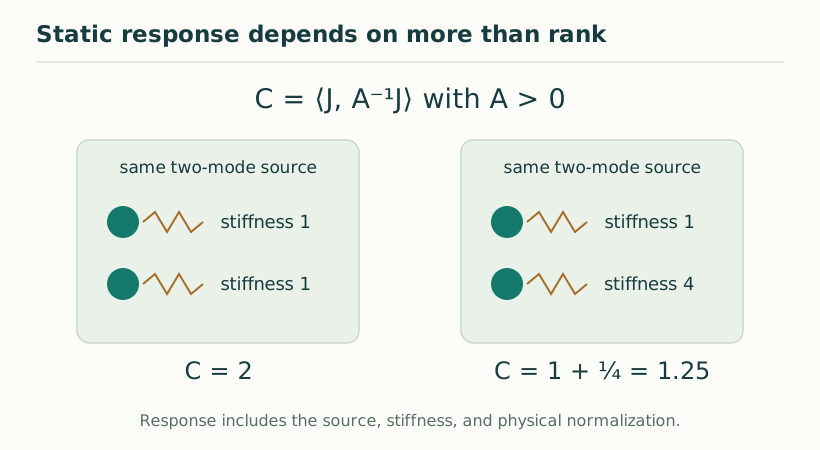
Figure 2. Static response depends on more than rank. With a positive response operator A and source J, capacity is C = ⟨J,A⁻¹J⟩. Equal dimensions can have different capacities; the displayed diagonal two-mode examples are exact illustrative arithmetic. View full size ↗
05A solvable response branch shows what calibration can do
The compact-phase model supplies a completed stiffness K(t) that is strictly decreasing from infinity to zero. A chosen stiffness therefore fixes one completion-width parameter t uniquely within that architecture. The same t then fixes a nonlinear response and a comparator spectrum.
This is a useful one-input, many-output structure. It becomes an empirical test only after the nonlinear response and comparator are linked to physical instruments. If α was used to infer t, reproducing α is not a separate prediction. A held-out response could be a prediction, provided the architecture was not selected by fitting that same response.
06How the map advances SMM/DTT
A dependency map is most useful when it makes missing bridges visible. The rank-137 receiver, the compact response, the charged matter sector, and the curvature functional may each be mathematically coherent while still lacking a common source derivation. Their connections are the research tasks, not decorative arrows.
The six nested inner dependencies provide an organizational aim: the same generating process should produce the quantities later read as geometry, clocks, and matter. A completed theory would constrain the shared inputs enough to predict cross-sector relations. Until then, the map distinguishes proven conditional results from free choices and makes proposed improvements auditable.
KEEP THE CONNECTION
Key ideas
A constants program must distinguish calculation, matching, and calibration.
A shared dimensional dictionary exposes dependencies across sectors.
Predictive content requires restrictions on the remaining dimensionless inputs.
Scope of the argument. Research architecture with exact conditional dictionaries; no claim that all constants have been derived.
Sources & further reading
dtt_constants_reconstruction.pdfWorking draft, pp. 4–16, 18–20
Source editions and catalogue entries
Working manuscript
Physical Constants from Temporal Completion: Dependency Structure, Identifiability, and Cross-Sector Tests in SMM/DTT
Draft file: dtt_constants_reconstruction.pdf
Working manuscript. Article-level references identify the consulted sections and the scope of the interpretation. No public URL was supplied for this exact manuscript version.