Identifiability: can observations determine the model?
Explain why a collection of observable constants can leave parameter directions unresolved. Use the draft’s two remaining directions to distinguish a good fit from unique reconstruction.
01Fitting numbers is different from reconstructing a source
A model may reproduce several measured constants while still admitting many different microscopic parameter choices. Identifiability asks whether the observations distinguish those choices. The constants draft proves that its common dictionary has two exact unresolved dimensionless directions.
This is a useful result for SMM/DTT because a common-source explanation should eventually restrict hidden freedoms rather than merely rename them. The ambiguity remains after ordinary unit choices have canceled. It therefore cannot be dismissed as a change from seconds to another unit.
02The six inputs and four outputs
The dictionary takes positive K, εe, εp, κ, υ and a signed vacuum coefficient r to four dimensionless outputs. Their formulas are α=1/(4πK), μ=εp/εe, g_e=εe²/(16πκυ²), and λ_e=rυ²/(2κεe²).
For any allowed output quadruple, one can choose εe and υ freely, then solve for K, εp, κ, and r. Thus the unrestricted dictionary reaches every target with α,μ,g_e positive and λ_e of either sign. It imposes no numerical relation among those four observables by itself.
K=1/(4πα); εp=μεe
κ=εe²/(16πg_eυ²); r=2κεe²λ_e/υ²
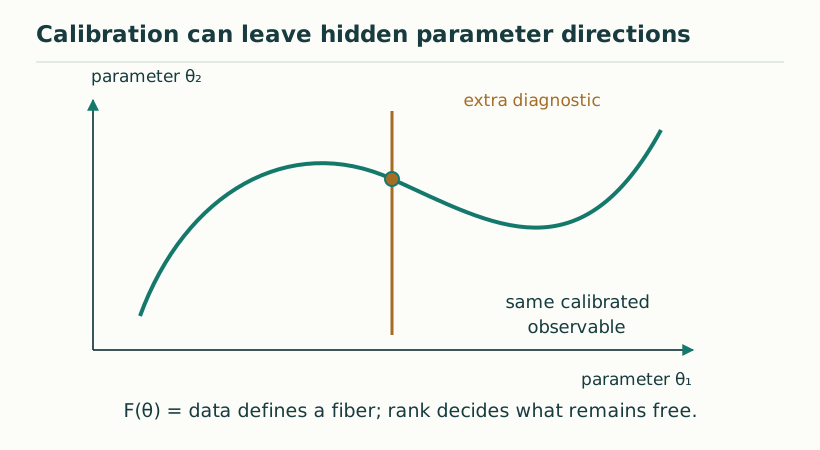
Figure 1. Calibration can leave hidden parameter directions. A fixed measurement may select a curve of models rather than one point. A genuine prediction must be constant on that calibration fiber, or require additional independently measured diagnostics. View full size ↗
03The exact transformations preserving the outputs
Let s and u be arbitrary positive numbers. Scale both matter gaps by s, the propagation coefficient by u, κ by s²/u², and r by s⁴/u⁴, leaving K unchanged. Direct substitution shows that all four outputs remain the same.
Conversely, any two input tuples with the same four outputs are related by exactly such a transformation. The two parameters describe the full calibration fiber of this dictionary. A fiber is simply the family of models compatible with the same calibrated observations.
(εe,εp,υ,κ,r) ↦ (sεe,sεp,uυ,s²κ/u²,s⁴r/u⁴)
04A concrete invisible change
Take s=2 and u=1. Both gaps double, κ becomes four times larger, and r becomes sixteen times larger. The mass ratio is unchanged; the doubled electron gap is canceled by the fourfold curvature coefficient in g_e, and the corresponding powers cancel in λ_e.
The models can have very different internal scales while agreeing on the four targets. An extra diagnostic sensitive only to K adds no information because K is already fixed by α. A useful measurement must vary along at least one of the unresolved directions.
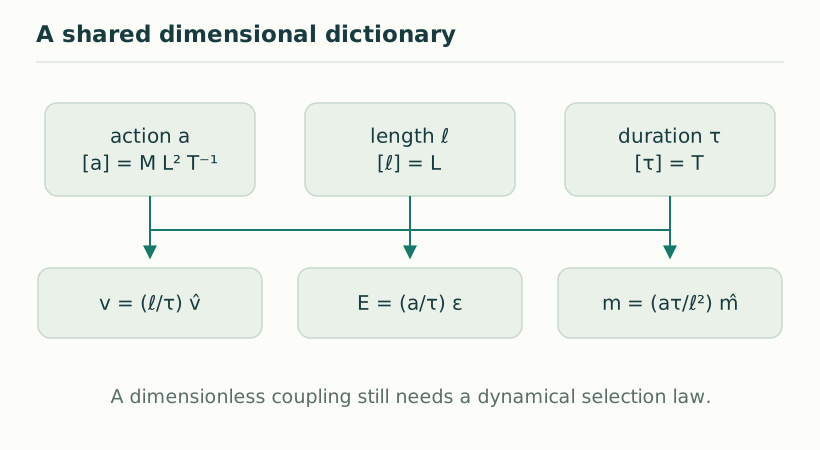
Figure 2. A shared dimensional dictionary. Dimensionless model outputs acquire physical units only after an action scale a, length scale ℓ, and time scale τ are supplied. These conversions are dimensional identities, not derivations of numerical constants. View full size ↗
05Why two independent diagnostics are required
On a fixed nonzero-r sign branch, logarithms turn the dictionary into an affine map with a rank-four Jacobian. Its nullspace has dimension two. Let N contain a basis of those invisible directions, and H be the derivative of two proposed additional diagnostics. The combined observations have full local rank exactly when det(HN)≠0.
One scalar diagnostic cannot distinguish both independent directions. Two diagnostics can also fail if they respond to the same combination. The condition tests independence on the actual remaining fiber, not merely whether the new quantities have different names.
Local completion criterion: det(HN)≠0
06What a physical diagnostic must provide
The formal choices log εe and log υ would resolve the two directions, but this does not prove that those microscopic quantities are independently measurable. A physical proposal must construct their readouts without reusing the same mass, speed, or curvature calibration that created the ambiguity.
For SMM/DTT, a stronger source dynamics could remove freedom before observation by deriving relations among the six inputs. Alternatively, new observables could identify them. The theorem gives a clear criterion for either route. It is local when used as a differential test; global uniqueness and different sign branches require additional analysis.
KEEP THE CONNECTION
Key ideas
The common dictionary has an exact two-parameter ambiguity.
More precision on the same four targets cannot remove that ambiguity.
Two diagnostics must respond independently along the unresolved directions.
Scope of the argument. Identifiability result for the displayed dictionary, not a statement that every future SMM/DTT source model has the same freedom.
Sources & further reading
dtt_constants_reconstruction.pdfWorking draft, pp. 13–15
Source editions and catalogue entries
Working manuscript
Physical Constants from Temporal Completion: Dependency Structure, Identifiability, and Cross-Sector Tests in SMM/DTT
Draft file: dtt_constants_reconstruction.pdf
Working manuscript. Article-level references identify the consulted sections and the scope of the interpretation. No public URL was supplied for this exact manuscript version.