
In this article
- A numerical proximity becomes testable only after a law is stated
- The proposed relation
- Eliminate the shared parameter
- The draft’s exact comparison fails
- Why the failure is informative
- What a stronger mass-ratio derivation needs
Examine the shared-valuation proposal that fails simultaneous matching in the draft. Use the failure as an example of how a specific law can be rejected without settling the entire framework.
The integers 137 and 1836 occur in proposed receiver and inertia constructions. Their proximity to familiar physical quantities is not enough to establish a common mechanism. The draft tests a stronger claim by introducing one shared deformation parameter b for both sectors.
This is a useful SMM/DTT strategy: if a single source controls coupling and mass ratio, changing its parameter should affect both in a constrained way. The shared law can then fail. A theory that adjusts an unrelated correction for every observable does not expose itself to the same cross-sector test.
Define X(b)=b²+3b+7 and M(b)=(b+3)X(b)+b(b+1)/2 for b>0. At b=10, the first equals 137 and the second equals 1836. The proposed physical matching is X=α⁻¹ and M=μ, the proton–electron mass ratio.
For noninteger b this is an effective valuation ansatz. Vector-space dimensions remain integers, so varying b continuously is not literally changing the dimension of a symmetric receiver. The signed-root and triangular terms also require a baryonic dynamical derivation before they can be interpreted as particle energy.
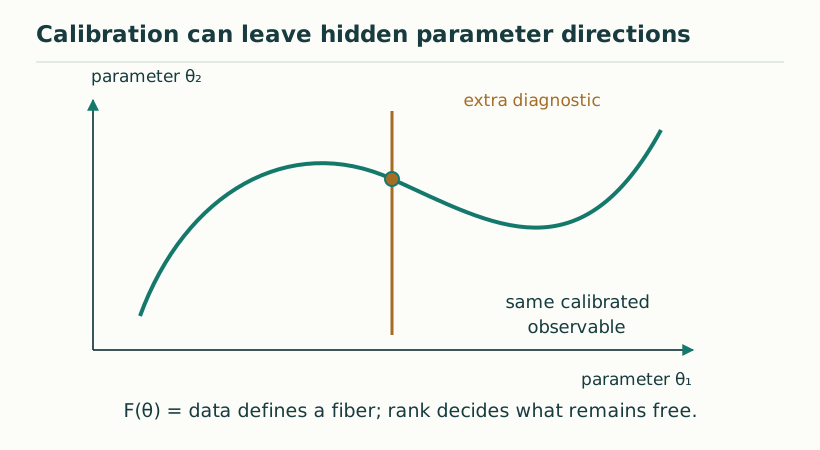
Because X is increasing for positive b, it can be inverted explicitly: b(X)=[√(4X−19)−3]/2. Substituting this into M gives a one-dimensional curve in the plane of inverse coupling and mass ratio. Once X is calibrated, M is no longer independently adjustable.
At the baseline b=10, dX/db=23 and dM/db=446.5, giving dM/dX≈19.413. The slope is a quick local diagnostic, but the final comparison should use the exact inverse rather than relying on a small-deformation approximation.
Using the reference inverse-coupling value quoted in the draft to calibrate X gives b*≈10.0015650751. The law then predicts M(b*)≈1836.698895446. The draft’s reference mass ratio is approximately 1836.152673426, leaving a discrepancy of about 0.546222020.
The failure is far larger than the reference uncertainty used in that comparison. These are the draft’s benchmark inputs and results, not a new determination of current recommended constants. Their purpose is to show that the specified complete two-observable law does not fit both targets simultaneously.
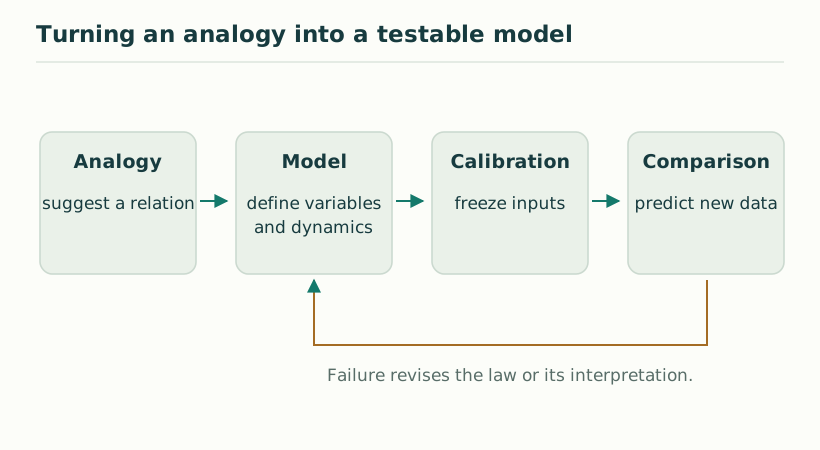
The result rejects this exact shared-valuation matching proposal. It does not reject every SMM/DTT model, the algebraic receiver count, or the possibility of a different common-source mechanism. The value of the test is that one independently calibrated sector constrains another.
Adding an unexplained correction to M after seeing the discrepancy would restore numerical flexibility but remove this particular test. A justified correction should follow from a specified interaction, boundary condition, or spectral calculation and should produce further observable consequences. Its uncertainty should be included before comparison, not introduced only to cover a residual.
A physical proton–electron ratio requires identification of charged sectors, spin and statistics, a common time and action dictionary, and a calculation of their rest energies or appropriate thresholds. Color symmetry and a three-fold singlet are not by themselves a proton energy calculation.
The SMM/DTT ambition of generating matter with geometry makes these obligations especially important. The same inner construction should select the relevant operators and their completion readouts. A failed ansatz helps direct effort toward that missing dynamics. It also supplies a useful public example of how the research program can state a precise proposal, calculate its consequence, and discard a law that does not survive the comparison.
KEEP THE CONNECTION
Scope of the argument. Negative result for one explicit ansatz; benchmark numbers are attributed to the draft and do not establish or refute the entire framework.
Draft file: dtt_constants_reconstruction.pdf
Working manuscript. Article-level references identify the consulted sections and the scope of the interpretation. No public URL was supplied for this exact manuscript version.
Source register →