Explain the obstruction to inferring gravitating vacuum energy from normalized completion response. Adding an invisible offset exposes information that the response alone cannot determine.
01Normalized observations can discard an absolute quantity
Many response calculations normalize a partition weight at zero source or divide transfer eigenvalues by a reference eigenvalue. This is useful because it removes irrelevant overall factors for those observables. But the removed information may be exactly what an absolute vacuum-energy calculation needs.
The constants draft proves this obstruction explicitly. In SMM/DTT, a completion response may determine relative phase stiffness while leaving an absolute vacuum coefficient undetermined. A successful electromagnetic calibration therefore does not automatically solve the cosmological-constant problem.
02The common-offset transformation
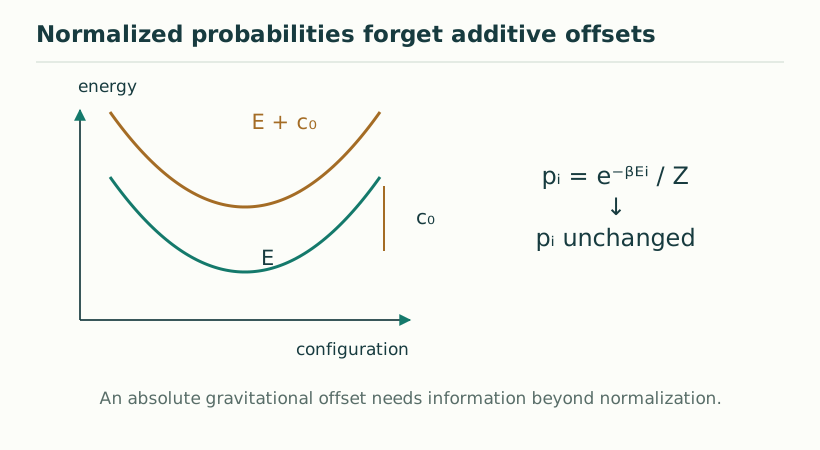
Let T₀ be a positive transfer operator and introduce a source-independent offset C by T_C=e^(−C)T₀. Every eigenvalue receives the same factor, so eigenvalue ratios remain unchanged. Likewise, if Z_C[J]=e^(−nC)Z₀[J], normalized expectations and positive-order derivatives of log Z with respect to J are unchanged.
The absolute zero-source quantity −log Z_C[0] increases by nC. Thus two models can agree on all normalized source responses while differing in an absolute offset. No amount of precision in those same normalized measurements can recover information that the normalization has removed.
T_C=e^(−C)T₀; t_a(C)/t_b(C)=t_a(0)/t_b(0)
log Z_C[J]=log Z₀[J]−nC
Figure 1. Normalized probabilities forget additive offsets. Adding an energy constant c₀ multiplies every Boltzmann weight by the same factor and leaves normalized probabilities unchanged. Such response alone cannot fix an absolute vacuum-energy offset. View full size ↗
03Why taking more derivatives does not help
Differentiating log Z with respect to the source annihilates the constant −nC. The second derivative may give a susceptibility, higher derivatives nonlinear responses, and eigenvalue ratios spectral gaps, but all remain blind to the common offset.
This is an identifiability obstruction rather than a computational difficulty. A more accurate numerical solver of the same normalized model will not determine C. One must introduce an observable or physical principle that is sensitive to the missing absolute contribution.
04Geometric response can change the question
A metric variation can change cell volumes, measures, cutoff scales, channel widths, and normalization factors. A factor independent of a phase source at fixed geometry may therefore depend on a geometric source. Its derivative can contribute to the effective metric action.
This does not mean that every mathematical constant necessarily gravitates. It means that the gravitating functional must be defined before its response is calculated. Subtractions, counterterms, and the physical normalization must be justified in that functional. The normalized completion weight alone cannot supply this missing prescription.
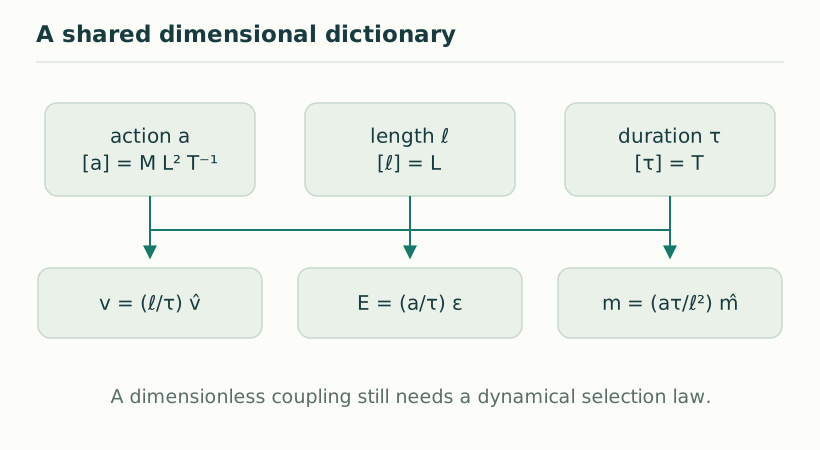
Figure 2. A shared dimensional dictionary. Dimensionless model outputs acquire physical units only after an action scale a, length scale ℓ, and time scale τ are supplied. These conversions are dimensional identities, not derivations of numerical constants. View full size ↗
05Averaging suppresses fluctuations, not the mean
For a stationary process with mean ρ̄, the average of M samples still has expectation ρ̄. With summable correlations its variance typically decreases like 1/M. Long-range correlations can slow that suppression, but neither behavior changes the mean.
Adding the same constant C to every sample shifts every normalized weighted average by C. Therefore temporal averaging cannot by itself turn an arbitrary large common vacuum offset into a small mean. It can explain smoother observed fluctuations under stated correlation assumptions; a small gravitating mean requires a different mechanism.
E[(1/M)Σρ_n]=ρ̄
Var(average)=[Mγ(0)+2Σₖ₌₁ᴹ⁻¹(M−k)γ(k)]/M²
06The SMM/DTT research obligation
A viable common-source vacuum theory must calculate a metric-sensitive action or stress tensor and explain why its absolute contribution is small, protected, canceled, or otherwise selected. It must also address changes at particle thresholds and consistency with conservation. These are stronger requirements than normalizing a phase response at its minimum.
The constructive lesson is to keep the vacuum branch of the dependency map separate until the absolute functional is supplied. Completion dynamics may still be relevant, but it must contribute an actual selection law. The offset theorem identifies precisely why an argument based only on normalized stiffnesses, spectra, or temporal smoothing cannot complete that derivation.
KEEP THE CONNECTION
Key ideas
Normalized responses are exactly blind to a common source-independent offset.
Metric response requires a separately specified absolute functional.
Temporal averaging can reduce variance while leaving the mean unchanged.
Scope of the argument. An information obstruction for normalized data, not a claim that every mathematical offset has a gravitational effect.
Sources & further reading
dtt_constants_reconstruction.pdfWorking draft, pp. 12, 16–18
Source editions and catalogue entries
Working manuscript
Physical Constants from Temporal Completion: Dependency Structure, Identifiability, and Cross-Sector Tests in SMM/DTT
Draft file: dtt_constants_reconstruction.pdf
Working manuscript. Article-level references identify the consulted sections and the scope of the interpretation. No public URL was supplied for this exact manuscript version.