Compare the inherited polynomial phase with the selected coherent-output phase. Explain why determinant closure can produce a 137-fold condition only after the stated phase identifications.
01The same vector space can carry different phase actions
The 137-dimensional receiver is built from symmetric powers, exterior powers, tensor products, and direct sums. These constructions inherit a natural polynomial phase action. The draft also defines a different common phase on completed outputs. Both act on the same underlying vector space, but they are not the same representation.
This distinction is crucial in SMM/DTT because generation and completed observation may use different comparison rules. Forgetting construction labels does not automatically change how phase acts. Any new output-phase rule must be stated as an additional constitutive choice.
02Calculate the inherited polynomial weights
Assign weight one to each original innovation and envelope vector. Symmetric pairs then have weight two, exterior degree k has weight k, and tensor products add weights. In the final receiver the phase generator K has weights 1,2,3,4,5 with multiplicities 3,3,21,10,100.
The dimension is the sum of multiplicities, 137. The determinant exponent is the weighted sum, 612. These are different invariants. The quadratic source norm associated with K uses the squared-weight sum, 2864, which is different again.
dim R₃=3+3+21+10+100=137
Tr K=3+6+63+40+500=612
Tr K²=2864; det P(z)=z⁶¹²
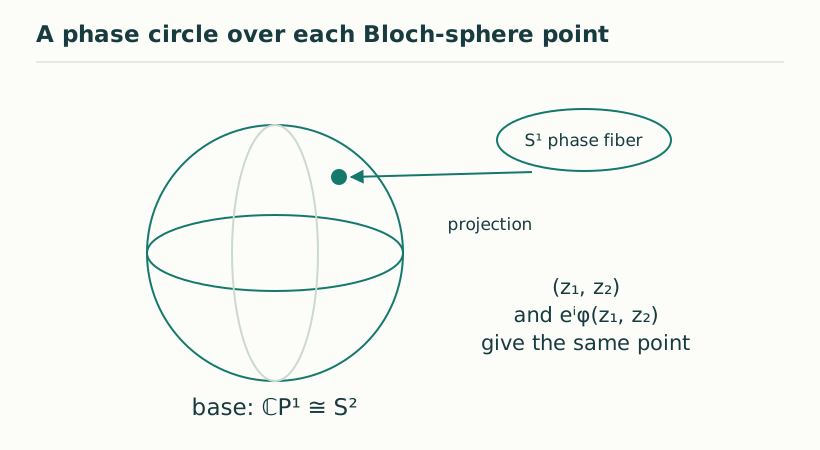
Figure 1. A phase circle over each Bloch-sphere point. For a normalized spinor (z₁,z₂), a common phase leaves the point of ℂP¹ ≅ S² unchanged. The Hopf bundle has total space S³; the drawing is a schematic of its fibers, not an embedding of S³ in ordinary three-space. View full size ↗
03The selected coherent-output action
The output comparison diagram retains selected linear inclusion maps while omitting the original symmetric pairing and exterior multiplication. Within a scalar-diagonal class, require every innovation, branch, and completed receiver to have the same normalized weight one. Compatibility then forces the continuation memory Q to be neutral.
The resulting action is C(z)=zI₁₃₇, with determinant z¹³⁷. It is a valid action on that reduced linear diagram, but it does not preserve the original multiplication rules. A product of two weight-one exterior inputs would have weight two, whereas the chosen output assigns weight one to the product object.
C(z)=zI₁₃₇; det C(z)=z¹³⁷
04Why one action cannot simply be relabelled as the other
Identify the two phase circles with the same orientation and ask for a complex-linear map T intertwining the actions. On a polynomial weight-k vector, equivariance requires e^{ikθ}Tv=e^{iθ}Tv for every θ. Unless k=1, this forces Tv=0.
Only the three-dimensional weight-one sector can survive, so rank T≤3. There is no invertible coherent phase-preserving conversion of all 137 modes under this same-circle requirement. A classical record channel can retain all basis labels while discarding off-diagonal coherence, but that is a different physical task requiring its own environment and instrument.
TP(e^{iθ})=C(e^{iθ})T ⇒ rank T≤3
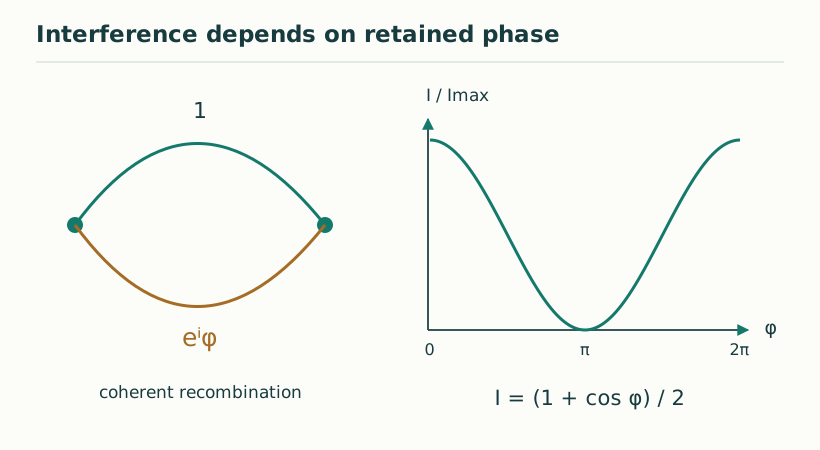
Figure 2. Interference depends on retained phase. The ideal two-path law I(φ) = |1 + eⁱφ|²/4 = (1 + cos φ)/2 is an illustrative quantum baseline. A temporal interpretation must specify which histories retain coherence and how the phase is controlled. View full size ↗
05Determinant closure and its limits
If one additionally requires determinant-neutral closure for the coherent-output action, allowed phases satisfy z¹³⁷=1. The least positive phase fraction is then 1/137 of a full turn. With the polynomial action the analogous determinant condition instead uses 612.
These finite determinant kernels are not the kernels of the full representations: a phase can have determinant one while acting nontrivially on the receiver. Nor is the closure fraction automatically a connection holonomy or electromagnetic coupling. A Hopf-associated determinant line can record the same exponent after an explicit circle identification, but topology still leaves the gauge-action normalization free.
06What physical source selection must decide
The response calculation makes the distinction operational. For isotropic stiffness κ, a trace source J=I has capacity 137/κ, whereas choosing J=K gives 2864/κ in the same receiver. The source must be identified independently; choosing an output phase alone does not choose a field current.
The SMM/DTT program therefore needs to specify what completion preserves: polynomial coherent amplitudes, classical labels, a common output phase, or some richer state including an environment. Each choice has different constraints. The value 137 is most useful when its exact provenance is preserved, rather than when phase fraction, probability, determinant degree, and interaction strength are treated as one quantity.
KEEP THE CONNECTION
Key ideas
Polynomial and coherent-output phases have determinant weights 612 and 137.
A same-circle coherent intertwiner between them has rank at most three.
Determinant closure requires an added rule and does not fix electromagnetic coupling.
Scope of the argument. The coherent-output action and determinant-neutral closure are explicit selections, not consequences of forgetting a grading.
Sources & further reading
smm_dtt_quaternionic_rank3_hopf_reconstruction_v8.pdfWorking draft, pp. 18–22
smm_dtt_alpha0_137_v3.pdfWorking draft, pp. 13–15
Source editions and catalogue entries
Working manuscript
Quaternionic Rank-Three Readout, Hopf Geometry, and a Free Symmetric–Exterior Reconstruction Functor
Working manuscript. Article-level references identify the consulted sections and the scope of the interpretation. No public URL was supplied for this exact manuscript version.