
In this article
- From a quaternion to a complex doublet
- Why a common phase does not change the direction
- A familiar coordinate picture
- The primitive topological degree
- Why topology does not determine charge strength
- The SMM/DTT connection
Introduce the relation between a two-component complex description and a sphere of readout directions. Explain the Hopf bundle’s role in the draft’s reconstruction.
After choosing a circular phase slice Cph inside the quaternions, every quaternion can be written using two complex coefficients. This makes H a two-dimensional complex space, often called a spinor doublet. Unit quaternions act on it by SU(2) matrices, while their action on the three-dimensional imaginary readout gives SO(3).
The construction connects phase, orientation, and local readout in one mathematical setting. In SMM/DTT it provides a candidate interface between generative phase information and observable directions. It does not by itself identify the doublet with an electron or supply its dynamical equation.
Normalize the doublet to unit norm. The normalized states form a three-sphere S³. Multiplying a doublet by a common unit complex phase changes its representative but leaves its projective direction unchanged. The quotient of normalized doublets by that phase circle is CP¹, which is a two-sphere.
In quaternionic notation the draft uses β(ψ)=−ψe₁ψ⁻¹. Multiplication ψ↦ψz by a phase z commuting with e₁ leaves β unchanged. Conversely, equal β values imply that the two representatives differ by such a phase. This proves that the fibers are exactly circles.
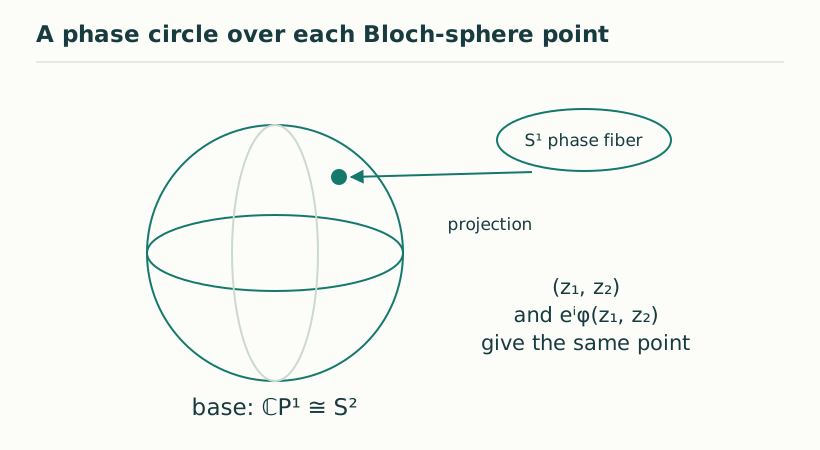
For a normalized complex doublet (z₁,z₂), the associated unit direction can be represented, up to the draft’s orientation convention, by components 2Re(z₁* z₂), 2Im(z₁* z₂), and |z₁|²−|z₂|². Their squared sum is one. A common phase cancels from all three components.
The states (1,0) and (0,1) give opposite poles, while equal-magnitude components lie on the equator and their relative phase selects an equatorial direction. The overall phase remains in the fiber. This example shows explicitly which information the projective direction retains and which it forgets.
The Hopf bundle is not globally a trivial product of a sphere and a circle. A local phase convention can be chosen on patches, but its transition function winds once around the equator. With the draft’s positive-line convention, the associated line bundle has first Chern degree +1.
Continuous circle characters are z↦z^q with integer q. Tensoring the positive Hopf line q times multiplies its Chern degree by q; dualization changes the sign. This produces an integer topological lattice. It does not select a continuous interaction strength.
Fixing a line bundle and its Chern class still allows gauge actions with any positive coefficient multiplying the curvature energy. The integer degree constrains how local phases fit together, while the coupling coefficient determines the energetic response. These are different pieces of data.
The same caution applies to calling the primitive Hopf degree a source-monopole interpretation. It describes a projective phase line downstream of the source; it does not place a detectable magnetic monopole at a point of empirical spacetime. A physical electromagnetic identification would require a spacetime bundle, connection, source normalization, and dynamical field law.
The Hopf construction illustrates how a richer phase-bearing carrier can yield a lower-dimensional observable direction without losing all information about the phase organization. It is a precise example of projection, one of the recurring conceptual themes in SMM/DTT. Its nontrivial topology can organize later reconstruction choices.
However, the phase fiber is not automatically inner time, and the sphere is not automatically physical space. The relevant operations, clocks, and records must be supplied. The draft keeps the spinor, Hopf line, spin-cover structure, and electromagnetic bundle distinct so that a later physical bridge can be tested rather than assumed.
KEEP THE CONNECTION
Scope of the argument. Mathematical bundle geometry; particle identity, temporal interpretation, and electromagnetic matching are separate interfaces.
Draft file: smm_dtt_quaternionic_rank3_hopf_reconstruction_v8.pdf
Working manuscript. Article-level references identify the consulted sections and the scope of the interpretation. No public URL was supplied for this exact manuscript version.
Source register →