
In this article
- Why the reconstruction uses pair data
- Count the independent pairs
- The universal property explains the choice
- Why multiplication alone is too small
- Quantum retention is not cloning
- How ten enters the 137 construction
Count the independent symmetric quadratic combinations of a four-component envelope. Explain the receiver interpretation and why selecting that construction is a substantive modeling choice.
A generated configuration can retain more information than the current product of its elementary operations. The draft models one such retention rule by storing symmetric quadratic combinations of a four-component unital envelope. The scalar identity channel and three displacement directions enter that envelope, but only the latter are spatial readout directions.
This is a concrete way to express memory in SMM/DTT: histories can remain distinguishable even after their instantaneous carrier values coincide. The ten-mode receiver is the free space of symmetric pair data under the stated rule. It is not obtained from a preferred numeral system.
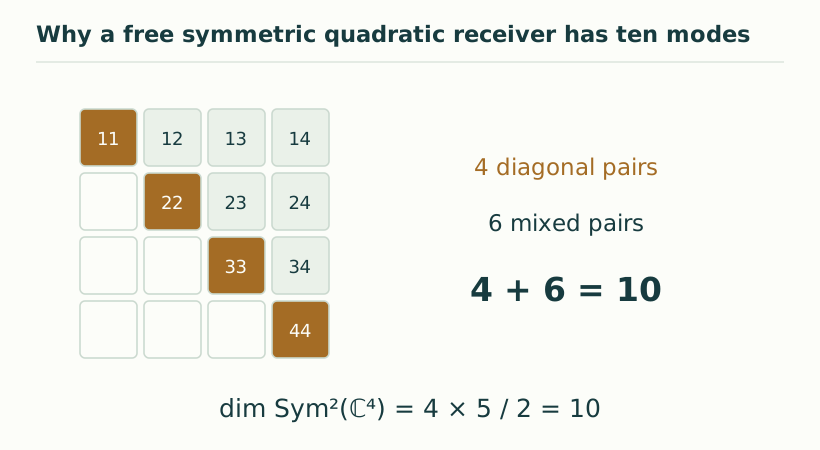
Let V have basis e₀,e₁,e₂,e₃. A symmetric pair identifies e_a⊗e_b with e_b⊗e_a. There are four diagonal pairs and six unordered off-diagonal pairs. Their total is ten. More generally, an n-dimensional space has n(n+1)/2 independent symmetric pairs.
The complex receiver Q=Sym²V therefore has dimension ten when dim V=4. Complex coefficients describe amplitudes in this receiver; the ten labels are basis modes, not ten classical digits. A change of basis alters the labels while preserving the dimension.
| Pair type | Examples | Count |
|---|---|---|
| Repeated | e₀e₀, e₁e₁, e₂e₂, e₃e₃ | 4 |
| Distinct unordered | e₀e₁, e₀e₂, e₀e₃, e₁e₂, e₁e₃, e₂e₃ | 6 |
Every symmetric bilinear rule b:V×V→X factors uniquely through a linear map from Sym²V to X. In that sense the symmetric square retains all information required by any symmetric bilinear receiver without imposing extra relations. This is the free-construction meaning of the ten-mode space.
The universal property is powerful but conditional. It proves uniqueness of the receiver for the declared task. It does not prove that a physical source must perform that task, retain every symmetric pair, or avoid additional identifications. Those are physical retention assumptions to be tested or derived.
Identify the real envelope with H and consider the symmetrized product m(u⊙v)=(uv+vu)/2. It reaches every quaternion because m(1⊙x)=x, so its rank is four. Its ten-dimensional domain therefore has a six-dimensional kernel.
Explicit lost combinations include mixed imaginary pairs e_i⊙e_j for i≠j, which vanish by anticommutation, and e_i⊙e_i+1⊙1, which vanish because e_i²=−1. A model keeping only the accumulated product cannot claim to retain all ten pair-memory directions. It must provide an additional register or another faithful encoding.
A register can coherently record orthogonal labels through |j⟩|0⟩↦|j⟩|j⟩. On a superposition this creates correlations between the original label and its record; it does not produce two independent copies of an unknown state. Nonorthogonal inputs cannot be nondisturbingly assigned perfectly distinguishable record labels.
Likewise, the formal expression u⊙u does not specify a deterministic quantum cloning operation. The symmetric receiver describes the algebra of pair information. A physical implementation must state how its pair inputs are prepared, how the record is written, and what coherence and memory resources are available.
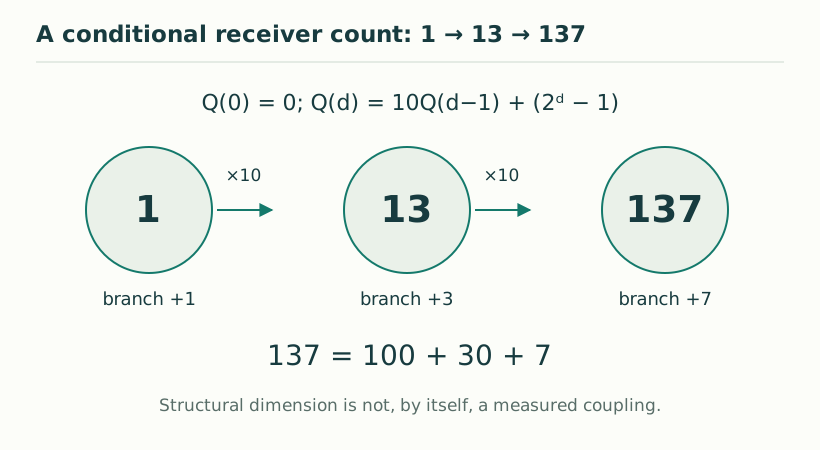
The selected depth-homogeneous grammar reuses Q as a continuation alphabet. Each continuation multiplies the number of distinguishable earlier records by ten, while a new exterior branch is added at the current depth. With branch counts 1,3,7, the recurrence gives 1,13,137.
The decimal-looking arithmetic reflects a ten-dimensional receiver in this model; it is not a derivation of human decimal notation or proof that every source must use base ten. SMM/DTT would gain a deeper result by deriving the symmetric retention rule and its physical response from one source dynamics. The present construction makes the required rule explicit and exposes what information would be lost by replacing it with a simpler product.
KEEP THE CONNECTION
Scope of the argument. Exact dimension count under a chosen free symmetric-retention rule.
Draft file: smm_dtt_quaternionic_rank3_hopf_reconstruction_v8.pdf
Working manuscript. Article-level references identify the consulted sections and the scope of the interpretation. No public URL was supplied for this exact manuscript version.
Source register →