Alternating branches and the ranks one, three, seven
Explain how positive-degree exterior sectors produce the branch counts used by the reconstruction. Keep the counting argument separate from any identification with particle families.
01Branches as distinct combinations of innovations
The reconstruction uses a growing d-dimensional innovation space I_d. Its branch receiver retains alternating products of distinct innovations, excludes the empty product, and assigns zero to repeated factors. These rules select the positive-degree exterior algebra.
The SMM/DTT interpretation is that a completed record can distinguish combinations of generative innovations while respecting a specified exclusion and ordering rule. The interpretation is architectural: the algebra does not by itself identify innovations with particles, spatial cells, or physical time ticks.
02The exterior-algebra rule
Start with formal products of innovation vectors and impose v∧v=0. Expanding (u+v)∧(u+v)=0 gives u∧v=−v∧u. A basis consists of ordered products with strictly increasing indices. Each product corresponds to a subset of the basis innovations.
The empty subset would supply a scalar degree-zero element, but the selected branch receiver omits it. Therefore its dimension is the number of nonempty subsets, 2ᵈ−1. The complex coefficients remain general complex amplitudes; binary support counting does not make the amplitude field binary.
B_d=⊕ₖ₌₁ᵈ ΛᵏI_d
dim B_d=Σₖ₌₁ᵈ binom(d,k)=2ᵈ−1
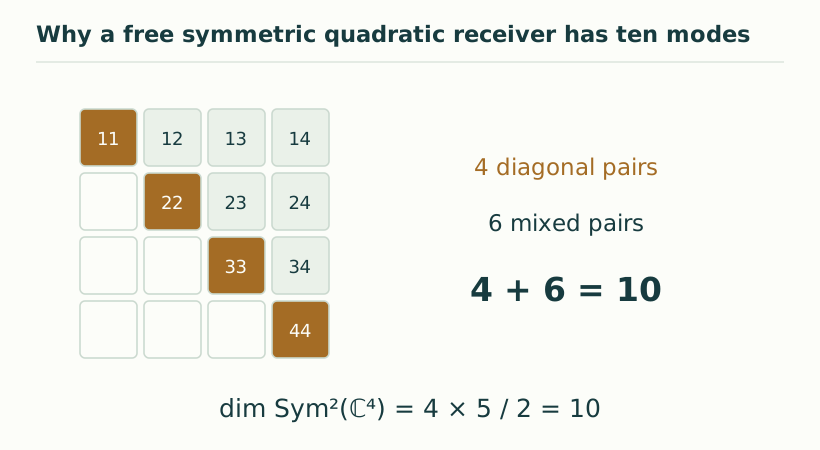
Figure 1. Why a free symmetric quadratic receiver has ten modes. A four-dimensional complex input has 4 diagonal quadratic modes and 6 unordered off-diagonal modes. Thus dim Sym²(ℂ⁴) = 4(4+1)/2 = 10. Selecting this receiver remains a model assumption. View full size ↗
03Work through dimensions one, two, and three
With one innovation, only e₁ occurs, giving one branch. With two, the basis is e₁,e₂,e₁∧e₂, giving three. With three, there are three single innovations, three two-innovation products, and one triple product, giving seven.
These are exact counts of the selected vector spaces. They do not imply that physical generation has one, three, and seven equally probable alternatives. A sampling law is additional data, and a static field can weight the modes differently.
Work through dimensions one, two, and three
Depth
Exterior degrees
Total rank
1
1
1
2
2+1
3
3
3+3+1
7
04Combine branches with retained pair memory
Let Q be the ten-dimensional quadratic receiver and R₀=0. The reconstruction rule R_d=(Q⊗R_d−1)⊕B_d propagates all earlier records through one Q label and adds the current terminal branches. Direct sums add dimensions, while tensor products multiply them.
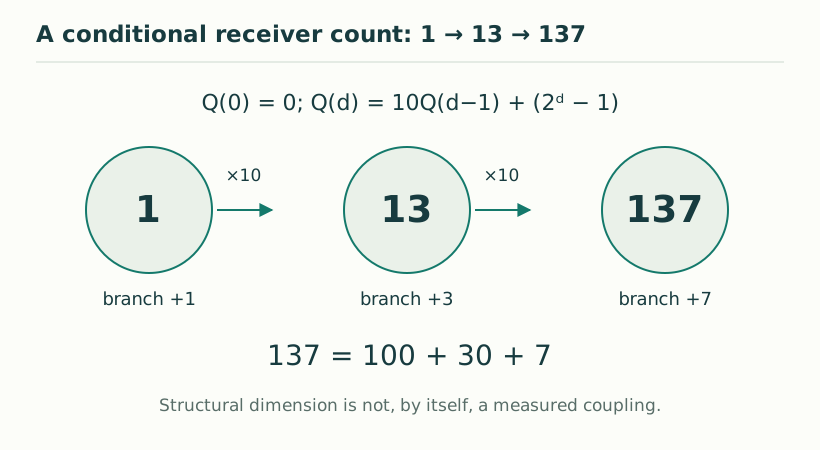
Consequently r₁=1, r₂=10×1+3=13, and r₃=10×13+7=137. Expanding the last expression gives sectors of dimensions 100,30,7. Every arithmetic operation corresponds to a declared record operation; this is more informative than merely observing a numerical coincidence.
r_d=10r_d−1+(2ᵈ−1)
r₁=1; r₂=13; r₃=137
Figure 2. A conditional receiver count: 1 → 13 → 137. For the selected finite grammar Q(0) = 0 and Q(d) = 10Q(d−1) + (2ᵈ − 1), the depth-three output has 137 retained modes. Identifying 1/137 with an electromagnetic coupling needs additional response normalization and matching. View full size ↗
05What relations would change the count?
The free construction assumes that all legal records remain distinct. If a realized stage identifies some combinations, its rank decreases. Writing δ_d for the new kernel dimension at stage d gives x_d=10x_d−1+(2ᵈ−1)−δ_d. At depth three the result is 137−100δ₁−10δ₂−δ₃.
Early losses are amplified because later memory factors propagate the lost distinctions. Full rank 137 therefore requires no new linear relations at any stage in this model class. This provides a concrete way to investigate compression, decoherence, or additional constraints without continuing to quote the free count after its premises have changed.
06The conceptual lesson for SMM/DTT
The binary subset rule and the ten-mode symmetric memory are independent assumptions with different purposes. One describes branch combinations; the other describes retention of pair data. Their combination can organize a finite record hierarchy, but neither follows from the other.
The six nested inner levels should not be replaced by the three displayed algebraic depths. A source realization must explain how its nested functions produce the required receiver and why those records remain distinguishable at completion. Until then, the counts provide a precise conditional model and a set of memory requirements, rather than a complete derivation of particles, spatial dimension, or coupling strength.
KEEP THE CONNECTION
Key ideas
Positive exterior degrees give the branch ranks 1,3,7.
The recurrence with a ten-mode memory yields 1,13,137.
Additional record relations change the count and must be included explicitly.
Scope of the argument. Conditional algebraic record counts, with no identification of branch ranks as particle multiplicities.
Sources & further reading
smm_dtt_quaternionic_rank3_hopf_reconstruction_v8.pdfWorking draft, pp. 18–22
smm_dtt_alpha0_137_v3.pdfWorking draft, pp. 3–15
Source editions and catalogue entries
Working manuscript
Quaternionic Rank-Three Readout, Hopf Geometry, and a Free Symmetric–Exterior Reconstruction Functor
Working manuscript. Article-level references identify the consulted sections and the scope of the interpretation. No public URL was supplied for this exact manuscript version.