Introduce the positive norm, associativity, and incompatible-phase hypotheses that select a quaternionic carrier. Present the conclusion as conditional algebraic rigidity.
If the Single Monad produces admissible operations that can be composed, the composition law needs a mathematical carrier. A carrier should specify how operations combine, which transformations are distinguishable, and which quantities remain positive. The draft investigates a particularly restrictive class: finite-dimensional real associative composition with a positive multiplicative quadratic norm.
Quaternions emerge only after these hypotheses are combined with two noncommuting circular phases. The conclusion is a conditional rigidity theorem. It is not a deduction of quaternionic space from the word monad, nor does it require treating quaternions as four observable spatial coordinates.
02The hypotheses and their functions
Let A be a real unital associative algebra and N a positive quadratic norm with N(xy)=N(x)N(y). For nonzero x, an equation xy=0 forces N(y)=0 and hence y=0. Left multiplication by x is therefore injective; finite dimension makes it surjective. The same argument applies on the right.
Left and right inverses agree by associativity, so A is a real associative division algebra. The classical finite-dimensional classification leaves R, C, and H. Requiring two elements j₁,j₂ with j₁²=j₂²=−1 and j₁j₂≠j₂j₁ excludes R and C, leaving H.
N(xy)=N(x)N(y), N(x)>0 for x≠0
j₁²=j₂²=−1; j₁j₂≠j₂j₁
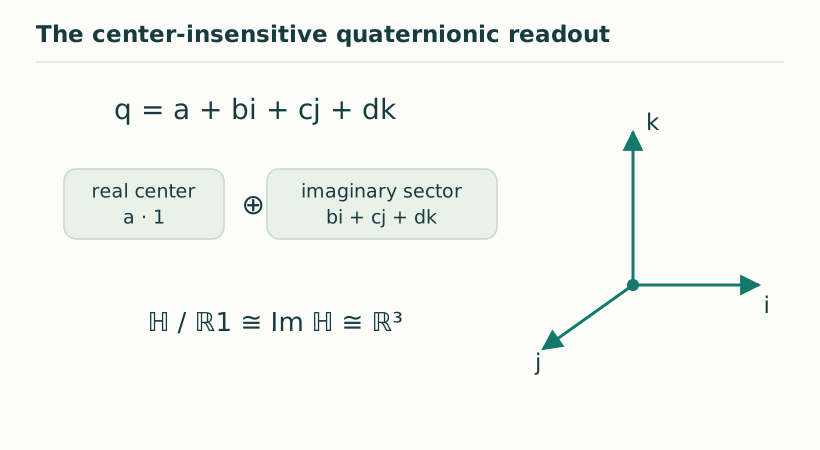
Figure 1. The center-insensitive quaternionic readout. Under the stated associative positive-norm and noncommutation hypotheses, the carrier is quaternionic. Quotienting the real center leaves the three-dimensional imaginary sector. This is a conditional readout result, not a standalone spatial dynamics. View full size ↗
03The two phases need not start orthogonal
A unit imaginary quaternion squares to −1. Let η be the Euclidean inner product of the two phase directions. Noncommutation means |η|<1. One can orthogonalize the pair, defining e₁=j₁ and e₂=(j₂−ηj₁)/√(1−η²), then set e₃=e₁e₂.
The resulting imaginary frame is orthonormal and obeys eₐ²=−1 and eₐe_b=−e_beₐ for distinct axes. Thus the orthogonal third direction follows from the multiplication and the incompatible pair. The original phase angle η remains an input; the theorem does not select it.
e₁=j₁; e₂=(j₂−ηj₁)/√(1−η²); e₃=e₁e₂
04What changes when a hypothesis changes
If phase composition is commutative, the complex numbers remain possible and the quaternionic conclusion fails. If associativity is relaxed, octonionic alternatives are no longer excluded by this argument. If positivity or the multiplicative norm is removed, much larger classes of algebras become possible.
These alternatives are not defects in the proof. They identify the physical selection obligations. SMM/DTT must explain why its operation carrier has the stated norm and associativity properties and why two incompatible circular phases are accessible. Algebraic uniqueness inside a selected class is different from proving that nature selects that class.
05Circular phase is different from split-complex time
The phase units used in this positive-norm reconstruction square to −1. A split-complex coordinate unit j with j²=+1 has a different role: its quadratic form is indefinite and it admits zero divisors. It is not interchangeable with a circular quantum phase unit in the preceding division argument.
DTT can use a hyperbolic temporal-coordinate description downstream while using circular phase for coherent operations. If both structures occur, their interface must be stated. Treating the symbols as the same object would invalidate the norm-based selection proof and obscure which geometry each one describes.
06From algebraic carrier to physical space
The imaginary quaternionic module carries a Euclidean inner product, cross product, and rotation action. Under suitable detector accessibility, its scalar-insensitive quotient has real rank three. These are promising ingredients for a local spatial readout.
A physical space additionally requires calibrated distances, neighborhoods, transport, persistence, and agreement among observers. The carrier theorem alone supplies none of those operational mechanisms. Its role in SMM/DTT is to make one part of the dimensional-emergence program precise: if a source’s composition obeys the listed laws, a quaternionic organization is unavoidable within that class. The remaining work is to derive or test those laws and connect the carrier to records.
KEEP THE CONNECTION
Key ideas
Positive associative normed composition plus incompatible circular phases selects H.
The orthogonal frame is constructed from a nonorthogonal phase pair.
Circular phase and split-complex temporal coordinates play distinct mathematical roles.
Scope of the argument. Conditional algebraic classification, not a proof of the physical source hypotheses or global spatial emergence.
Sources & further reading
smm_dtt_quaternionic_rank3_hopf_reconstruction_v8.pdfWorking draft, pp. 8–12
smm_dtt_alpha0_137_v3.pdfWorking draft, pp. 3–15
Source editions and catalogue entries
Working manuscript
Quaternionic Rank-Three Readout, Hopf Geometry, and a Free Symmetric–Exterior Reconstruction Functor
Working manuscript. Article-level references identify the consulted sections and the scope of the interpretation. No public URL was supplied for this exact manuscript version.