Ask when retained information is sufficient to predict future outputs autonomously. Explain the completion criterion and why keeping observations need not keep every dynamically relevant distinction.
01A record can be readable without being predictive
A retained observation describes what can be read now. A predictive state must also contain enough information to determine the statistics or values of future observations under the admitted dynamics. These tasks are different. The latest alpha draft includes an exact criterion for when a linear completed record supports an autonomous update.
This issue is central to DTT. Inner generation may retain phase or memory not present in the current outer record. If that hidden information later affects a readable output, the outer record alone is not a closed state description. Calling it complete does not remove the dependence.
02The exact linear criterion
Let H be a finite-dimensional carrier, P the orthogonal projection onto retained information, Q=I−P the hidden sector, and M the completed update. We seek an update T acting only on retained records such that PM=TP.
Multiplying this identity by Q shows the necessary condition PMQ=0. Conversely, if PMQ vanishes, PM=PMP and the required map is T=PM restricted to the retained subspace. This proves necessity, sufficiency, and uniqueness. The criterion asks whether hidden input can leak into the next visible output.
PM=TP ⇔ PMQ=0
T=PM|PH
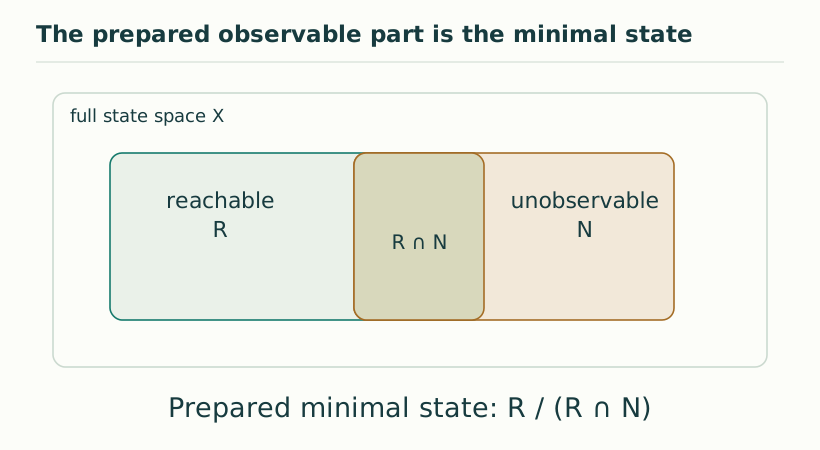
Figure 1. The prepared observable part is the minimal state. For a prepared linear interface, only reachable information that survives observational equivalence contributes to minimal behavior. The canonical state is R/(R∩N), not the entire hidden carrier. View full size ↗
03A two-coordinate example
Write a state as (x,y), with x retained and y hidden. If M maps it to (ax+by,cx+dy), the next record is ax+by. An autonomous rule using x alone exists exactly when b=0. Otherwise two states with the same x and different y have different next records.
The best retained-only linear approximation uses T(x)=ax, but its error on hidden changes is controlled by b. In the general Hilbert-space model, the exact worst-case residual is the operator norm of PMQ. This turns a qualitative claim of missing memory into a quantitative diagnostic.
inf_T ‖PM−TP‖=‖PMQ‖
04Quaternionic readout gives a concrete warning
The instantaneous imaginary part of a quaternion has three real components and forgets its scalar part. A later circular phase action can mix the scalar part into a visible imaginary component. Two quaternions with the same present three-dimensional readout can therefore have different later readouts.
A second suitably delayed observation can recover the missing scalar component when the phase sine is nonzero. The combined observations then need four real dimensions to retain all that information. This does not contradict the rank-three instantaneous detector theorem. It shows that the number of presently readable directions and the dimension of an autonomous predictive state answer different questions.
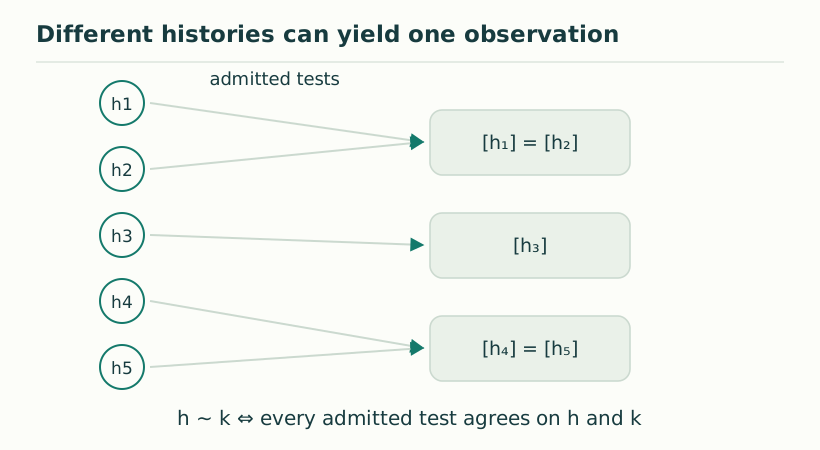
Figure 2. Different histories can yield one observation. The observational equivalence h ∼ k means that all admitted tests give the same result. Changing the test language can split an equivalence class and expose previously hidden distinctions. View full size ↗
05Completion can restore autonomy after an inner excursion
For finite-dimensional unitary M, exact autonomy is equivalent to P commuting with M. However, when M is a product of inner operations, the criterion constrains the completed product rather than every prefix. An inner rotation can mix retained and hidden directions, and a subsequent inverse rotation can cancel that mixing.
For example, with P selecting the first coordinate, a rotation U₁ by θ has leakage |sin θ|. Taking U₂=U₁⁻¹ makes the complete update U₂U₁=I, with zero leakage. This fits the DTT distinction between unfinished internal work and a completed observable return, while leaving the actual completion rule to be physically justified.
‖PU₁Q‖=|sin θ|; PU₂U₁Q=0
06Records, channels, and physical implementation
The projection P in this theorem is a linear information map. A quantum measurement on density matrices requires an instrument. The operation ρ↦PρP is trace decreasing and represents one outcome; normalizing it is postselection. Retaining both outcomes gives a trace-preserving measurement channel. These are not interchangeable descriptions.
A practical SMM/DTT construction should therefore identify its retained state, full update, and actual observation instrument separately. If autonomy fails, it can retain additional memory, restrict the operation language, or model the reduced process with history dependence. The exact leakage norm provides a useful target for approximate completion, but neither the criterion nor a cancellation example derives the six nested stages or the physical coupling normalization.
KEEP THE CONNECTION
Key ideas
Retained observations and autonomous predictive states need not coincide.
Hidden-to-visible leakage PMQ is the exact obstruction in the linear model.
A completed cycle can be autonomous even when its inner prefixes are not.
Scope of the argument. The theorem concerns finite-dimensional linear completion; quantum measurement claims additionally require a specified instrument.
Sources & further reading
smm_dtt_alpha0_137_v3.pdfWorking draft, pp. 5, 26–27
Source editions and catalogue entries
Working manuscript
Three-Dimensional Readout and the Structural Value 137 — Version 3
Draft file: smm_dtt_alpha0_137_v3.pdf
Working manuscript. Article-level references identify the consulted sections and the scope of the interpretation. No public URL was supplied for this exact manuscript version.