
In this article
- Changing the frame can mean two different things
- The stated flag convention
- The fixed-fiber obstruction
- Transporting the response still works
- An instructive surviving freedom
- How to interpret the result physically
Explain the draft’s distinction between covariantly transported response and a single fixed rotation representation. A useful invariant can survive even when a stronger representation requirement fails.
A construction may use a line inside a plane inside a three-dimensional space. Such a nested choice is a flag. The rank-137 receiver depends on this flag through its lower-dimensional branch objects. Equal dimensions for different flags do not automatically provide a single rotation action on one fixed receiver.
The draft distinguishes transport between different receivers from active rotation within one fixed receiver. This distinction is important for SMM/DTT because a spatial readout should not acquire arbitrary observable dependence on an auxiliary construction frame. A covariant family can remove some frame dependence even when a stronger fixed-space representation does not exist.
The ambient three-dimensional readout W is oriented, but the proper line W₁ and plane W₂ are unoriented. A rotation g maps one flag F to another and induces a unitary map U_g between their receivers by the symmetric, exterior, tensor, and direct-sum constructions. Composition of rotations gives composition of these maps.
For an adapted orthonormal frame, the rotations fixing the entire flag are diagonal sign changes with determinant +1. This four-element stabilizer is isomorphic to Z₂×Z₂. Its nonidentity elements are half-turns about the three adapted axes. They act nontrivially on the retained words even though they leave the underlying unoriented flag unchanged.
The natural stabilizer representation on the 137-dimensional receiver decomposes with multiplicities 31,38,34,34 in its four one-dimensional characters. The traces of the three half-turns are therefore 1,−7,−7.
In any representation of SO(3), conjugate group elements must have the same character. All three half-turns are conjugate in SO(3), but these traces differ. Hence the natural stabilizer action cannot extend to one SO(3) representation on the same fixed receiver while preserving all those stabilizer maps. This is an explicit obstruction, not merely a missing construction.
Let A₀ and J₀ be the positive response operator and source at a base flag. Transport them together by T_g(F)=U_gFU_g†. The transported pair is independent of which rotation reaches a target flag exactly when the base pair is invariant under the stabilizer.
Under that condition, the source capacity is unchanged because T_g preserves the inner product and transports A⁻¹ along with J. Thus a flag-independent static scalar response exists despite the fixed-fiber obstruction. The theorem concerns the response pair and its observable capacity, not every individual record vector.
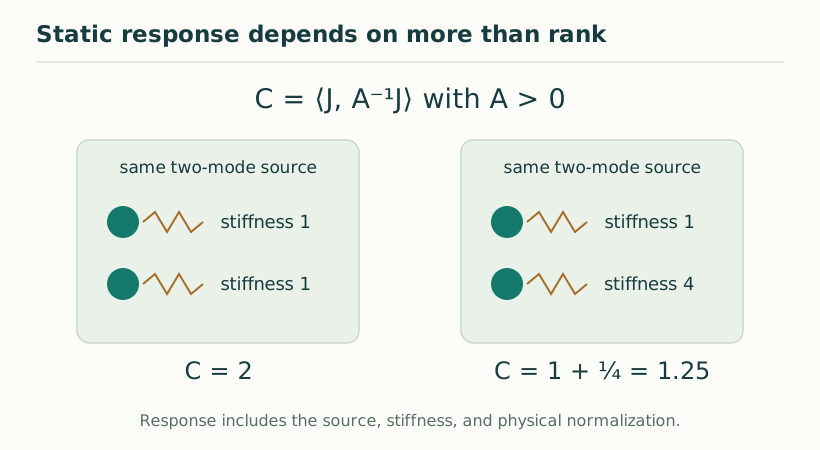
The isotropic choice J=I and A=κI satisfies the stabilizer conditions and gives C=137/κ. But a block response with different stiffnesses on the 100-, 30-, and 7-dimensional sectors also descends consistently. Its capacity remains 100/κ₁+30/κ₂+7/κ₃ at every transported flag.
Therefore covariance does not select equal stiffnesses or the normalization needed for α₀model=1/137. It removes arbitrary coordinate dependence from a supplied response law while permitting physically different laws. Confusing covariance with isotropy or universality would hide this remaining freedom.
The obstruction is tied to the stated unoriented-flag convention. Fully oriented proper subspaces have a different stabilizer and do not inherit this argument unchanged. Changing the convention is legitimate, but it changes the model and still requires an operational explanation of what is retained or forgotten.
The constructive message is that an invariant observable can survive a failure of a stronger representation demand. For SMM/DTT, this offers a disciplined way to connect internally organized histories to public quantities. A full spatial theory would additionally need compatible matter dynamics, transport connections, and tests of an embedded geometry. Invariance of one static capacity is an important consistency check, but it is not that entire theory.
KEEP THE CONNECTION
Scope of the argument. The obstruction and covariance theorem apply to the precise unoriented-flag model, not every possible frame convention.
Draft file: smm_dtt_alpha0_137_v3.pdf
Working manuscript. Article-level references identify the consulted sections and the scope of the interpretation. No public URL was supplied for this exact manuscript version.
Source register →