
In this article
- The question behind this comparison
- The SMM/DTT starting point
- How the comparator works
- The decisive comparison
- Worked benchmark
- What follows for the source programme


A source can release repeatable classical labels without duplicating its unknown quantum state. This comparison with QBism derives the no-cloning restriction, distinguishes reversible work from record publication, and examines what physical memory and computational constraints could make DTT’s cosmic-computer idea an explanatory model.
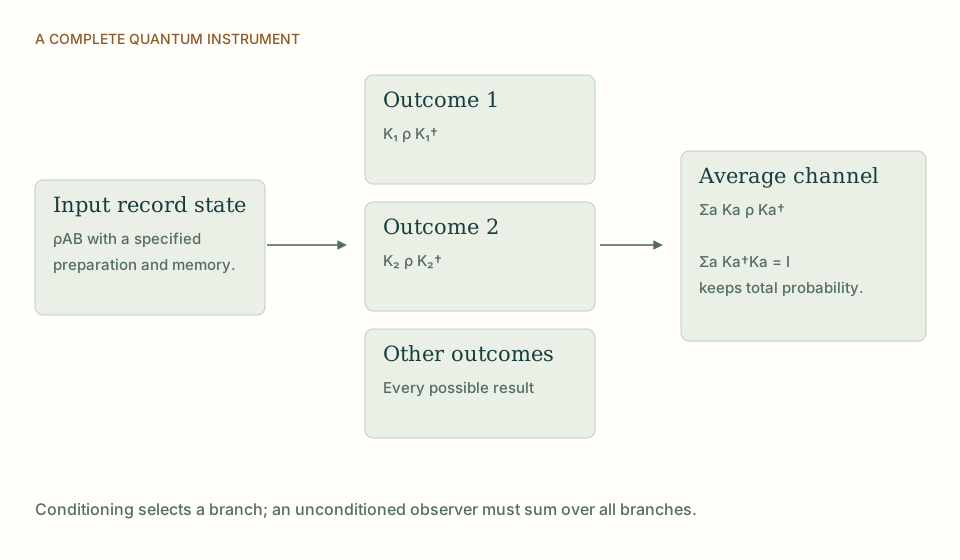
Quantum information is encoded in states and transformations whose coherence matters to the result. A reversible computation acts bijectively on the relevant state space; a quantum circuit ordinarily uses unitary gates. Irreversible operations such as resetting a register require an environment or another information-bearing resource. A source can carry out a long sequence of reversible inner steps while releasing an effectively irreversible record at its outer interface.
This makes DTT a promising language for separating work, memory and publication. Its distinct ambition is to connect those computational roles to the production of physical structure itself. A simulation of particles on a pre-existing lattice is not yet an explanation of why space exists. The key mathematical question is which architecture and resource restrictions force an observable geometry or clock relation, rather than merely allow an arbitrary controller to implement one. [3] [4]
The Single Monad Model begins with one nonspatial generative source. The Duality of Time Theory distinguishes the source’s inner production from the outer order in which completed records become accessible. Its six inner levels are nested functional roles of one process: a higher role organizes lower-level work. The seventh is the completion or observation interface. They are neither six independent clocks nor six additional time coordinates.
This distinction supplies a useful research question: which features of an observed world can follow from the way a source produces, retains and releases information? A concrete answer needs a state space, an autonomous update, retained memory and a rule connecting completion to an accessible measurement. In the constructions discussed here, those mathematical ingredients are stated explicitly. A successful finite example establishes what its specified mechanism can do; further arguments connect it to physical particles, spacetime or universal laws. [1]
QBism interprets quantum probabilities as an agent’s personal expectations for the consequences of actions on the world. The quantum state belongs to that probability assignment rather than serving as a complete observer-independent description of the system. The Born rule acts as an additional normative constraint among an agent’s probability judgments. QBism does not deny an external world; it rejects an interpretation in which the state is simply a catalogue of its intrinsic properties.
The Single Monad Model has a much stronger ontological ambition: one source is intended to explain the production of physical multiplicity. A mathematical DTT model can still use an operational probability interface, but equating that interface with QBism would obscure this difference. The informative question is whether a proposed generative law imposes new, testable restrictions on the probabilities an agent should assign. If it does not, the two views can organize the same data while offering substantially different accounts of what the formalism means. [2]
QBism interprets a quantum computation as a structured sequence of actions for which an agent assigns probabilities to possible outcomes. It does not require the processor to be a literal simulator of many worlds or a metaphysical computer. DTT gives the computational organization an ontological ambition by proposing that physical multiplicity itself arises from source activity. Both views nevertheless face the same operational restrictions on what a device can deliver.
The no-cloning benchmark makes this common ground precise. An agent cannot demand independent copies of an unknown state, and a source theorist cannot evade that limit merely by placing the copying operation inside unobserved time. A concrete DTT model might explain why only certain completed labels can be duplicated and why coherent memory has a finite capacity. These would be physical constraints that an agent could incorporate into expectations. The distinction between a useful model and an established cosmic mechanism remains: implementing a circuit shows that the source architecture can process quantum information, while demonstrating that its resource laws also determine spatial readout would supply the deeper explanatory result. [2] [3] [4]
Suppose a unitary device could copy every unknown qubit: U|ψ⟩|0⟩=|ψ⟩|ψ⟩. Apply it to two possible inputs |ψ⟩ and |φ⟩. Unitarity preserves their inner product, so s=⟨ψ|φ⟩ must satisfy s=s². This requires s=0 or s=1. Two distinct nonorthogonal states, such as |0⟩ and |+⟩ with s=1/√2, cannot both be copied perfectly by that device.
The result still permits copying an orthogonal classical record. A controlled-NOT gate sends |0⟩|0⟩ to |0⟩|0⟩ and |1⟩|0⟩ to |1⟩|1⟩. On a superposition it creates entanglement rather than two independent copies. Thus an outer archive may distribute a stable outcome label widely without cloning the full inner quantum state. This simple distinction prevents the cosmic-computer analogy from assuming an impossible universal backup of unknown quantum information. [3] [4]
The argument assumes deterministic exact copying by one input-independent unitary and an initially fixed blank register.
A source-based computational model becomes informative when it includes the cost of protected memory, resetting and local access. Quantum error correction shows that reliable logical information can survive selected errors through redundancy without cloning an unknown state. DTT can investigate whether the same protection rules also select completed records or effective neighborhoods. That is a more concrete route than identifying the cosmos with a computer solely because its history can be represented as a sequence of symbols. [3] [4]
THE SAME QUESTION, DIFFERENT STARTING POINTS
| Question | SMM/DTT | QBism |
|---|---|---|
| Starting structure | One nonspatial source, retained memory and six nested inner functions with an outer completion interface. | An agent’s probability assignments for actions and experiences. |
| Observable connection | The source update and readout must generate the measured records and their calibrated relations. | An outcome informs that agent’s subsequent expectations. |
| Quantum information and reversible computation | The no-cloning benchmark makes this common ground precise. | QBism interprets a quantum computation as a structured sequence of actions for which an agent assigns probabilities to possible outcomes. |
| Status of the claim | A constructive research programme; a specified finite model establishes only its stated conditional results. | Interpretation of quantum probabilities rather than a unique hidden source dynamics. |
KEEP THE CONNECTION
Connects this comparison with the author’s underlying construction.
Connects this comparison with the author’s underlying construction.
Connects this comparison with the author’s underlying construction.
Connects this comparison with the author’s underlying construction.
Places the comparison alongside the programme’s published results, assumptions and open targets.
References support the comparator and the specific mathematical or interpretive claims indicated. SMM/DTT connections are developed in the analysis above.
How these comparisons distinguish premises, results and physical claims