
FOLLOW THE ARGUMENT
Research claim map
Find the precise statement, the inputs it needs, the result established by its argument and the next connection to be made.
Read each statement with its dependencies
Use this map to move from a claim to its assumptions, calculation and source. Its categories describe the role of the statement in this collection. They are not a scale of empirical confirmation: published theorems also have hypotheses, and a model result can be rigorous without selecting the physical world.
A motivating commitment or chosen starting rule. The map identifies what a realization must supply.
An exact calculation or conditional theorem for the declared state space, operations and readouts.
A result connected to a journal publication, interpreted under that paper’s hypotheses. Publication does not establish every proposed physical extension.
A mathematical or physical bridge still required by the programme. The entry states what would count as progress.
Follow a row to inspect its detailed entry. For a complete argument, open the linked derivation or original publication. The course introduces the vocabulary, while the critical discussions and validation guides examine how the constructions could be strengthened.
No claims match these filters. Try a broader term or clear the filters.
| Statement | Topic | Role | Central claim |
|---|---|---|---|
| One source is an organizing premise | Source and records | Framework premise | Observable multiplicity is proposed to arise from the differentiated activity and retained records of one source. |
| A completed display must retain its predictive distinctions | Source and records | Result within a stated model | A deterministic update descends to displayed records exactly when equal displayed inputs always have equal displayed successors. |
| Six inner roles and a seventh completion role | Nested generation | Framework premise | The six inner roles are nested dependencies in one generative process; the seventh makes a completed result available. |
| Paired channels give the rank sequence 1, 1, 2, 2, 3, 3 | Nested generation | Result within a stated model | A six-digit paired-difference readout has prefix affine rank ceiling(a/2) under its declared frame and initialization. |
| 64 binary addresses produce 27 nonuniformly weighted sites | Nested generation | Result within a stated model | Uniform sampling of six bits gives a 27-site paired readout with product multiplicities, not a uniform spatial measure. |
| Uniform refinement gives a precise address-space dimension | Geometry | Result within a stated model | For B children and scale contraction q⁻¹, the specified infinite address ultrametric has Hausdorff dimension D=log B/log q. |
| Structured operations yield lattice neighborhoods and a support bound | Geometry | Result within a stated model | Commuting record operations and a declared local circuit can establish exact finite locality. |
| Normalized comparison blocks recover shortest-path distance | Geometry | Result within a stated model | The specified direct sum of two-site spectral blocks gives exactly the weighted graph metric. |
| Hermitian positivity supplies a cone before physical relativity | Geometry | Result within a stated model | For X=TI+x·σ, positivity is equivalent to T≥|x| and the determinant is T²−|x|². |
| Real skew dynamics selects an ordinary complex structure | Quantum phase | Result within a stated model | For an invertible finite real skew generator A, its polar factor J=A(−A²)⁻¹ᐟ² is an orthogonal complex structure. |
| Published completion and observable-descent framework | Published mathematics | Published mathematical result | The completion paper formalizes when history actions induce well-defined dynamics on completed observable records. |
| Published real-commutant phase selection | Published mathematics | Published mathematical result | The phase-selection paper studies compatible imaginary units of a real Hilbert representation and their selection by oriented orthogonal dynamics. |
| Published representation of convolution memory | Published mathematics | Published mathematical result | The temporal-asymmetry paper represents a specified class of convolution equations by a local age-structured dual-time system. |
| Quaternionic composition gives a conditional three-direction readout | Quantum and spatial readout | Result within a stated model | The declared algebra class selects quaternions, whose scalar-insensitive linear quotient has three real directions. |
| Spinor directions and full-turn signs have exact readout laws | Spin and composition | Result within a stated model | A normalized complex doublet produces a unit Bloch vector and a spin-half rotation changes its sign after 2π. |
| A free symmetric quadratic receiver has ten modes | Receiver and 137 | Result within a stated model | Sym²(V) has ten independent modes when V has dimension four over the declared scalar field. |
| The selected free grammar has exactly 137 records | Receiver and 137 | Result within a stated model | Ten continuation modes and nonempty exterior branches at depths one through three yield a receiver of dimension 137. |
| Dimension 137 does not fix the inherited phase degree | Receiver and 137 | Result within a stated model | The free receiver’s dimension and its determinant phase exponent differ unless a new common output action is selected. |
| A receiver response depends on stiffness and source normalization | Coupling | Result within a stated model | Positive quadratic minimization gives capacity C=⟨f,K⁻¹f⟩ and minimum energy j²/(2C) at fixed current j. |
| Selecting a physical alpha requires a dimensionless source law | Coupling | Open research target | The missing coupling target is the primitive ratio s_cont/(4πac), followed by electromagnetic identification. |
| Branch invisibility is an exact commutant condition | Clocks | Result within a stated model | In the finite clock model, branch operations are invisible precisely when their generator commutes with the resolution-evolved accessible algebra. |
| A common refinement encoder does not select every clock | Clocks | Open research target | Universal material-clock behavior requires a source restriction on admissible clock couplings. |
| The supplied Coulomb model has an exact normalized ground state | Matter | Result within a stated model | For H=−DΔ−C/r with D,C>0, the spinless ground state has a=2D/C and energy −C²/(4D). |
| The alpha relation concerns relative RMS speed | Matter | Result within a stated model | The Coulomb ground state gives v_rel,rms/c=g, becoming alpha after electromagnetic matching. |
| Compatible complex composition needs a balancing relation | Spin and composition | Result within a stated model | Balancing the two local phase actions recovers the complex tensor product from supplied real carriers. |
| Projected memory and a thermodynamic arrow are separate results | Temporal asymmetry | Result within a stated model | Eliminating a hidden mode creates exact memory, but the kernel’s decay alone does not establish stable or entropic evolution. |
| A retained block structure has an exact conditional stabilizer | Gauge interactions | Result within a stated model | Two Hermitian blocks and a fixed product-volume tensor have stabilizer S(U(3)×U(2)). |
| A gravitational limit requires dynamics and universal matter response | Gravity and scales | Open research target | The source must derive an effective geometric action and a shared stress-energy coupling, beyond recovering a cone or metric. |
| Phase composition fixes a form while physical scales remain inputs | Gravity and scales | Result within a stated model | A continuous nontrivial character of additive real action has the form exp(iεS/a), with a>0 and orientation ε=±1. |
| One dynamics should constrain geometry, clocks and matter together | Common-source programme | Open research target | The central target is a joint relation among independently defined records, clock readings and matter transport under one source update. |
| A physical particle spectrum needs source-selected carriers and dispersion | Matter | Open research target | Persistent or isolated model modes become particle candidates only after charge, spin, transport and a common scale dictionary are established. |
| Normalized response cannot determine an absolute vacuum offset | Gravity and scales | Open research target | Vacuum selection needs an absolute metric-dependent functional that normalized source responses cannot recover. |
On a narrow screen, scroll the table horizontally or read the full entries below. All claims and links remain available without JavaScript.
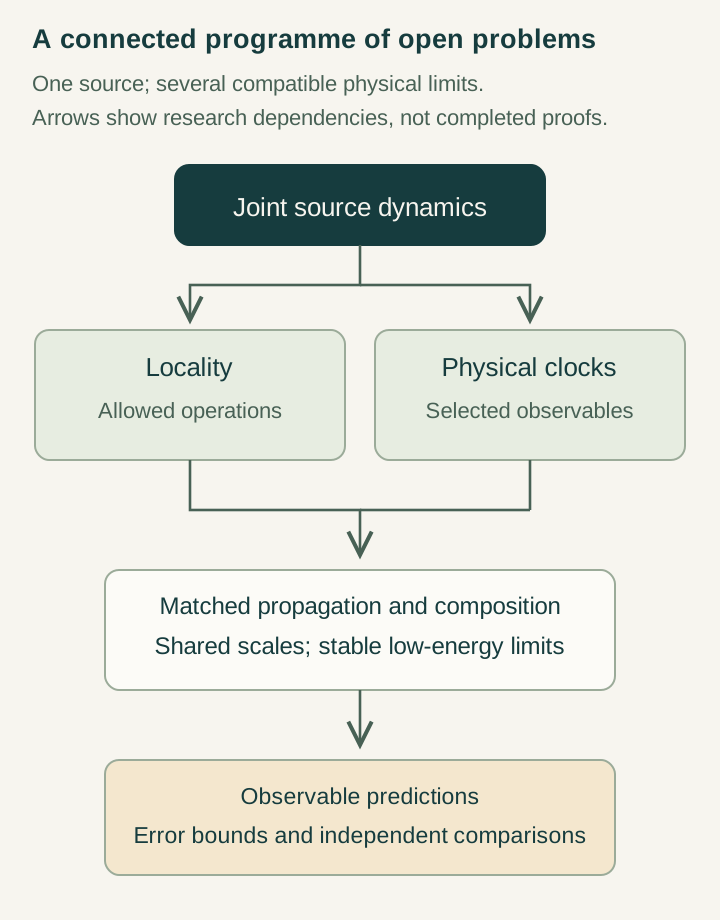
Open the full-size diagram →
One source is an organizing premise
Observable multiplicity is proposed to arise from the differentiated activity and retained records of one source.
Assumptions and interface
- A generative state, admissible operations and retained memory are specified before physical coordinates.
- Completion identifies which outputs become available to later tests.
What the argument establishes
This premise changes the reconstruction question: operations and their relations must explain the observed organization. A single active controller can process many stored labels, so unity of activity is compatible with a large archive. In the finite translation example, three commuting operations on residues modulo five generate 125 distinct relational records.
The remaining connection
The premise alone selects no operation table, probability measure or memory capacity. A physical model must account for the archive, preparation and completion costs and explain why its particular relations are realized. The 125-record example demonstrates a supplied architecture; it is not a proof that source unity forces a particular spatial geometry.
Return to the claim table ↑A completed display must retain its predictive distinctions
A deterministic update descends to displayed records exactly when equal displayed inputs always have equal displayed successors.
Assumptions and interface
- The complete state update U and record map Π are fixed.
- Every admitted continuation belongs to the declared test language.
What the argument establishes
The condition Π(z)=Π(w) ⇒ Π(Uz)=Π(Uw) makes V(Π(z))=Π(Uz) independent of the representative. In a finite linear model, with retained projection P and update M, the equivalent condition is PM(I−P)=0. The minimum operator-norm error of any autonomous retained update is exactly ‖PM(I−P)‖.
The remaining connection
The binary paired counter gives an exact failure: addresses 0 and 3 both display the origin, while successors 1 and 4 display ℓe₁ and ℓe₂. A completed predictive record must retain the carry information, use a boundary that resets it, or include memory in its future law. Present agreement alone does not establish observational equivalence under future experiments.
Return to the claim table ↑Six inner roles and a seventh completion role
The six inner roles are nested dependencies in one generative process; the seventh makes a completed result available.
Assumptions and interface
- A higher role acts on retained output from lower roles.
- A completion condition is implemented by the specified process.
What the argument establishes
A radix-q counter realizes this organization: one update drives all six digits, while digit a changes only after groups of qa−1 elementary advances. A completed archive can retain the generated sites, their multiplicities and the information needed for later use. The outer role certifies availability; it need not add another coordinate to the internal counter.
The remaining connection
The role description does not establish six independent laboratory clocks, seven time axes or a universal duration per completion. A physical realization must state each retained register, its update, its completion flag and the resources used to export a record. The paired rank theorem below adds a particular spatial readout to this organizational premise.
Return to the claim table ↑Paired channels give the rank sequence 1, 1, 2, 2, 3, 3
A six-digit paired-difference readout has prefix affine rank ceiling(a/2) under its declared frame and initialization.
Assumptions and interface
- Radix q≥2, ℓ>0 and three independent frame vectors are supplied.
- Q(d)=ℓ[(d₁−d₂)e₁+(d₃−d₄)e₂+(d₅−d₆)e₃], starting at the zero address.
What the argument establishes
The first a digits span at most ceiling(a/2) columns, and single nonzero odd digits attain that bound. For an odd linear readout CP=−C under a channel-pair exchange P, each exchanged pair contributes at most one independent direction. Rank three therefore needs at least six channels in that architecture.
The remaining connection
This lower bound assumes individual opposite primitive pairs and one primitive channel per level. Four nonnegative tetrahedral vectors (1,1,1), (1,−1,−1), (−1,1,−1), (−1,−1,1) already span three dimensions without individual opposite partners. Thus the model proves its restricted rank law while leaving physical selection of the pairing and frame to a source theorem.
Return to the claim table ↑64 binary addresses produce 27 nonuniformly weighted sites
Uniform sampling of six bits gives a 27-site paired readout with product multiplicities, not a uniform spatial measure.
Assumptions and interface
- The six-bit sweep visits every address exactly once.
- Three paired differences are read in an independent frame.
What the argument establishes
Each difference takes −1, 0, +1 with multiplicities 1, 2, 1. Their product gives 27 sites and 64 total representatives. The origin has probability 1/8; each corner has probability 1/64. For an orthonormal frame the covariance is (ℓ²/2)I. The displayed site retains 4.5 bits of the six-bit address entropy, losing 1.5 bits on average.
The remaining connection
Uniform site sampling would require a different preparation or explicit inverse-multiplicity weighting. A coherent source preparation also needs its own amplitudes and completion instrument. Site count, statistical weight and predictive state size remain different outputs. In particular, the counter’s scan and carry jumps cannot be identified with local particle motion without an additional transport law.
Return to the claim table ↑Uniform refinement gives a precise address-space dimension
For B children and scale contraction q⁻¹, the specified infinite address ultrametric has Hausdorff dimension D=log B/log q.
Assumptions and interface
- B≥2, q>1 and scale L>0 are fixed.
- Infinite words have distance Lq⁻ᵐ when their longest common prefix has length m.
What the argument establishes
Level-n cylinders give Bⁿ covers of diameter Lq⁻ⁿ. The upper bound follows because Bⁿ(Lq⁻ⁿ)s tends to zero for s>D. Uniform cylinder mass B⁻ⁿ supplies the matching lower bound. Thus B=8 and q=2 give dimension three, while B=6 gives log₂6 within the same construction.
The remaining connection
A finite archive itself has Hausdorff dimension zero; the positive exponent belongs to the stated limit or a scaling window. Even D=3 leaves an ultrametric, disconnected address geometry. Connecting it to a spatial manifold requires additional adjacency, comparison and stability results. Linear readout rank, spectral dimension and this refinement dimension should be measured separately before being identified.
Return to the claim table ↑Structured operations yield lattice neighborhoods and a support bound
Commuting record operations and a declared local circuit can establish exact finite locality.
Assumptions and interface
- Reversible operations act transitively and commute, giving records ℤᵈ/Λ.
- Each completed update uses on-site gates and one nearest-edge port layer, without an extra remote memory channel.
What the argument establishes
If the shortest nonzero return word exceeds 2R+1, induced radius-R neighborhoods agree with the infinite lattice. Separately, k completed circuit updates enlarge observable support by at most k graph steps. A modulo-seven cubic archive therefore has ordinary radius-two neighborhoods, and the supplied circuit preserves its influence bound.
The remaining connection
Preparing the commuting tables is a separate problem from transporting locally on them. A controller carrying an unknown payload between distant labels creates an extra channel unless its route is included in the physical graph. Stability also requires controlling defects and shortcuts. A physical speed emerges only after edge lengths and actual completion durations are independently calibrated.
Return to the claim table ↑Normalized comparison blocks recover shortest-path distance
The specified direct sum of two-site spectral blocks gives exactly the weighted graph metric.
Assumptions and interface
- The record graph is connected and each edge has positive length ℓₑ.
- Each comparison block has off-diagonal entries 1/ℓₑ; observables are vertex functions.
What the argument establishes
The commutator norm is L(f)=maxₑ|f(x)−f(y)|/ℓₑ. Every L(f)≤1 function has endpoint difference at most any path length. The function f(z)=dist(z,y) attains the shortest-path value. If each edge changes by at most a relative ε, every resulting distance stays between (1−ε) and (1+ε) times its original value.
The remaining connection
The normalization and comparison graph remain inputs. A cubic axial graph gives Manhattan distance: (0,0,0) to (1,1,0) costs two, rather than √2. A Euclidean limit needs a derived isotropic comparison law. Spectral counting alone is insufficient: when D and all observables are diagonal, every commutator vanishes and distinct evaluation states have infinite spectral distance.
Return to the claim table ↑Hermitian positivity supplies a cone before physical relativity
For X=TI+x·σ, positivity is equivalent to T≥|x| and the determinant is T²−|x|².
Assumptions and interface
- Completed records are represented by two-by-two Hermitian matrices with the declared Pauli basis.
- The scalar coordinate T and three-vector x are initially algebraic readouts.
What the argument establishes
The eigenvalues T±|x| give the round future cone exactly. Another construction composes completed displacement-delay bounds: ‖xₖ‖≤c*τₖ implies ‖Σxₖ‖≤c*Στₖ by the triangle inequality. Both calculations make a causal-looking ordered structure explicit from supplied readout data.
The remaining connection
To interpret the cone physically, material clocks and rulers must realize its coordinates and transformations. Matter and electromagnetic propagation must share the same calibrated bound. A cone fixes less than a fully normalized metric, while a metric fixes no gravitational equation by itself. The remaining theorem must connect these interfaces through the actual source dynamics, rather than identifying them because their formulas resemble relativity.
Return to the claim table ↑Real skew dynamics selects an ordinary complex structure
For an invertible finite real skew generator A, its polar factor J=A(−A²)⁻¹ᐟ² is an orthogonal complex structure.
Assumptions and interface
- Aᵀ=−A on a finite real inner-product space, with oriented forward flow exp(tA).
- An independently chosen positive action scale a is used for energy conversion.
What the argument establishes
Set Ω=(−A²)¹ᐟ². Positivity and commutation give A=JΩ, J²=−I and JᵀJ=I. For A=diag(2J₀,−3J₀), the phase is diag(J₀,−J₀), retaining orientation while Ω retains rates. Positive H=aΩ in i aψ̇=Hψ uses the convention i=−J for this forward flow.
The remaining connection
On ker A the flow selects no phase; an odd-dimensional stationary sector cannot carry a complex structure at all. Infinite-dimensional versions require their operator-domain hypotheses. This ordinary complex unit differs from split-complex j²=+1. Observable access, probabilities, composite systems and the physical action scale remain further construction steps.
Return to the claim table ↑Published completion and observable-descent framework
The completion paper formalizes when history actions induce well-defined dynamics on completed observable records.
Assumptions and interface
- A history monoid acts on a state space X.
- A surjective record map ρ satisfies ρ(x)=ρ(y) ⇒ ρ(hx)=ρ(hy) for every admitted history h.
What the argument establishes
The observable-descent result gives a unique induced action with h̄(ρ(x))=ρ(hx). The published framework then treats real commutants, oriented phase and downstream cone readouts as separate mathematical modules. Its physical cone statement explicitly requires supplied length-delay data; it does not follow from source unity alone.
The remaining connection
Here published result means a linked journal mathematical statement under its stated hypotheses, not experimental validation or general acceptance of SMM/DTT physics. The source still has to select the state space, test language and physical calibration. Applying another module requires its additional assumptions; the paper does not turn every later receiver, clock or coupling construction into a published theorem.
Primary sources
Return to the claim table ↑Published real-commutant phase selection
The phase-selection paper studies compatible imaginary units of a real Hilbert representation and their selection by oriented orthogonal dynamics.
Assumptions and interface
- A real Hilbert space carries the specified orthogonal representation.
- Compatible J operators commute with that representation and satisfy J²=−I and J*=−J.
- Selection uses an oriented orthogonal flow on its dynamic sector.
What the argument establishes
The real commutant organizes admissible complex structures. Polar factorization A=J|A| selects phase on the nonstationary sector; reversing the oriented generator reverses that phase. A real norm-preserving reversal that anticommutes with J becomes antiunitary after complex reconstruction. The local guide illustrates these facts with explicit rotating planes.
The remaining connection
Stationary modes leave extension freedom or an obstruction, and compatible subsystem composition requires a separate balancing rule. This entry records a published kinematical result, not a derivation of every quantum postulate or evidence of a second measurable time. The linked journal is the authority for precise general hypotheses; the finite guide does not claim an independent audit of every infinite-dimensional proof.
Primary sources
Return to the claim table ↑Published representation of convolution memory
The temporal-asymmetry paper represents a specified class of convolution equations by a local age-structured dual-time system.
Assumptions and interface
- Bounded operators A, B, C and D define K(t)=C exp(tB)D.
- The memory field has boundary input χ(t,0)=Du(t), zero initial past and the stated solution regularity.
What the argument establishes
The characteristic formula χ(t,s)=exp(sB)Du(t−s) for 0≤s≤t gives a local transport equation (∂ₜ+∂ₛ)χ=Bχ. Integrating Cχ over memory ages recovers u̇=Au+∫₀ᵗK(t−r)u(r)dr. The reverse substitution establishes the stated representation under the paper’s hypotheses.
The remaining connection
The represented kernel and initial preparation are specified inputs. This is a published mathematical equivalence, not a proof that memory uniquely reveals two independently measurable times or that every such system produces thermodynamic entropy. Its two-coordinate formulation also differs from the later six-role nested construction; relating them requires an explicit map and observables.
Primary sources
Return to the claim table ↑Quaternionic composition gives a conditional three-direction readout
The declared algebra class selects quaternions, whose scalar-insensitive linear quotient has three real directions.
Assumptions and interface
- The carrier is a finite-dimensional real unital associative algebra with positive multiplicative quadratic norm.
- It contains two noncommuting circular units squaring to −1.
- The completed detector has access to all distinctions modulo real scalars.
What the argument establishes
Positive multiplicativity excludes nonzero zero divisors. Finite dimension and associativity give a real division algebra; noncommutation excludes the real and complex cases. For ℍ, removing the scalar direction gives the linear quotient ℍ/ℝ1≅Im ℍ≅ℝ³. This is a quotient of real vector spaces, not an algebra quotient by an ideal.
The remaining connection
Scalar blindness alone is insufficient: a detector reading only one component has a larger kernel. Available controls must expose all three directions with a bounded conditioning error. The source must also select the algebra hypotheses and generate neighborhoods, length calibration and compatible transport. Three local readout components alone do not establish physical space.
Return to the claim table ↑Spinor directions and full-turn signs have exact readout laws
A normalized complex doublet produces a unit Bloch vector and a spin-half rotation changes its sign after 2π.
Assumptions and interface
- The carrier is a normalized two-component complex spinor.
- Pauli quadratic tests and the representation U(θ)=exp[−iθ(n·σ)/2] are supplied.
What the argument establishes
The readout (2Re(z₁*z₂),2Im(z₁*z₂),|z₁|²−|z₂|²) has unit norm and is unchanged by a common phase. Thus common-phase circles in S³ project to S². Meanwhile U(2π)=−I and U(4π)=I. A full-turn sign applied to one coherent path can exchange bright and dark interference outputs.
The remaining connection
A global sign on an isolated ray is unobservable. The interference claim requires a coherent reference and controlled path phases. The two-dimensional sphere of directions is embedded in a three-dimensional readout module, not a derivation of a spatial manifold. Particle identity, magnetic response, fermionic exchange and the Pauli exclusion law require additional composition and dynamical structure.
Return to the claim table ↑A free symmetric quadratic receiver has ten modes
Sym²(V) has ten independent modes when V has dimension four over the declared scalar field.
Assumptions and interface
- The envelope is a scalar identity channel plus a three-direction module.
- The receiver must retain every symmetric bilinear test without additional relations.
What the argument establishes
An orthonormal basis consists of four diagonal tensors eₐ⊗eₐ and six mixed tensors (eₐ⊗eᵦ+eᵦ⊗eₐ)/√2. Their count is 4+6=10. Every symmetric bilinear test factors uniquely through this space. Quaternionic symmetrized multiplication is only rank four, with six independent kernel directions, so product storage alone loses pair information.
The remaining connection
Ten is real dimension for a real envelope and complex dimension after complexification; it is not ten spatial directions. The retention task is a physical choice requiring pair preparation, memory and measurement access. Its bilinear formula does not clone an unknown quantum state. Using all ten modes as continuation labels in a later grammar adds another assumption.
Return to the claim table ↑The selected free grammar has exactly 137 records
Ten continuation modes and nonempty exterior branches at depths one through three yield a receiver of dimension 137.
Assumptions and interface
- Q has dimension ten and B_d is the sum of positive-degree exterior powers of a d-dimensional innovation space.
- R₀=0 and R_d=(Q⊗R_d₋₁)⊕B_d, with no extra identifications and stopping at d=3.
What the argument establishes
The branch ranks are 2ᵈ−1, giving 1, 3 and 7. Dimensions therefore follow 0→1→13→137, with final sectors 100+30+7. Tagged continuation and terminal symbols parse uniquely, avoiding double counting. Perfect single-shot discrimination of all records requires 137 orthogonal states and the free basis attains that minimum.
The remaining connection
Changing retention relations, allowing errors or asking fewer questions changes the minimum. Dimension does not determine sampling: uniform final words and uniform local branch choices give different probabilities on the same receiver. This exact structural ideal integer is distinct from a measured inverse electromagnetic coupling, an energy-running law or a derived particle spectrum.
Return to the claim table ↑Dimension 137 does not fix the inherited phase degree
The free receiver’s dimension and its determinant phase exponent differ unless a new common output action is selected.
Assumptions and interface
- Each original envelope vector and innovation has phase weight one.
- Symmetric pairs carry weight two, exterior k-products weight k, and continuation preserves these weights.
What the argument establishes
The resulting weight polynomial is P(z)=3z+3z²+21z³+10z⁴+100z⁵. Its value P(1)=137 counts states, while P′(1)=612 gives the determinant exponent of the inherited action. A separately imposed scalar output action zI₁₃₇ instead has determinant z¹³⁷. Determinant-one closure then admits 137th roots of unity.
The remaining connection
The phase fraction 1/137 follows only for that selected output action and closure rule. Forgetting the grading does not derive the new action. A source argument must explain which phase is transported, which comparison reads it and why that closure condition is physically required. A discrete phase fraction still needs an independently normalized response before it can be identified with a coupling.
Return to the claim table ↑A receiver response depends on stiffness and source normalization
Positive quadratic minimization gives capacity C=⟨f,K⁻¹f⟩ and minimum energy j²/(2C) at fixed current j.
Assumptions and interface
- K is a positive self-adjoint stiffness and f is a fixed nonzero source direction.
- The energy is ½⟨F,KF⟩ with constraint ⟨f,F⟩=j.
What the argument establishes
The minimizing field is F*=(j/C)K⁻¹f. For ordinary trace coupling f=I_N, eliminating traceless directions gives C=N/s, with s the positive Schur complement of their response block. Hidden relaxation can therefore alter the scalar response even when those directions are absent from the final readout.
The remaining connection
An exact 137-mode counterexample preserves all record counts: sector stiffnesses κ,κ,κ give C=137/κ, while 2κ,κ,κ give C=87/κ. Each sector retains its internal unitary symmetry. Thus covariance and rank do not force equal stiffnesses, and even a common stiffness leaves its scale relative to action and propagation undetermined.
Return to the claim table ↑Selecting a physical alpha requires a dimensionless source law
The missing coupling target is the primitive ratio s_cont/(4πac), followed by electromagnetic identification.
Assumptions and interface
- A trace-coupled rank-N receiver has a controlled three-dimensional continuum response.
- The physical action scale a, propagation speed c and unit current are independently identified.
What the argument establishes
Under the declared continuum flux convention, V(r)=−A_N/r with A_N=s_cont/(4πN), giving g_N=s_cont/(4πacN). Consequently N=137 produces g_N=1/137 only when the primitive ratio equals one. This equation isolates a concrete source-level target and shows how a record count could constrain an interaction.
The remaining connection
The primitive ratio is dimensionless, so changing units cannot set it. The same source must fix the response operator, current normalization and matter dictionary before calibration to the target alpha. The ideal label α₀=1/137 is neither automatically a bare nor a measured coupling. Any finite correction or running relation needs a calculated observable and specified matching scale.
Return to the claim table ↑Branch invisibility is an exact commutant condition
In the finite clock model, branch operations are invisible precisely when their generator commutes with the resolution-evolved accessible algebra.
Assumptions and interface
- Stationary Hermitian generators K_b and K_r describe branch and resolution activity.
- All admitted states and open calibration intervals are tested; A_r is the algebra generated by resolution-conjugated clock effects.
What the argument establishes
The criterion K_b∈A_r′ follows by differentiating invariance and is sufficient by exponentiation. Moving effects backward through an admitted nested word then removes each branch factor, so protection covers interleaving. On the code spanned by |01⟩ and |10⟩, K_b=κ(Z₁+Z₂) vanishes while a suitable difference generator produces a readable logical phase.
The remaining connection
A constant output would also be branch insensitive, so a useful clock needs nonzero resolution sensitivity, accessible quadratures and phase unwrapping. Leakage bounds depend on accumulated branch activity. The theorem proves a supplied protected sector; deriving why all relevant material clocks obey the restriction remains a separate physical selection problem.
Return to the claim table ↑A common refinement encoder does not select every clock
Universal material-clock behavior requires a source restriction on admissible clock couplings.
Assumptions and interface
- Independent contacts establish u=a*log B and τ=a*log q with one shared encoder.
- Spatial refinement is measured independently, giving D=log B/log q=u/τ.
What the argument establishes
A protected clock reading T=τ converts matter evolution per u by the factor D. An allowed clock reading T=u+τ instead gives D/(D+1), with unchanged record geometry. For D=2 and D=3 the two laws give (2,3) and (2/3,3/4). No fixed change of clock units makes both families agree.
The remaining connection
A successful theorem must define the physical clock class independently, derive its common coupling and include preparation, failed completion and export time. A clock counting every trial differs from one labeling successes; input-independent success probability p gives mean 1/p attempts only under the stated independent-reset assumptions. Identifying a band velocity with a universal causal speed adds another propagation requirement.
Return to the claim table ↑The supplied Coulomb model has an exact normalized ground state
For H=−DΔ−C/r with D,C>0, the spinless ground state has a=2D/C and energy −C²/(4D).
Assumptions and interface
- States lie in L²(ℝ³), with the lower-bounded Coulomb form on H¹.
- The relative geometry, kinetic coefficient and attractive inverse-distance interaction are supplied.
What the argument establishes
Completing the square gives D∫|∇ψ+r̂ψ/a|²=q[ψ]+D‖ψ‖²/a²≥0. The normalized exponential ψ=exp(−r/a)/√(πa³) attains the bound and fixes the scalar ground-state shape. It yields ⟨r⟩=3a/2, ⟨r²⟩=3a² and 2T+V=0. Its radial shell probability peaks at r=a although its volume density peaks at the origin.
The remaining connection
A source reconstruction must produce the Hamiltonian and coefficients rather than infer them from the target spectrum. Every positive C binds in this family, so binding does not select alpha. Preparation, relaxation, spin, radiation and corrections beyond the scalar nonrelativistic model remain separate calculations.
Return to the claim table ↑The alpha relation concerns relative RMS speed
The Coulomb ground state gives v_rel,rms/c=g, becoming alpha after electromagnetic matching.
Assumptions and interface
- H=p²/(2μ)−C/r, p=−iħ∇ and g=C/(ħc) are fixed independently.
- Relative velocity is the operator p/μ and RMS magnitude means √⟨p²⟩/μ.
What the argument establishes
For ψ=exp(−r/a)/√(πa³), a=ħ/(μcg), the gradient gives ⟨p²⟩=ħ²/a² and therefore v_rel,rms=cg. The virial identity independently gives ⟨p²⟩=−2μE. In the center-of-mass frame the electron ratio is (μ/m_e)g. The real 1s wavefunction has zero probability current and zero mean momentum despite its positive momentum variance.
The remaining connection
This is neither a classical orbital speed nor a hidden circulation law. Changing nuclear mass changes radius and binding energy through μ while leaving the relative ratio fixed at given g. Electromagnetic matching names g as α but does not select its value. A source prediction must fix C, ħ and c upstream and then recover these linked atomic observables.
Return to the claim table ↑Compatible complex composition needs a balancing relation
Balancing the two local phase actions recovers the complex tensor product from supplied real carriers.
Assumptions and interface
- Real carriers V₁ and V₂ have compatible chosen complex structures J₁ and J₂.
- The composite identifies (J₁x)⊗y with x⊗(J₂y), with the induced Hilbert structure.
What the argument establishes
For complex dimensions m and n, the balanced composite has real dimension 2mn, while the raw real tensor product has dimension 4mn. For two complex lines the balancing relation also gives J₁x⊗J₂y=−x⊗y. On two qubits, a Bell state has ⟨X⊗X⟩=1, whereas the corresponding incoherent equal mixture gives zero even though both agree in the Z-label test.
The remaining connection
Local phase selection alone does not impose this quotient. A source model must derive which joint histories every allowed continuation identifies and show associative composition for larger systems. A completion interface preserving only classical labels loses the displayed coherent distinction. Positive states, probability rules and identical-particle statistics still require their own operational and dynamical assumptions.
Return to the claim table ↑Projected memory and a thermodynamic arrow are separate results
Eliminating a hidden mode creates exact memory, but the kernel’s decay alone does not establish stable or entropic evolution.
Assumptions and interface
- Observed x and hidden y obey ẋ=−ax+by and ẏ=−λy+kx, with λ>0.
- The initial hidden state y(0) is retained in the reduced description.
What the argument establishes
Substitution gives ẋ=−ax+b exp(−λt)y(0)+bk∫₀ᵗexp[−λ(t−s)]x(s)ds. With a=2, λ=3, b=k=1, the characteristic roots (−5±√5)/2 are negative. Setting b=7 leaves an exponentially decaying kernel but makes the determinant −1, giving one growing mode. Thus memory and decay of its kernel do not force relaxation.
The remaining connection
A thermodynamic interpretation needs an identified entropy or free-energy functional, appropriate sign conditions and physical energy accounting. Reversible inner activity plus completed record order alone does not prove a universal arrow. The positive research target is a source-derived memory law with independently testable coefficients and a justified monotonic functional.
Return to the claim table ↑A retained block structure has an exact conditional stabilizer
Two Hermitian blocks and a fixed product-volume tensor have stabilizer S(U(3)×U(2)).
Assumptions and interface
- V=V₃⊕V₂ has separate retained blocks of complex dimensions three and two.
- A positive Hermitian metric on each block and a nonzero tensor in Λ³V₃⊗Λ²V₂ are fixed exactly.
What the argument establishes
Metric preservation gives U(3)×U(2); fixing the tensor imposes det A·det B=1. The resulting group is [SU(3)×SU(2)×U(1)]/ℤ₆ under (A₀,B₀,z)↦(z⁻²A₀,z³B₀), with a six-element kernel. This establishes the global group for the declared retained data.
The remaining connection
The source must still select those blocks and that tensor. Keeping only a combined five-dimensional metric would allow U(5); keeping merely the tensor’s line would weaken the determinant restriction. No chiral matter spectrum, anomaly cancellation, interaction coefficient or physical Yang–Mills gap follows from the stabilizer. Those require a dynamical field and matter construction with controlled limits.
Return to the claim table ↑A gravitational limit requires dynamics and universal matter response
The source must derive an effective geometric action and a shared stress-energy coupling, beyond recovering a cone or metric.
Assumptions and interface
- Geometry and material observables are defined through the same source and completion process.
- A continuum or long-wavelength limit is specified with an error-controlled effective action.
What the argument establishes
Conditional coefficient matching is already explicit. If S_eff/a=∫d⁴y√|g|(κR̂−r+…), with x=ℓ*y, R̂=ℓ*²R and x⁰=ct, then G=c³ℓ*²/(16πaκ) and Λ=r/(2κℓ*²). These formulas identify which dimensionless source coefficients would determine gravitational strength and the constant term.
The remaining connection
The formulas do not calculate κ or r, derive Einstein’s equation, or guarantee stability. Matter species must couple to the same normalized geometry; a source may otherwise permit distinct gravitational responses. The limit must control higher-curvature terms, conservation, regulator dependence and the relation between Euclidean and Lorentzian descriptions. A finite weak-field response shared by two independently defined matter sectors would be a concrete intermediate success.
Return to the claim table ↑Phase composition fixes a form while physical scales remain inputs
A continuous nontrivial character of additive real action has the form exp(iεS/a), with a>0 and orientation ε=±1.
Assumptions and interface
- Admissible actions fill ℝ, add under history composition and have physical action units.
- The phase map is continuous, nontrivial and multiplicative under concatenation.
What the argument establishes
A local continuous phase angle satisfies the additive equation and is linear; subdivision extends the exponential law to every action. A full phase turn spans 2πa. After quantum matching, h=2πa and a common energy difference obeys Δω=ΔE/a. Transfer eigenvalue ratios can then give masses through m_s=aε_s/(c²τ*).
The remaining connection
Every positive a satisfies the character assumptions, so functional form does not select the action scale. A shared time and length dictionary must be fixed independently across matter and geometry. Discrete sampled actions ns₀ also alias slopes differing by 2πm/s₀. Recovering a calibration from the same mass or transition used to define it supplies no new prediction.
Return to the claim table ↑One dynamics should constrain geometry, clocks and matter together
The central target is a joint relation among independently defined records, clock readings and matter transport under one source update.
Assumptions and interface
- The complete state includes retained memory, preparation, an autonomous update and a completion instrument.
- Each output has an operational definition and calibration independent of the desired relation.
What the argument establishes
A constructive starting point uses Q=log z, a circular phase θ and H=F(K+ηJ+W), with W independent of the conjugate momenta K and J. Hamilton’s equations give Δθ=ηΔQ exactly. Separate contacts at B and q can then produce the common logarithmic activities used by the refinement calculation.
The remaining connection
This common-charge identity leaves contact laws, physical clock couplings and matter calibration as specified ingredients. The stronger theorem should remove at least one surviving freedom across a nontrivial family of settings, while accounting for memory, unsuccessful trials and export costs. A countermodel satisfying all present premises but changing the joint relation identifies the exact source-selection principle still required.
Return to the claim table ↑A physical particle spectrum needs source-selected carriers and dispersion
Persistent or isolated model modes become particle candidates only after charge, spin, transport and a common scale dictionary are established.
Assumptions and interface
- A source Hamiltonian or update defines invariant sectors and observables before particle labels are assigned.
- Different sectors use the same physical clock and action normalization.
What the argument establishes
An exact benchmark is U(k)=exp(−ikσz)exp(−iθσx), with cosω=cosθ cosk. Near k=0, ω=θ+(cotθ)k²/2+O(k⁴). Using E=aω/τ and p=ak/ℓ gives rest mass aθτ/ℓ² and kinetic mass aτtanθ/ℓ². Their ratio is tanθ/θ, approaching one only in the small-angle regime.
The remaining connection
Thus a recurrence threshold does not automatically equal an inertial mass. The source must select its carrier, mixing and interactions, calculate dispersion over a range and control stability as volume and resolution change. A positive auxiliary or charged-sector gap does not prove a gap for all physical neutral excitations. Mass ratios become predictions only when their common spectral inputs are fixed independently.
Return to the claim table ↑Normalized response cannot determine an absolute vacuum offset
Vacuum selection needs an absolute metric-dependent functional that normalized source responses cannot recover.
Assumptions and interface
- A common transfer offset gives T_C=exp(−C)T₀ and Z_C[J]=exp(−nC)Z₀[J].
- Source derivatives are taken at fixed geometry with the offset independent of J.
What the argument establishes
Every transfer eigenvalue ratio is unchanged, and log Z_C=log Z₀−nC has the same positive-order source derivatives. Absolute −log Z[0] retains the offset. If cell number depends on geometry, its variation can expose CδN(g). This precisely separates normalized response information from a potentially gravitating absolute contribution.
The remaining connection
A source mechanism must specify which full functional couples to geometry, fix its normalization and show stability when matter thresholds change. Averaging completed samples reduces variance but leaves the mean unchanged. The joint dimensionless target GΛa/c³=r/(32πκ²) links vacuum selection to curvature response, yet only a derived restriction on r and κ would make it predictive.
Return to the claim table ↑