
Normalized complex doublets lie on S³, while their common-phase quotient is the sphere S². Relative phase survives in the direction; an overall phase is invisible to the stated quadratic readout.
A carrier richer than its display
Let ψ=(z₁,z₂) be a complex doublet with |z₁|²+|z₂|²=1. Its four real coordinates obey one condition, so the normalized carrier is the three-sphere S³. A detector that only reads quadratic combinations ψ†Eψ cannot distinguish ψ from exp(iχ)ψ. Every common phase produces the same response.
This makes the construction a useful SMM/DTT example. Inner generation can carry phase information that the chosen outer record does not retain. It is a model of an information-reducing interface, not a proof that the fiber itself is physical inner time. The allowed operations and later tests decide whether the forgotten phase remains irrelevant.
The three components of the readout
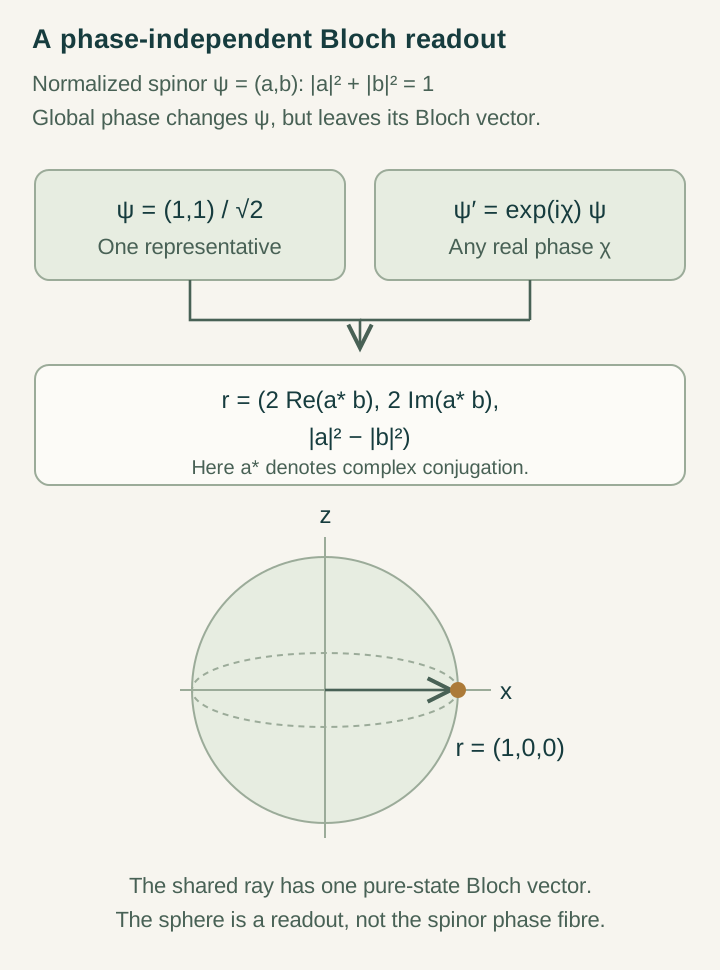
Using the Pauli matrices, define na=ψ†σaψ. In components the map is:
Its squared length is 4|z₁|²|z₂|²+(|z₁|²−|z₂|²)²=(|z₁|²+|z₂|²)²=1. Thus every normalized spinor gives a point on a unit two-sphere. The sphere is a set of possible orientations, with two independent surface coordinates, embedded in a three-dimensional real readout space. These dimensions answer different questions and should not be interchanged.
Open the full-size diagram →
What common phase erases and relative phase preserves
Multiply both components by exp(iχ). Each product z₁*z₂ and each modulus stays unchanged, so n stays fixed. By contrast, changing the phase of z₂ alone generally changes nx and ny. The readout is insensitive to common phase, not to every phase distinction.
Write a representative as ψ=(cos(θ/2),exp(iφ)sin(θ/2)). Substitution gives n=(sinθ cosφ,sinθ sinφ,cosθ). The relative phase φ becomes an azimuthal direction. At either pole one component vanishes, so that coordinate convention loses its meaning. The apparent coordinate singularity reflects the phase choice on that patch, rather than a singular physical state.
Three states that separate the ideas
The spinor (1,0) gives the north pole. The balanced real spinor (1,1)/√2 gives the positive x direction, while (1,i)/√2 gives the positive y direction. The latter two have identical populations |z₁|²=|z₂|²=1/2 but different relative phase, so a population-only detector cannot distinguish them.
An appropriate rotation followed by the same population detector can expose the difference. The rotation converts a previously unread phase into a readable population imbalance. This is the operational lesson: a record that looks complete for one immediate detector can be incomplete for a richer language of future tests. The records and memory guide formulates that requirement as a dynamical criterion.
Why the fibers are circles
The pure-state record is ρ=ψψ†. If two normalized spinors produce the same rank-one projector, they span the same one-dimensional complex subspace and differ by a scalar of modulus one. Conversely, such a scalar cancels in the outer product. Equal readouts therefore identify exactly the common-phase circles.
This is the Hopf fibration. Locally one can choose a phase convention, but a single smooth choice cannot trivialize the entire bundle globally. A diagram of circles over a sphere is schematic: it does not place the full S³ inside ordinary three-dimensional space. The total carrier, fiber, and readout each have their own dimensional meaning.
Mixed records fill the Bloch ball
A mixture of normalized spinors has ρ=Σapaψaψa† with nonnegative weights summing to one. Its Bloch vector is the weighted average of the pure vectors, so |n|≤1. The eigenvalues of ρ are (1±|n|)/2, which confirms positivity. Pure states lie on the surface; mixed states can occupy the interior.
For example, an equal mixture of the north and south poles gives ρ=I/2 and n=0. It does not give a normalized spinor at the center: no such pure spinor exists. Many ensembles yield the same mixed record. A record model must therefore distinguish forgetting common phase from forgetting which preparation occurred; these are different identifications.
Geometry, charge, and the next source question
The Hopf bundle has a primitive integer winding, with its sign depending on the chosen orientation and associated-line convention. Tensor powers multiply that integer. An integer topological class can organize phase compatibility, but it does not determine the coefficient of a physical gauge-field energy or the strength of an electromagnetic interaction.
The constructive SMM/DTT question is which source operations generate the doublet, which completion tests realize its quadratic readout, and how transport between completed records is calibrated. Solving those problems would turn a precise local geometry into a candidate physical interface. The present calculation already supplies an exact map and shows which distinctions survive; it deliberately leaves particle identity and coupling normalization to their own dynamical arguments.
Continue with the articles
- Hopf geometry from a spinor doublet
Introduce the relation between a two-component complex description and a sphere of readout directions. Explain the Hopf bundle’s role in the draft’s reconstruction.
- Test languages and observable quotients
Explore how richer tests alter the distinctions retained by a record model. Introduce the draft’s correspondence between test languages and observational congruences.
- Hermitian records from complete tests
Explain how complete tests identify records with positive two-by-two Hermitian matrices in the draft. Relate record positivity to admissible observations rather than a chosen spatial coordinate system.
- The center-blind route to three dimensions
Explain how removing the scalar center from the quaternionic readout leaves three real directions. Clarify the operational meaning of a detector that cannot distinguish central changes.